The Research Center of Journalism and Social Development, Renmin University of China, Beijing, China.
Greenlee School Journalism and Communication, Iowa State University, Ames, IA, United States.
J Med Internet Res. 2021 Mar 9;23(3):e24945. doi: 10.2196/24945.
Existing health education and communication research routinely measures online channel use as a whole by, for example, evaluating how frequently people use the internet to search for health information. This approach fails to capture the complexity and diversity of online channel use in health information seeking. The measurement of generic online channel use may cause too much error, and it lends no support to media planning in public health promotion campaigns or scholarly research involving online channel use.
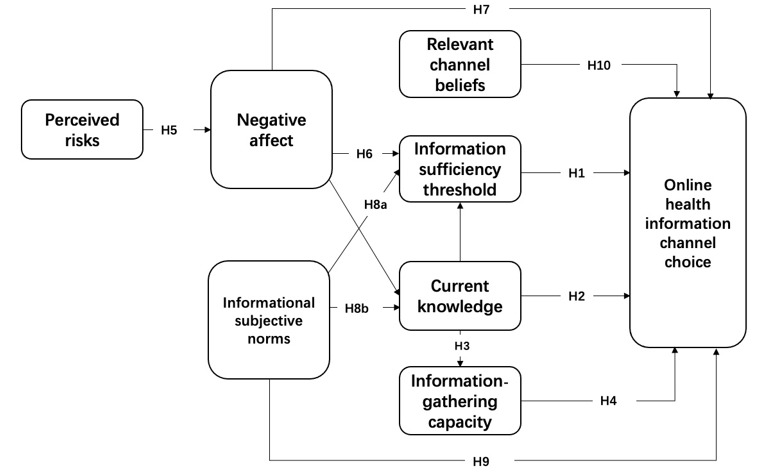
This study intends to present a thorough picture of patterns of online health information channel use and classify the use of various types of online health information channels, including WeChat, microblogs, web portals, search engines, mobile apps, and online forums. Under the framework of the risk information seeking and processing model, this study also analyzes the differences in individuals' motivations for channel selection to offer further evidence to validate the classification scheme.
This study sampled 542 Chinese internet users in Beijing. The average age of the respondents was 33 years, female respondents accounted for 52.0% (282/542) of the sample, and the average monthly income ranged from US $900 to $1200. The study surveyed the use of 13 commonly used online health information channels and various sociopsychological factors associated with online health information seeking.
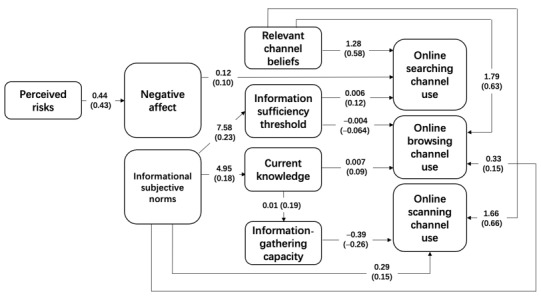
This study derived 3 categories of online health information channels: searching, browsing, and scanning channels. It was found that the use of online searching channels was affect driven (B=0.11; β=0.10; P=.02) and characterized by a stronger need for health knowledge (B=0.09; β=0.01; P<.001). The use of browsing channels was directly influenced by informational subjective norms (B=0.33; β=0.15; P=.004) and perceived current knowledge (B=0.007; β=0.09; P=.003). The use of scanning channels was mainly influenced by informational subjective norms (B=0.29; β=0.15; P=.007).
The results of this study suggest that health communication practitioners and scholars may consider measuring the use of internet, new media, or online media more precisely instead of simply asking the public about the frequency of online channel use or internet use in the acquisition of health information. Scholars and practitioners may consider measuring the use of online health information channels by using the 3-category scheme described in this study. Future research is encouraged to further explore how people process health information when using different online channels.
现有的健康教育和传播研究通常通过评估人们使用互联网搜索健康信息的频率等方式,将在线渠道使用整体作为一个指标进行衡量。然而,这种方法未能捕捉到健康信息搜索中在线渠道使用的复杂性和多样性。通用在线渠道使用的测量可能会导致过多的误差,并且无法为公共卫生促进活动中的媒体策划或涉及在线渠道使用的学术研究提供支持。
本研究旨在全面描绘在线健康信息渠道使用模式,并对各种类型的在线健康信息渠道(包括微信、微博、门户网站、搜索引擎、移动应用程序和在线论坛)的使用进行分类。在风险信息搜索和处理模型的框架下,本研究还分析了个体选择渠道的动机差异,为分类方案提供进一步的证据支持。
本研究在北京抽取了 542 名互联网用户作为样本。受访者的平均年龄为 33 岁,女性受访者占样本的 52.0%(282/542),平均月收入在 900 至 1200 美元之间。该研究调查了 13 种常用在线健康信息渠道的使用情况以及与在线健康信息搜索相关的各种社会心理因素。
本研究得出了 3 类在线健康信息渠道:搜索、浏览和扫描渠道。研究发现,在线搜索渠道的使用受情感驱动(B=0.11;β=0.10;P=.02),且对健康知识的需求更强(B=0.09;β=0.01;P<.001)。浏览渠道的使用直接受到信息主观规范(B=0.33;β=0.15;P=.004)和感知当前知识(B=0.007;β=0.09;P=.003)的影响。扫描渠道的使用主要受信息主观规范影响(B=0.29;β=0.15;P=.007)。
本研究结果表明,健康传播从业者和学者可以考虑更精确地测量互联网、新媒体或在线媒体的使用情况,而不是简单地询问公众获取健康信息时在线渠道使用或互联网使用的频率。学者和从业者可以考虑使用本研究中描述的 3 类方案来测量在线健康信息渠道的使用情况。鼓励未来的研究进一步探索人们在使用不同在线渠道时如何处理健康信息。