Department of Pulmonary Diseases, AA11, University Medical Center Groningen, PO Box 30001, 9700 RB, Groningen, The Netherlands.
Lung. 2021 Apr;199(2):195-198. doi: 10.1007/s00408-021-00430-0. Epub 2021 Mar 9.
For this study, we aimed to compare dynamic hyperinflation measured by cardiopulmonary exercise testing (CPET), a six-minute walking test (6-MWT), and a manually paced tachypnea test (MPT) in patients with severe emphysema who were treated with endobronchial coils. Additionally, we investigated whether dynamic hyperinflation changed after treatment with endobronchial coils.
Dynamic hyperinflation was measured with CPET, 6-MWT, and an MPT in 29 patients before and after coil treatment.
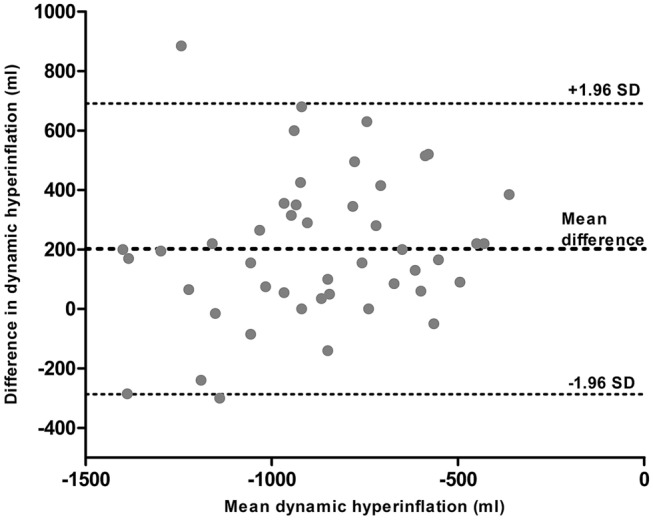
There was no significant change in dynamic hyperinflation after treatment with coils. Comparison of CPET and MPT showed a strong association (rho 0.660, p < 0.001) and a moderate agreement (BA-plot, 202 ml difference in favor of MPT). There was only a moderate association of the 6-MWT with CPET (rho 0.361, p 0.024).
MPT can be a suitable alternative to CPET to measure dynamic hyperinflation in severe emphysema but may overestimate dynamic hyperinflation possibly due to a higher breathing frequency.
在这项研究中,我们旨在比较经支气管镜线圈治疗的重度肺气肿患者通过心肺运动试验(CPET)、6 分钟步行试验(6-MWT)和手动快呼吸试验(MPT)测量的动态过度充气,并探讨治疗后动态过度充气是否发生变化。
在支气管镜线圈治疗前后,用 CPET、6-MWT 和 MPT 测量 29 例患者的动态过度充气。
线圈治疗后,动态过度充气无明显变化。CPET 和 MPT 的比较显示出很强的关联性(rho 0.660,p<0.001)和中度一致性(BA 图,MPT 倾向于高 202ml)。6-MWT 与 CPET 的关联性仅为中度(rho 0.361,p=0.024)。
MPT 可作为 CPET 的替代方法,用于测量重度肺气肿患者的动态过度充气,但由于呼吸频率较高,可能会高估动态过度充气。