Li Hongquan, Gong Anmin, Zhao Lei, Zhang Wei, Wang Fawang, Fu Yunfa
Institute of Information Engineering and Automation, Kunming University of Science and Technology, Kunming 650500, China.
Brain Cognition and Brain-Computer Intelligence Fusion Innovation Group, Kunming University of Science and Technology, Kunming 650500, China.
Comput Intell Neurosci. 2021 Feb 22;2021:6614112. doi: 10.1155/2021/6614112. eCollection 2021.
Brain-computer interface (BCI) based on functional near-infrared spectroscopy (fNIRS) is expected to provide an optional active rehabilitation training method for patients with walking dysfunction, which will affect their quality of life seriously. Sparse representation classification (SRC) oxyhemoglobin (HbO) concentration was used to decode walking imagery and idle state to construct fNIRS-BCI based on walking imagery.
15 subjects were recruited and fNIRS signals were collected during walking imagery and idle state. Firstly, band-pass filtering and baseline drift correction for HbO signal were carried out, and then the mean value, peak value, and root mean square (RMS) of HbO and their combinations were extracted as classification features; SRC was used to identify the extracted features and the result of SRC was compared with those of support vector machine (SVM), K-Nearest Neighbor (KNN), linear discriminant analysis (LDA), and logistic regression (LR).
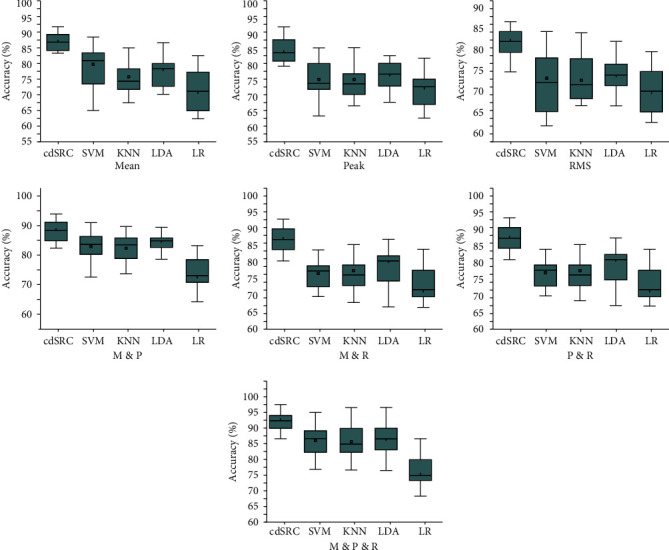
The experimental results showed that the average classification accuracy for walking imagery and idle state by SRC using three features combination was 91.55±3.30%, which was significantly higher than those of SVM, KNN, LDA, and LR (86.37±4.42%, 85.65±5.01%, 86.43±4.41%, and 76.14±5.32%, respectively), and the classification accuracy of other combined features was higher than that of single feature.
The study showed that introducing SRC into fNIRS-BCI can effectively identify walking imagery and idle state. It also showed that different time windows for feature extraction have an impact on the classification results, and the time window of 2-8 s achieved a better classification accuracy (94.33±2.60%) than other time windows. . The study was expected to provide a new and optional active rehabilitation training method for patients with walking dysfunction. In addition, the experiment was also a rare study based on fNIRS-BCI using SRC to decode walking imagery and idle state.
基于功能近红外光谱(fNIRS)的脑机接口(BCI)有望为行走功能障碍患者提供一种可选的主动康复训练方法,行走功能障碍会严重影响患者的生活质量。利用稀疏表示分类(SRC)的氧合血红蛋白(HbO)浓度来解码行走想象和静息状态,以构建基于行走想象的fNIRS-BCI。
招募15名受试者,在行走想象和静息状态下采集fNIRS信号。首先,对HbO信号进行带通滤波和基线漂移校正,然后提取HbO的平均值、峰值和均方根(RMS)及其组合作为分类特征;使用SRC对提取的特征进行识别,并将SRC的结果与支持向量机(SVM)、K近邻(KNN)、线性判别分析(LDA)和逻辑回归(LR)的结果进行比较。
实验结果表明,SRC使用三种特征组合对行走想象和静息状态的平均分类准确率为91.55±3.30%,显著高于SVM、KNN、LDA和LR(分别为86.37±4.42%、85.65±5.01%、86.43±4.41%和76.14±5.32%),其他组合特征的分类准确率高于单一特征。
该研究表明,将SRC引入fNIRS-BCI可以有效识别行走想象和静息状态。研究还表明,不同的特征提取时间窗对分类结果有影响,2-8秒的时间窗比其他时间窗获得了更好的分类准确率(94.33±2.60%)。该研究有望为行走功能障碍患者提供一种新的可选主动康复训练方法。此外,该实验也是基于fNIRS-BCI使用SRC解码行走想象和静息状态的罕见研究。