Peng James, Mann Sabrina A, Mitchell Anthea M, Liu Jamin, Laurie Matthew T, Sunshine Sara, Pilarowski Genay, Ayscue Patrick, Kistler Amy, Vanaerschot Manu, Li Lucy M, McGeever Aaron, Chow Eric D, Team IDseq, Marquez Carina, Nakamura Robert, Rubio Luis, Chamie Gabriel, Jones Diane, Jacobo Jon, Rojas Susana, Rojas Susy, Tulier-Laiwa Valerie, Black Douglas, Martinez Jackie, Naso Jamie, Schwab Joshua, Petersen Maya, Havlir Diane, DeRisi Joseph
Division of HIV, Infectious Diseases, and Global Medicine, University of California, San Francisco, San Francisco, CA 94143, USA.
Chan Zuckerberg Biohub, San Francisco, CA 94158, USA.
medRxiv. 2021 Mar 3:2021.03.01.21252705. doi: 10.1101/2021.03.01.21252705.
Sequencing of the SARS-CoV-2 viral genome from patient samples is an important epidemiological tool for monitoring and responding to the pandemic, including the emergence of new mutations in specific communities.
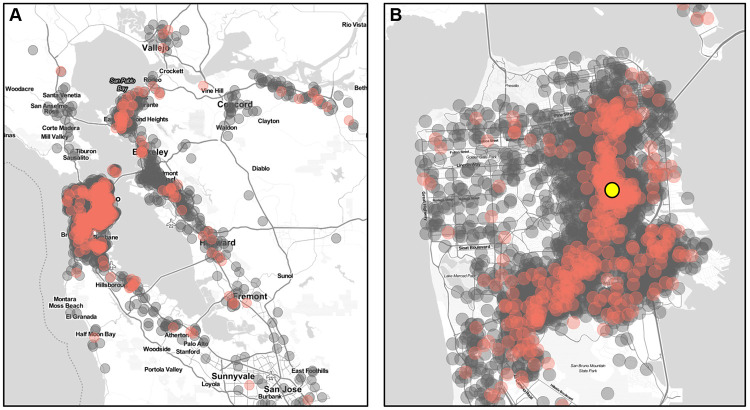
SARS-CoV-2 genomic sequences were generated from positive samples collected, along with epidemiological metadata, at a walk-up, rapid testing site in the Mission District of San Francisco, California during November 22-December 2, 2020 and January 10-29, 2021. Secondary household attack rates and mean sample viral load were estimated and compared across observed variants.
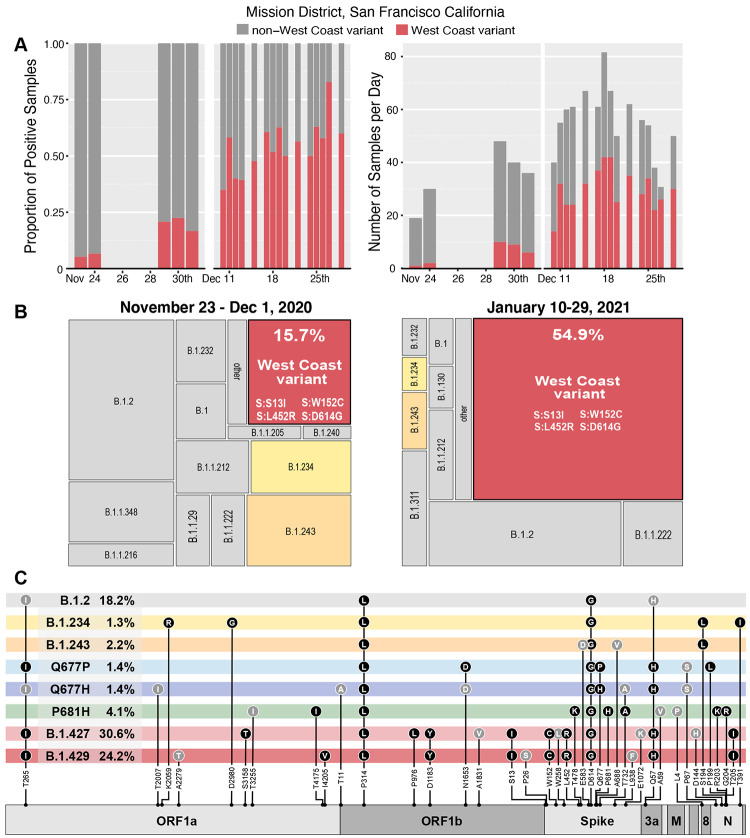
A total of 12,124 tests were performed yielding 1,099 positives. From these, 811 high quality genomes were generated. Certain viral lineages bearing spike mutations, defined in part by L452R, S13I, and W152C, comprised 54.9% of the total sequences from January, compared to 15.7% in November. Household contacts exposed to "West Coast" variants were at higher risk of infection compared to household contacts exposed to lineages lacking these variants (0.357 vs 0.294, RR=1.29; 95% CI:1.01-1.64). The reproductive number was estimated to be modestly higher than other lineages spreading in California during the second half of 2020. Viral loads were similar among persons infected with West Coast versus non-West Coast strains, as was the proportion of individuals with symptoms (60.9% vs 64.1%).
The increase in prevalence, relative household attack rates, and reproductive number are consistent with a modest transmissibility increase of the West Coast variants; however, additional laboratory and epidemiological studies are required to better understand differences between these variants.
We observed a growing prevalence and elevated attack rate for "West Coast" SARS-CoV-2 variants in a community testing setting in San Francisco during January 2021, suggesting its modestly higher transmissibility.
对患者样本中的严重急性呼吸综合征冠状病毒2(SARS-CoV-2)病毒基因组进行测序是监测和应对疫情的一项重要流行病学工具,包括监测特定社区中新突变的出现情况。
2020年11月22日至12月2日以及2021年1月10日至29日期间,在加利福尼亚州旧金山教会区的一个无需预约的快速检测点,从采集的阳性样本中生成SARS-CoV-2基因组序列,并附上流行病学元数据。估计并比较了观察到的不同变体的家庭二代发病率和平均样本病毒载量。
共进行了12124次检测,其中1099次呈阳性。从中生成了811个高质量基因组。某些携带刺突蛋白突变的病毒谱系,部分由L452R、S13I和W152C定义,在1月份的序列总数中占54.9%,而11月份为15.7%。与接触缺乏这些变体的谱系的家庭接触者相比,接触“西海岸”变体的家庭接触者感染风险更高(0.357对0.294,相对风险=1.29;95%置信区间:1.01-1.64)。估计其传播数略高于2020年下半年在加利福尼亚州传播的其他谱系。感染西海岸毒株与非西海岸毒株的人之间的病毒载量相似,有症状个体的比例也相似(60.9%对64.1%)。
患病率、相对家庭发病率和传播数的增加与西海岸变体的传播性适度增加一致;然而,需要更多的实验室和流行病学研究来更好地了解这些变体之间的差异。
2021年1月,我们在旧金山的一个社区检测环境中观察到“西海岸”SARS-CoV-2变体的患病率不断上升,发病率升高,表明其传播性略高。