Zeller Mark, Gangavarapu Karthik, Anderson Catelyn, Smither Allison R, Vanchiere John A, Rose Rebecca, Snyder Daniel J, Dudas Gytis, Watts Alexander, Matteson Nathaniel L, Robles-Sikisaka Refugio, Marshall Maximilian, Feehan Amy K, Sabino-Santos Gilberto, Bell-Kareem Antoinette R, Hughes Laura D, Alkuzweny Manar, Snarski Patricia, Garcia-Diaz Julia, Scott Rona S, Melnik Lilia I, Klitting Raphaëlle, McGraw Michelle, Belda-Ferre Pedro, DeHoff Peter, Sathe Shashank, Marotz Clarisse, Grubaugh Nathan D, Nolan David J, Drouin Arnaud C, Genemaras Kaylynn J, Chao Karissa, Topol Sarah, Spencer Emily, Nicholson Laura, Aigner Stefan, Yeo Gene W, Farnaes Lauge, Hobbs Charlotte A, Laurent Louise C, Knight Rob, Hodcroft Emma B, Khan Kamran, Fusco Dahlene N, Cooper Vaughn S, Lemey Phillipe, Gardner Lauren, Lamers Susanna L, Kamil Jeremy P, Garry Robert F, Suchard Marc A, Andersen Kristian G
Department of Immunology and Microbiology, The Scripps Research Institute, La Jolla, CA 92037, USA.
Department of Immunology and Microbiology, The Scripps Research Institute, La Jolla, CA 92037, USA.
Cell. 2021 Sep 16;184(19):4939-4952.e15. doi: 10.1016/j.cell.2021.07.030. Epub 2021 Jul 27.
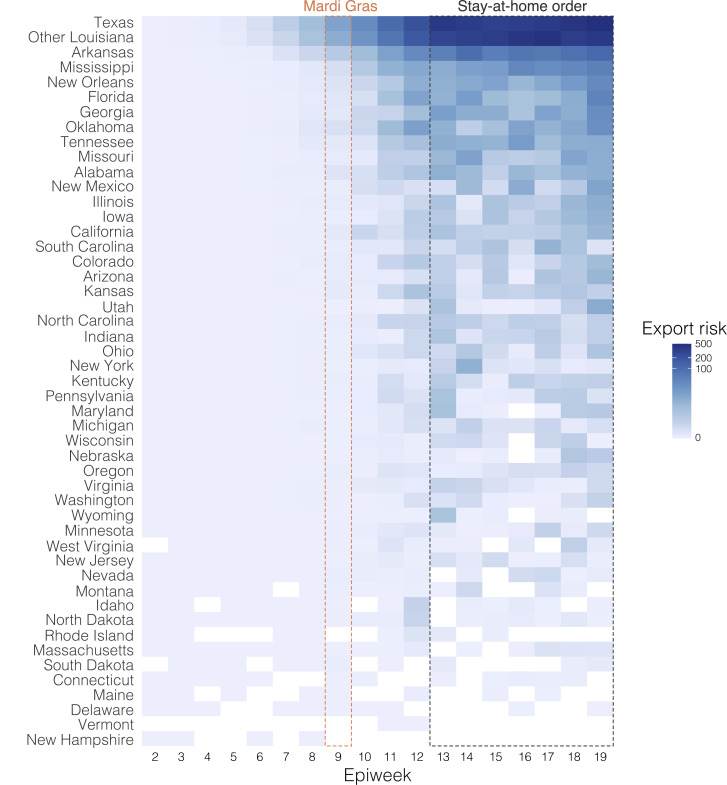
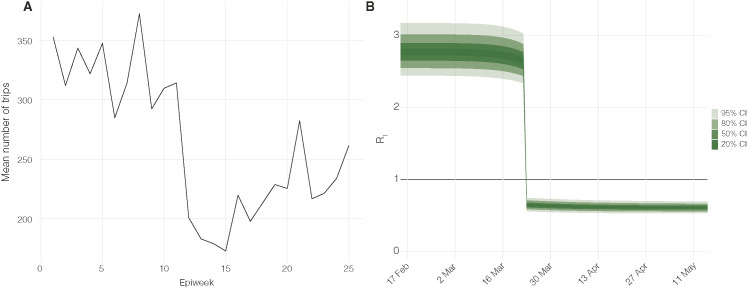
The emergence of the COVID-19 epidemic in the United States (U.S.) went largely undetected due to inadequate testing. New Orleans experienced one of the earliest and fastest accelerating outbreaks, coinciding with Mardi Gras. To gain insight into the emergence of SARS-CoV-2 in the U.S. and how large-scale events accelerate transmission, we sequenced SARS-CoV-2 genomes during the first wave of the COVID-19 epidemic in Louisiana. We show that SARS-CoV-2 in Louisiana had limited diversity compared to other U.S. states and that one introduction of SARS-CoV-2 led to almost all of the early transmission in Louisiana. By analyzing mobility and genomic data, we show that SARS-CoV-2 was already present in New Orleans before Mardi Gras, and the festival dramatically accelerated transmission. Our study provides an understanding of how superspreading during large-scale events played a key role during the early outbreak in the U.S. and can greatly accelerate epidemics.
由于检测不足,美国新冠疫情的出现很大程度上未被察觉。新奥尔良经历了最早且加速最快的疫情爆发之一,恰逢狂欢节。为深入了解严重急性呼吸综合征冠状病毒2(SARS-CoV-2)在美国的出现以及大规模活动如何加速传播,我们在路易斯安那州新冠疫情第一波期间对SARS-CoV-2基因组进行了测序。我们发现,与美国其他州相比,路易斯安那州的SARS-CoV-2多样性有限,且一次SARS-CoV-2的引入导致了路易斯安那州几乎所有的早期传播。通过分析流动性和基因组数据,我们表明在狂欢节之前SARS-CoV-2就已在新奥尔良存在,且该节日极大地加速了传播。我们的研究有助于理解大规模活动期间的超级传播在美国早期疫情爆发中如何发挥关键作用,并能极大地加速疫情传播。