Division of HIV, Infectious Diseases, and Global Medicine, University of California, San Francisco, San Francisco, California, USA.
Department of Biochemistry and Biophysics, University of California, San Francisco, California, USA.
Clin Infect Dis. 2022 Jan 7;74(1):32-39. doi: 10.1093/cid/ciab283.
Sequencing of the severe acute respiratory syndrome coronavirus 2 (SARS-CoV-2) viral genome from patient samples is an important epidemiological tool for monitoring and responding to the pandemic, including the emergence of new mutations in specific communities.
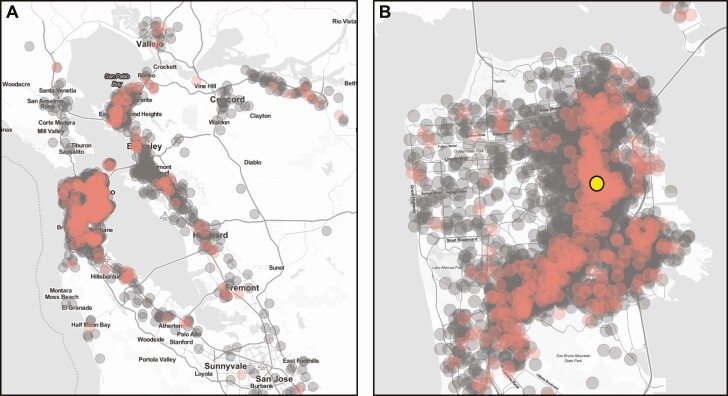
SARS-CoV-2 genomic sequences were generated from positive samples collected, along with epidemiological metadata, at a walk-up, rapid testing site in the Mission District of San Francisco, California during 22 November to 1 December, 2020, and 10-29 January 2021. Secondary household attack rates and mean sample viral load were estimated and compared across observed variants.
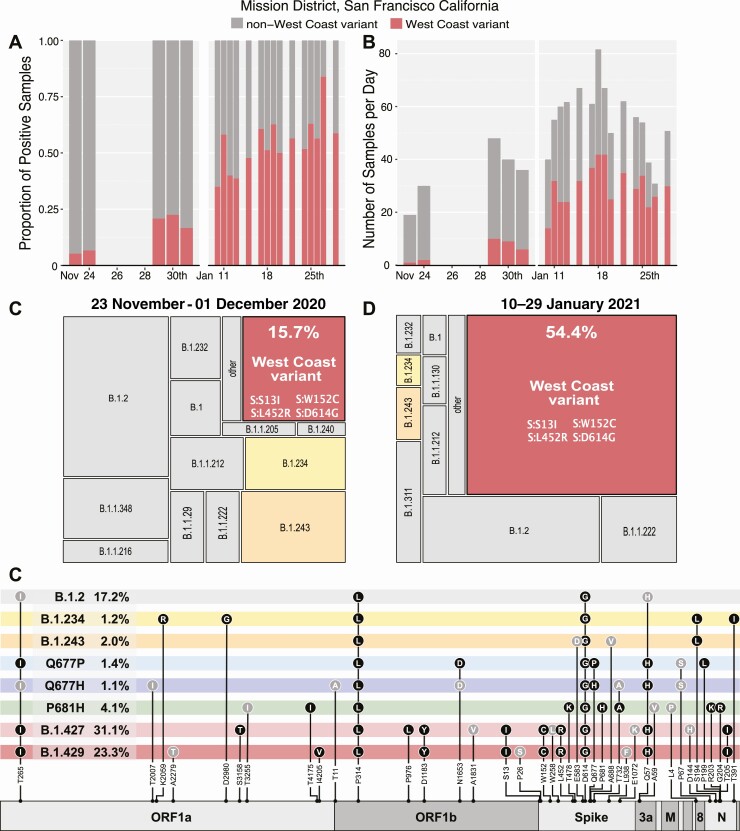
A total of 12 124 tests were performed yielding 1099 positives. From these, 928 high-quality genomes were generated. Certain viral lineages bearing spike mutations, defined in part by L452R, S13I, and W152C, comprised 54.4% of the total sequences from January, compared to 15.7% in November. Household contacts exposed to the "California" or "West Coast" variants (B.1.427 and B.1.429) were at higher risk of infection compared to household contacts exposed to lineages lacking these variants (0.36 vs 0.29, risk ratio [RR] = 1.28; 95% confidence interval [CI]: 1.00-1.64). The reproductive number was estimated to be modestly higher than other lineages spreading in California during the second half of 2020. Viral loads were similar among persons infected with West Coast versus non-West Coast strains, as was the proportion of individuals with symptoms (60.9% vs 64.3%).
The increase in prevalence, relative household attack rates, and reproductive number are consistent with a modest transmissibility increase of the West Coast variants. Summary: We observed a growing prevalence and modestly elevated attack rate for "West Coast" severe acute respiratory syndrome coronavirus 2 (SARS-CoV-2) variants in a community testing setting in San Francisco during January 2021, suggesting its modestly higher transmissibility.
对来自患者样本的严重急性呼吸综合征冠状病毒 2 (SARS-CoV-2) 病毒基因组进行测序是监测和应对大流行的重要流行病学工具,包括在特定社区中出现新的突变。
2020 年 11 月 22 日至 12 月 1 日和 2021 年 1 月 10 日至 29 日,在加利福尼亚州旧金山米申区的一个免下车、快速检测点收集阳性样本,并结合流行病学元数据,生成 SARS-CoV-2 基因组序列。在观察到的变异体中,估计并比较了二次家庭攻击率和平均样本病毒载量。
共进行了 12124 次检测,阳性率为 1099 次。从这些样本中,生成了 928 个高质量的基因组。与 11 月相比,1 月携带尖峰突变的某些病毒谱系(部分由 L452R、S13I 和 W152C 定义)占总序列的 54.4%。与接触缺乏这些变异体的谱系的家庭接触者相比,接触“加利福尼亚”或“西海岸”变异体(B.1.427 和 B.1.429)的家庭接触者感染风险更高(0.36 比 0.29,风险比[RR] = 1.28;95%置信区间[CI]:1.00-1.64)。估计繁殖数略高于 2020 年下半年在加利福尼亚传播的其他谱系。西海岸与非西海岸菌株感染者的病毒载量相似,有症状者的比例也相似(60.9%比 64.3%)。
流行率、相对家庭攻击率和繁殖数的增加与西海岸变异体传播能力的适度增加一致。总结:我们在 2021 年 1 月旧金山的社区检测环境中观察到“西海岸”严重急性呼吸综合征冠状病毒 2 (SARS-CoV-2) 变异体的流行率增加和适度升高的攻击率,表明其传播能力略有提高。