Zhou Shiyu, Zeng Zhenhua, Wei Hongxia, Sha Tong, An Shengli
Department of Biostatistics, School of Public Health (Guangdong Provincial Key Laboratory of Tropical Disease Research, Guangdong Provincial Key Laboratory of Construction and Detection in Tissue Engineering), Southern Medical University, No. 1838 North Guangzhou Avenue, Guangzhou, 510515, People's Republic of China.
Department of Critical Care Medicine, Nanfang Hospital, Southern Medical University, Guangzhou, 510515, People's Republic of China.
Ann Intensive Care. 2021 Mar 10;11(1):42. doi: 10.1186/s13613-021-00830-8.
Fluid therapy is a cornerstone in the treatment of sepsis. Recently, the guidelines have recommended the combined administration that using crystalloids plus albumin for septic patients, but the optimal timing for albumin combined is still unclear. The objective of this study was to investigate the association of timing of albumin combined with 28-day mortality in patients with sepsis.
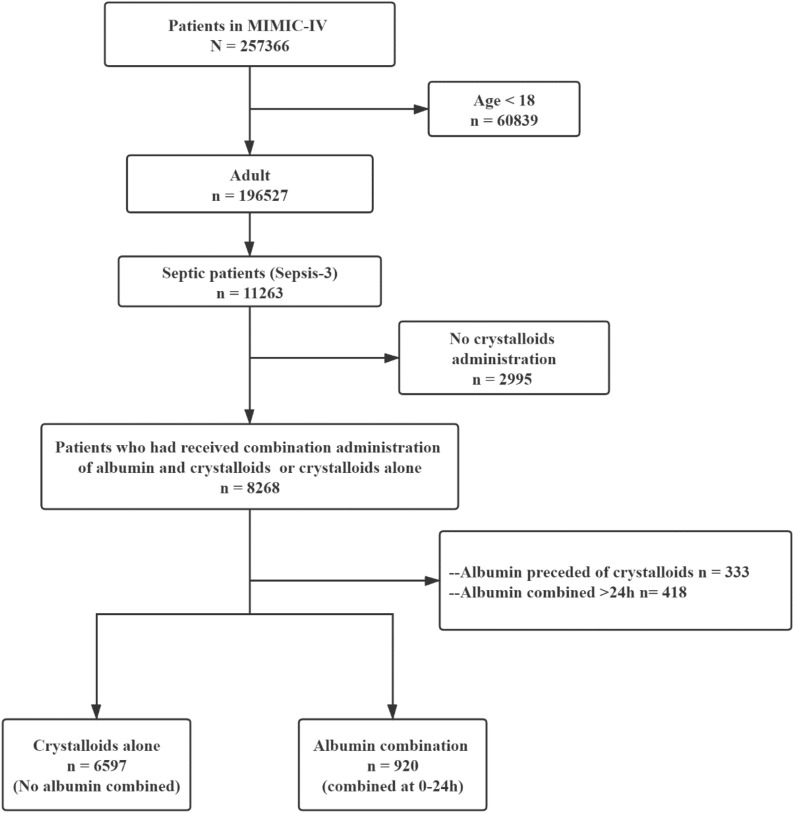
We involved septic patients from the Medical Information Mart for Intensive Care (MIMIC)-IV database, and these patients were categorized into crystalloids group (crystalloids alone) and early combination group (crystalloids combined albumin at 0-24 h). The primary outcome was 28-day mortality. We used propensity score matching (PSM) to adjust confounding and restricted mean survival time (RMST) analysis was conducted to quantify the beneficial effect on survival due to the combination group.
We categorized 6597 and 920 patients in the "crystalloids alone" and "early combination", respectively. After PSM, compared to the crystalloids group, the combination group was associated with the increased survival among 28-day (increased survival: 3.39 days, 95% CI 2.53-4.25; P < 0.001) after ICU admission. Patients who received albumin combination at the first 24-h was associated with prolonged LOS in ICU (10.72 days vs. 8.24 days; P < 0.001) but lower risk of 28-day mortality (12.5% vs 16.4%, P = 0.003) than those received crystalloids alone.
In septic patients, receiving albumin combined within the first 24-h after crystalloids administration was associated with an increment of survival in 28 days.
液体疗法是脓毒症治疗的基石。最近,指南推荐对脓毒症患者采用晶体液加白蛋白的联合给药方式,但白蛋白联合使用的最佳时机仍不明确。本研究的目的是探讨白蛋白联合使用的时机与脓毒症患者28天死亡率之间的关联。
我们纳入了重症监护医学信息数据库(MIMIC-IV)中的脓毒症患者,并将这些患者分为晶体液组(仅使用晶体液)和早期联合组(在0-24小时内使用晶体液联合白蛋白)。主要结局是28天死亡率。我们使用倾向评分匹配(PSM)来调整混杂因素,并进行受限平均生存时间(RMST)分析以量化联合组对生存的有益影响。
我们分别将6597例和920例患者分类为“仅使用晶体液”组和“早期联合”组。经过PSM后,与晶体液组相比,联合组在入住ICU后28天的生存率有所提高(生存时间增加:3.39天,95%CI 2.53-4.25;P<0.001)。在最初24小时内接受白蛋白联合治疗的患者与仅接受晶体液治疗的患者相比,在ICU的住院时间更长(10.72天对8.24天;P<0.001),但28天死亡率风险更低(12.5%对16.4%,P=0.003)。
在脓毒症患者中,在给予晶体液后的最初24小时内接受白蛋白联合治疗与28天生存率的提高有关。