Interdisciplinary Center Psychopathology and Emotion regulation, Department of Psychiatry, Universitair Medisch Centrum Groningen, University of Groningen, P.O. Box 30.001 (CC72), 9700, RB, Groningen, The Netherlands.
BMC Psychiatry. 2021 Mar 10;21(1):143. doi: 10.1186/s12888-021-03123-3.
Major depressive disorder (MDD) is a highly prevalent mental disorder with large disease burden, high levels of relapse or persistence, and overall suboptimal outcomes of protocolized pharmacological and psychotherapeutic treatments. There is an urgent need to improve treatment effectiveness, possibly through systematic treatment personalization. In psychotherapeutic treatments this can be achieved by case conceptualization. To support this process, we developed the Therap-i module, which consists of personalized Experienced Sampling Methodology (ESM) and feedback. The Therap-i module is integrated into outpatient psychotherapeutic treatment as usual (TAU) for depression. The study aim is to investigate the efficacy of the Therap-i module in decreasing symptomatology in unresponsive or relapsing patients diagnosed with MDD. We hypothesize that the Therap-i module will contribute to TAU by i) decreasing depressive symptoms, and ii) improving general functioning, therapeutic working alliance, and illness perception. This paper provides details of the study rationale, aims, procedures, and a discussion on potential pitfalls and promises of the module.
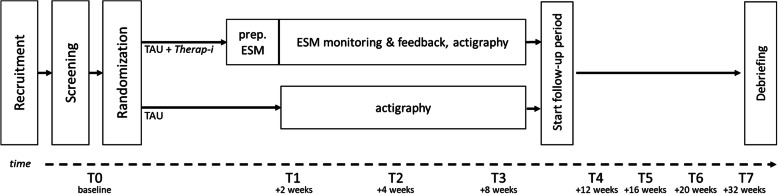
Patients diagnosed with MDD (n = 100) will enrol in a pragmatic two-armed randomized controlled trial. Randomization is stratified according to the patient's treatment resistance level assessed with the Dutch Method for quantification of Treatment Resistance in Depression (DM-TRD). All fill-out the Inventory of Depressive Symptomatology Self Report (IDS-SR), Outcome Questionnaire (OQ-45), Illness Perception Questionnaire Mental Health (IPQ-MH), and Work Alliance Inventory Self Report (WAI-SR). In the intervention arm, through close collaboration between patient, clinician, and researcher, a personalized ESM diary is developed based on the patient's case conceptualization. During the ESM monitoring period (8 weeks, 5 assessments/day), patients receive feedback three times, which is discussed among the abovementioned three parties. Both patients and clinicians will evaluate the Therap-i module.
Data collection is ongoing.
This is the first study in which personalized ESM and feedback is integrated in outpatient psychotherapeutic TAU for depression. The labour intensive procedure and methodological pitfalls are anticipated challenges and were taken into account when designing the study. When hypotheses are confirmed, the Therap-i module may advance treatment for depression by providing insights into personalized patterns driving or perpetuating depressive complaints.
Trial NL7190 (NTR7381) , registered prospectively 03-08-2018.
重度抑郁症(MDD)是一种高发精神疾病,具有较大的疾病负担、高复发或持续率,以及整体协议化药物和心理治疗效果不佳。迫切需要提高治疗效果,可能通过系统的治疗个体化来实现。在心理治疗中,这可以通过案例概念化来实现。为了支持这一过程,我们开发了 Therap-i 模块,它由个性化的经验采样方法(ESM)和反馈组成。Therap-i 模块集成到抑郁症的常规门诊心理治疗中。本研究的目的是调查 Therap-i 模块在治疗无反应或复发的 MDD 患者时降低症状的疗效。我们假设 Therap-i 模块将通过以下方式为 TAU 做出贡献:i)降低抑郁症状,ii)改善一般功能、治疗性工作联盟和疾病认知。本文详细介绍了研究的基本原理、目的、程序,并讨论了该模块的潜在陷阱和前景。
诊断为 MDD 的患者(n=100)将参加一项实用的双臂随机对照试验。随机分组根据荷兰抑郁治疗抵抗定量方法(DM-TRD)评估的患者治疗抵抗水平进行分层。所有患者都填写抑郁症状自评量表(IDS-SR)、结果问卷(OQ-45)、疾病认知问卷心理健康部分(IPQ-MH)和工作联盟量表自评(WAI-SR)。在干预组,通过患者、临床医生和研究人员之间的密切合作,根据患者的案例概念化制定个性化的 ESM 日记。在 ESM 监测期间(8 周,每天 5 次评估),患者将收到 3 次反馈,这将由上述三方讨论。患者和临床医生都将对 Therap-i 模块进行评估。
数据收集正在进行中。
这是第一个将个性化 ESM 和反馈集成到抑郁症常规门诊心理治疗中的研究。预计劳动密集型程序和方法学陷阱是预期的挑战,在设计研究时已考虑到这些挑战。如果假设得到证实,Therap-i 模块可以通过提供个性化的见解来推动或延续抑郁症状的驱动因素,从而为治疗抑郁症提供帮助。
NL7190 试验(NTR7381),前瞻性注册于 2018 年 8 月 3 日。