Department of Nursing, Chinese Academy of Medical Sciences - Peking Union Medical College, Peking Union Medical College Hospital (Dongdan Campus), Beijing, 100730, People's Republic of China.
Department of Nursing, The Second Affiliated Hospital of Harbin Medical University, Harbin, People's Republic of China.
Clin Interv Aging. 2021 Mar 4;16:389-401. doi: 10.2147/CIA.S294106. eCollection 2021.
Studies exploring the association of cognitive frailty and mortality have been mainly based on community settings or nursing home settings. The aim of our study was to explore the association between cognitive frailty and 30-day mortality among older Chinese inpatients.
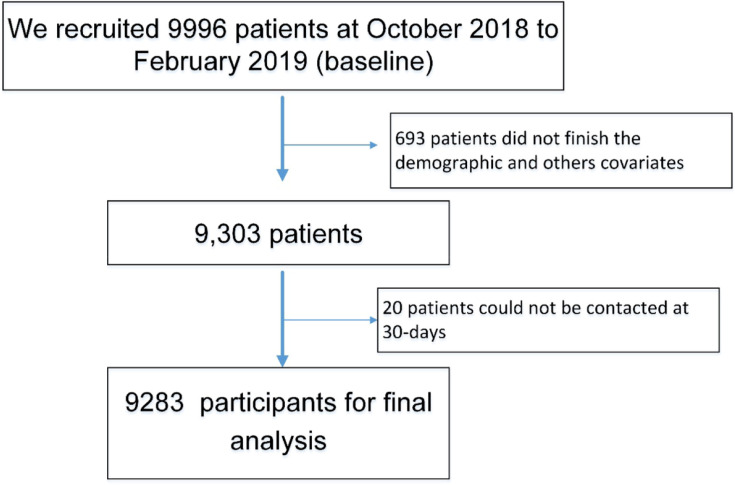
A national cohort study was performed in different hospitals in China. A baseline survey was conducted from October 2018 and February 2019. Trained investigators collected the 30-day mortality. Cognitive impairment and frailty were defined by the Mini-Cog and FRAIL scale, respectively. Multivariate regression was used to explore the association between cognitive impairment and frailty status with 30-day mortality.
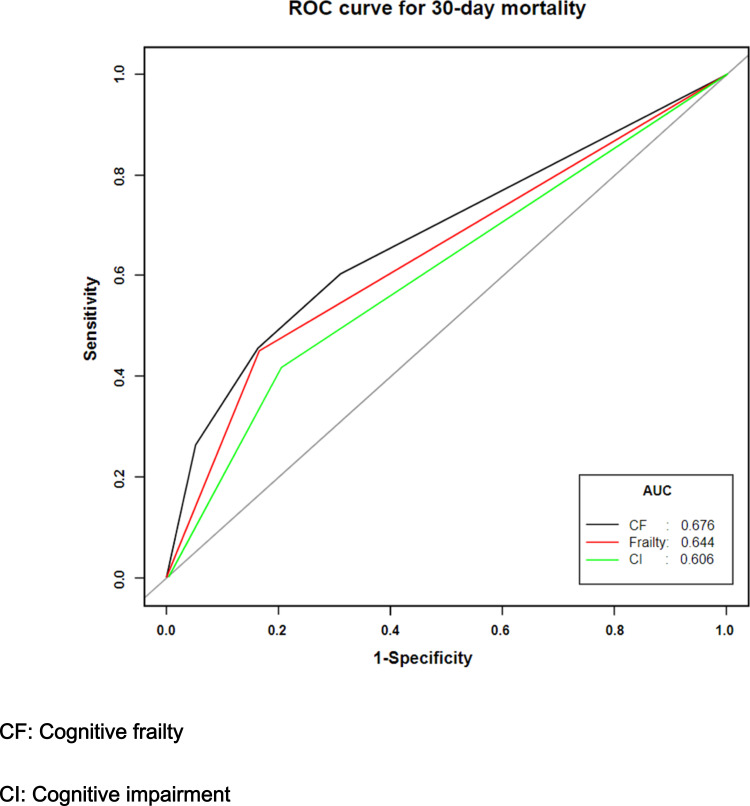
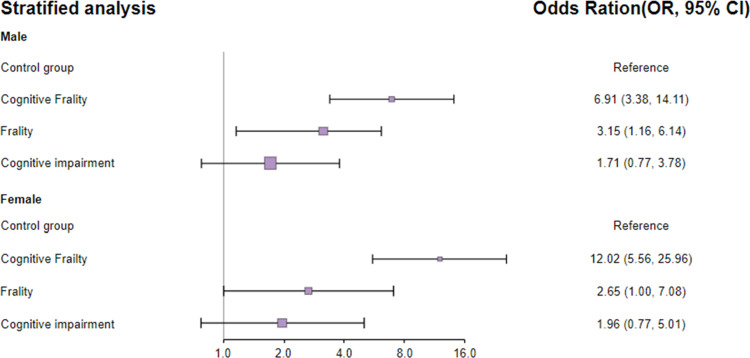
Of these participants, there were 3891 (41.91%) women and 5392 (58.09%) men, with an average age of 72.41 (SD=5.72). The prevalence of cognitive frailty was 5.44%. After adjusting for age, gender, education, depression and activities of daily living (ADL), the odds ratios (ORs) for 30-day mortality among inpatients were 3.43 (95% CI: 1.80-6.55) for cognitive frailty, 1.85 (95% CI: 1.01-3.41) for frailty only, and 1.43 (95% CI: 0.77-2.65) for cognitive impairment only compared to the reference group (neither frailty nor cognitive impairment). In addition, the discrimination of 30-day mortality was higher among patients with cognitive frailty (area under the curve =0.676 [95% CI: 0.621-0.731]) than either frailty (area under the curve =0.644 [95% CI: 0.594-0.694]) or cognitive impairment (area under the curve = 0.606 [95% CI: 0.556-0.655]) separately. Stratified analysis showed that these associations still existed when grouped by gender.
Our study found that Chinese inpatients with cognitive frailty had a higher risk of 30-day mortality than those without frailty and cognitive impairment, suggesting that clinicians should be encouraged to perform early screening of patients with frailty and cognitive impairment and carry out effective interventions to reverse cognitive frailty syndrome.
探索认知脆弱与死亡率之间关联的研究主要基于社区或疗养院环境。本研究旨在探讨中国老年住院患者认知脆弱与 30 天死亡率之间的关系。
在中国不同医院进行了一项全国性队列研究。基线调查于 2018 年 10 月至 2019 年 2 月进行。经过培训的调查人员收集了 30 天死亡率数据。认知障碍和脆弱性分别通过 Mini-Cog 和 FRAIL 量表来定义。使用多变量回归来探讨认知障碍和脆弱状态与 30 天死亡率之间的关联。
这些参与者中,有 3891 名(41.91%)女性和 5392 名(58.09%)男性,平均年龄为 72.41(SD=5.72)岁。认知脆弱的患病率为 5.44%。在调整年龄、性别、教育程度、抑郁和日常生活活动(ADL)后,与参考组(既无脆弱也无认知障碍)相比,30 天死亡率的住院患者的优势比(OR)分别为认知脆弱组的 3.43(95%CI:1.80-6.55)、脆弱组的 1.85(95%CI:1.01-3.41)和认知障碍组的 1.43(95%CI:0.77-2.65)。此外,与认知障碍或脆弱性单独相比,认知脆弱患者的 30 天死亡率的判别能力更高(曲线下面积=0.676[95%CI:0.621-0.731])。分层分析显示,按性别分组时,这些关联仍然存在。
本研究发现,中国住院患者认知脆弱与无脆弱和无认知障碍患者相比,30 天死亡率更高,这表明应鼓励临床医生对脆弱和认知障碍患者进行早期筛查,并开展有效的干预措施以逆转认知脆弱综合征。