Fregonese Martina, Albino Andrea, Covino Claudia, Gili Alessio, Bacci Mauro, Nicoletti Alessia, Gambelunghe Cristiana
Harm Reduction Services, Cooperative "Borgorete", Perugia, Italy.
Local Health Unit, USL Umbria 1, Ser.T Perugia, Ospedale S. Maria della Misericordia, Perugia, Italy.
Front Psychiatry. 2021 Feb 22;12:596895. doi: 10.3389/fpsyt.2021.596895. eCollection 2021.
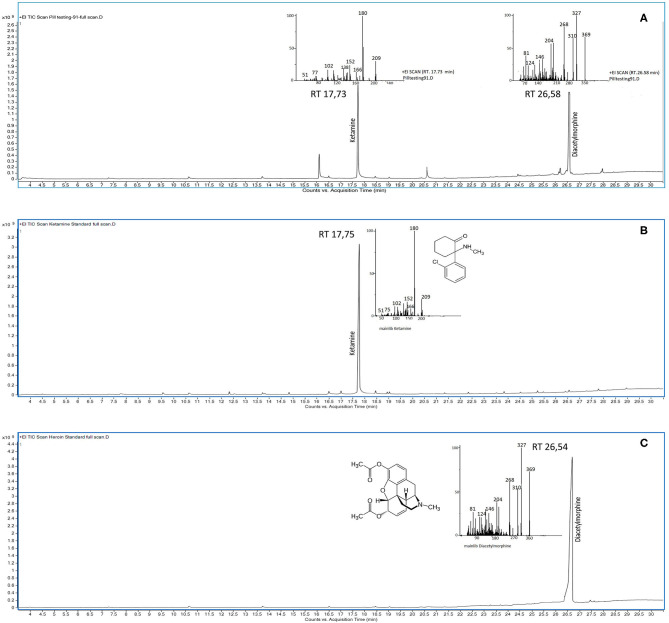
Drug checking as a part of drug harm-reduction strategies represents an essential aspect of public health policies. It focuses on rapid identification of drugs that individuals intend to use during night events, in order to implement health-protective behaviors. Chemical drug analysis techniques vary considerably, from simple colorimetric reagents to advanced forensic methods such as gas chromatography/mass spectrometry (GC/MS). In 2019, drug-check services were offered at some night events in Umbria (Central Italy). One hundred and twenty attendees directly delivered unidentified substances to a harm-reduction worker, who collected a few milligrams of the substances on ceramic plates and added a drop of colorimetric reagent. Multiple reagents were used to increase the diagnostic capacity of a substance, which may react with a specific drug or a few drugs. Later, a fraction of the samples was analyzed by GC/MS. The concordance of the results obtained using these two methodologies and the intended behaviors of consumers after being informed of the test result was evaluated. We analyzed 120 samples by colorimetric test: 32 MDMA, 25 ketamine, 10 amphetamine, 11 cocaine, 8 heroin, and 4 LSD samples. The results were inconclusive for 29 samples. The GS/MS analysis confirmed MDMA in 84%, ketamine in 78%, amphetamine in 91%, cocaine in 92%, heroin in 88%, and LSD in 100% of the samples. The results of samples with inconclusive results were as follows: 2, MDMA; 7, ketamine; 2, amphetamine; 2, cocaine; 2, heroin; 2, mephedrone; 6, mixes; 1, debris; and 5, adulterants as the main component. Twenty-one of 29 participants reported that they had no intention of consuming the unidentified substance. Discussion: The high percentage of individuals who claimed no intention of consuming the unidentified drugs indicates that drug checking is viable as a part of drug harm-reduction strategies. Overall, colorimetric reagents showed a good performance with regard to samples being unadulterated (LSD) or minimal in quantity, but failed to identify mixtures of substances and the adulterants present in them. Therefore, the use of more discriminatory on-site methods such as Raman or infrared spectrometry is strongly recommended.
药物检测作为减少药物危害策略的一部分,是公共卫生政策的一个重要方面。它专注于快速识别个人在夜间活动中打算使用的药物,以便实施健康保护行为。化学药物分析技术差异很大,从简单的比色试剂到先进的法医方法,如气相色谱/质谱联用仪(GC/MS)。2019年,意大利中部翁布里亚的一些夜间活动提供了药物检测服务。120名参与者直接将不明物质交给一名减少危害工作人员,该工作人员在陶瓷板上收集了几毫克该物质,并滴加了一滴比色试剂。使用多种试剂以提高对某种物质的诊断能力,该物质可能与一种特定药物或几种药物发生反应。之后,一部分样本通过GC/MS进行分析。评估了使用这两种方法获得的结果的一致性以及消费者在得知检测结果后的预期行为。我们通过比色测试分析了120个样本:32个摇头丸样本、25个氯胺酮样本、10个苯丙胺样本、11个可卡因样本、8个海洛因样本和4个麦角酸二乙酰胺(LSD)样本。29个样本的结果不明确。GS/MS分析在84%的样本中确认了摇头丸,78%的样本中确认了氯胺酮,91%的样本中确认了苯丙胺,92%的样本中确认了可卡因,88%的样本中确认了海洛因,100%的样本中确认了LSD。结果不明确的样本情况如下:2个摇头丸样本、7个氯胺酮样本、2个苯丙胺样本、2个可卡因样本、2个海洛因样本、2个甲麻黄碱样本、6个混合物样本、1个碎片样本以及5个以掺杂物为主要成分的样本。29名参与者中有21人报告称他们无意使用该不明物质。讨论:声称无意使用不明药物的人比例很高,这表明药物检测作为减少药物危害策略的一部分是可行的。总体而言,比色试剂对于未掺假(LSD)或数量极少的样本表现良好,但无法识别物质混合物及其所含的掺杂物。因此,强烈建议使用更具区分性的现场方法,如拉曼光谱或红外光谱法。