Li Juan, Pu Ke, Li Chunmei, Wang Yuping, Zhou Yongning
Department of Gastroenterology, The First Hospital of Lanzhou University, Lanzhou, China.
Key Laboratory for Gastrointestinal Diseases of Gansu Province, The First Hospital of Lanzhou University, Lanzhou, China.
Front Genet. 2021 Feb 22;12:615834. doi: 10.3389/fgene.2021.615834. eCollection 2021.
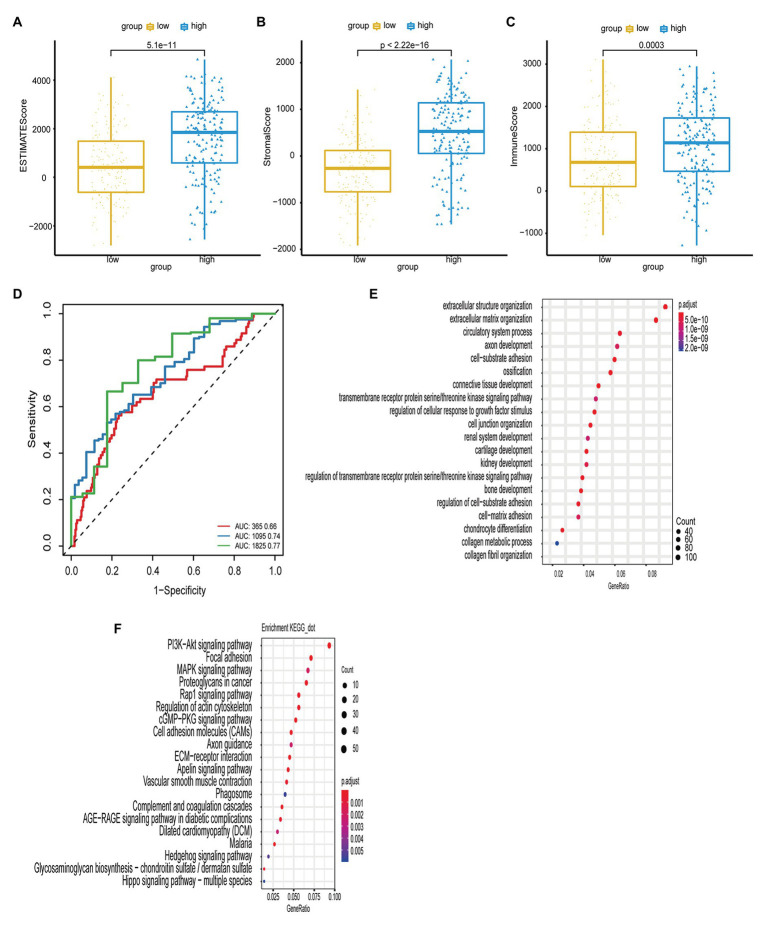
Autophagy plays a vital role in cancer initiation, malignant progression, and resistance to treatment. However, autophagy-related genes (ARGs) have rarely been analyzed in gastric cancer (GC). The purpose of this study was to analyze ARGs in GC using bioinformatic analysis and to identify new biomarkers for predicting the overall survival (OS) of patients with GC. The gene expression profiles and clinical data of patients with GC were obtained from The Cancer Genome Atlas (TCGA) and Gene Expression Omnibus (GEO) datasets, and ARGs were obtained from two other datasets (the Human Autophagy Database and Molecular Signatures Database). Lasso, univariate, and multivariate Cox regression analyses were performed to identify the OS-related ARGs. Finally, a six-ARG model was identified as a prognostic indicator using the risk-score model, and survival and prognostic performance were analyzed based on the Kaplan-Meier test and ROC curve. Estimate calculations were used to assess the immune status of this model, and Gene Ontology (GO) and Kyoto Encyclopedia of Genes and Genomes (KEGG) analyses were employed for investigating the functions and terms associated with the model-related genes in GC. The six ARGs, , , , , , and , were identified using Lasso and Cox regression analyses. Survival analysis revealed that the OS of GC patients in the high-risk group was significantly lower than that of the low-risk group ( < 0.05). The ROC curves revealed that the risk score model exhibited better prognostic performance with respect to OS. Multivariate Cox regression analysis indicated that the model was an independent predictor of OS and was not affected by most of the clinical traits ( < 0.05). The model-related genes were associated with immune suppression and several biological process terms, such as extracellular structure organization and matrix organization. Moreover, the genes were associated with the P13K-Akt signaling pathway, focal adhesion, and MAPK signaling pathway. This study presents potential prognostic biomarkers for GC patients that would aid in determining the best patient-specific course of treatment.
自噬在癌症的发生、恶性进展及治疗抵抗中起着至关重要的作用。然而,自噬相关基因(ARGs)在胃癌(GC)中的分析却很少见。本研究的目的是利用生物信息学分析来分析胃癌中的自噬相关基因,并识别预测胃癌患者总生存期(OS)的新生物标志物。从癌症基因组图谱(TCGA)和基因表达综合数据库(GEO)数据集中获取胃癌患者的基因表达谱和临床数据,并从另外两个数据集(人类自噬数据库和分子特征数据库)中获取自噬相关基因。进行套索分析、单变量和多变量Cox回归分析以识别与总生存期相关的自噬相关基因。最后,使用风险评分模型将一个由六个自噬相关基因组成的模型确定为预后指标,并基于Kaplan-Meier检验和ROC曲线分析生存及预后性能。使用估计计算来评估该模型的免疫状态,并采用基因本体(GO)和京都基因与基因组百科全书(KEGG)分析来研究与胃癌中模型相关基因相关的功能和术语。通过套索分析和Cox回归分析确定了六个自噬相关基因,分别为 、 、 、 、 、 和 。生存分析显示,高风险组胃癌患者的总生存期显著低于低风险组( < 0.05)。ROC曲线显示,风险评分模型在总生存期方面具有更好的预后性能。多变量Cox回归分析表明,该模型是总生存期的独立预测因子,且不受大多数临床特征的影响( < 0.05)。与该模型相关的基因与免疫抑制以及几个生物学过程术语相关,如细胞外结构组织和基质组织。此外,这些基因还与PI3K-Akt信号通路、粘着斑和MAPK信号通路相关。本研究为胃癌患者提供了潜在的预后生物标志物,有助于确定最佳的个体化治疗方案。