Raket Lars Lau
H. Lundbeck A/S, Copenhagen, Denmark.
Clinical Memory Research Unit, Department of Clinical Sciences, Lund University, Lund, Sweden.
Front Big Data. 2020 Aug 12;3:24. doi: 10.3389/fdata.2020.00024. eCollection 2020.
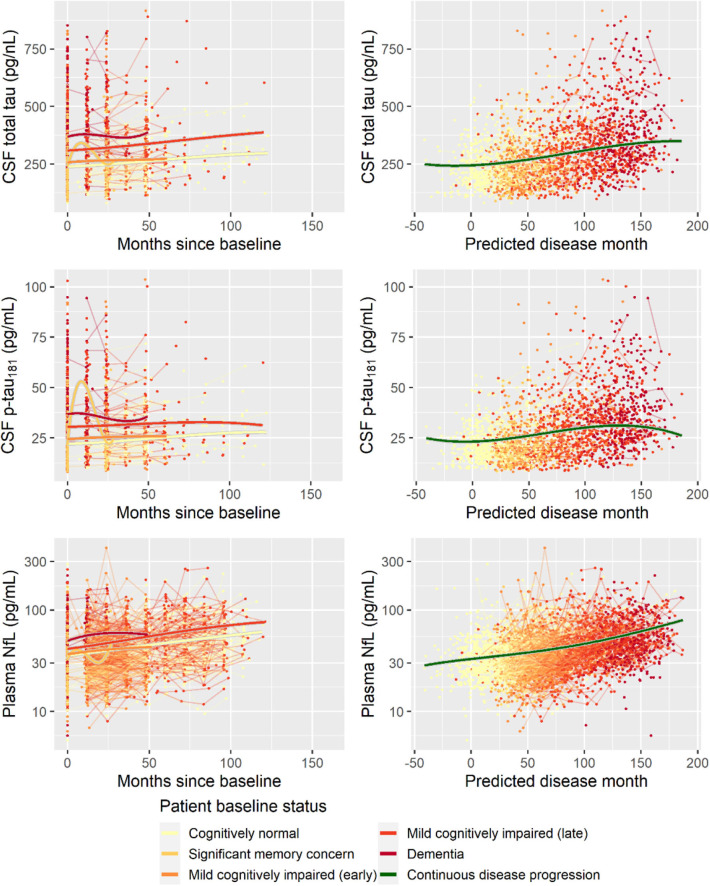
The characterizing symptom of Alzheimer disease (AD) is cognitive deterioration. While much recent work has focused on defining AD as a biological construct, most patients are still diagnosed, staged, and treated based on their cognitive symptoms. But the cognitive capability of a patient at any time throughout this deterioration reflects not only the disease state, but also the effect of the cognitive decline on the patient's pre-disease cognitive capability. Patients with high pre-disease cognitive capabilities tend to score better on cognitive tests that are sensitive early in disease relative to patients with low pre-disease cognitive capabilities at a similar disease stage. Thus, a single assessment with a cognitive test is often not adequate for determining the stage of an AD patient. Repeated evaluation of patients' cognition over time may improve the ability to stage AD patients, and such longitudinal assessments in combinations with biomarker assessments can help elucidate the time dynamics of biomarkers. In turn, this can potentially lead to identification of markers that are predictive of disease stage and future cognitive decline, possibly before any cognitive deficit is measurable. This article presents a class of statistical disease progression models and applies them to longitudinal cognitive scores. These non-linear mixed-effects disease progression models explicitly model disease stage, baseline cognition, and the patients' individual changes in cognitive ability as latent variables. Maximum-likelihood estimation in these models induces a data-driven criterion for separating disease progression and baseline cognition. Applied to data from the Alzheimer's Disease Neuroimaging Initiative, the model estimated a timeline of cognitive decline that spans ~15 years from the earliest subjective cognitive deficits to severe AD dementia. Subsequent analyses demonstrated how direct modeling of latent factors that modify the observed data patterns provides a scaffold for understanding disease progression, biomarkers, and treatment effects along the continuous time progression of disease. The presented framework enables direct interpretations of factors that modify cognitive decline. The results give new insights to the value of biomarkers for staging patients and suggest alternative explanations for previous findings related to accelerated cognitive decline among highly educated patients and patients on symptomatic treatments.
阿尔茨海默病(AD)的特征性症状是认知功能衰退。尽管最近的许多研究都致力于将AD定义为一种生物学概念,但大多数患者仍基于其认知症状进行诊断、分期和治疗。然而,在整个衰退过程中,患者在任何时候的认知能力不仅反映了疾病状态,还反映了认知衰退对患者病前认知能力的影响。与病前认知能力较低的患者相比,病前认知能力较高的患者在疾病早期对认知测试敏感的测试中往往得分更高。因此,仅通过一次认知测试评估通常不足以确定AD患者的分期。随着时间的推移对患者认知进行反复评估可能会提高对AD患者分期的能力,并且这种纵向评估与生物标志物评估相结合有助于阐明生物标志物的时间动态变化。反过来,这可能会识别出在任何认知缺陷可测量之前就能预测疾病分期和未来认知衰退的标志物。本文介绍了一类统计疾病进展模型,并将其应用于纵向认知评分。这些非线性混合效应疾病进展模型将疾病分期、基线认知以及患者认知能力的个体变化明确建模为潜在变量。这些模型中的最大似然估计引出了一个数据驱动的标准,用于区分疾病进展和基线认知。将该模型应用于阿尔茨海默病神经影像倡议(Alzheimer's Disease Neuroimaging Initiative)的数据,估计出认知衰退的时间线,从最早的主观认知缺陷到重度AD痴呆症大约跨越15年。随后的分析表明,对修改观察到的数据模式的潜在因素进行直接建模如何为理解疾病进展、生物标志物和疾病持续时间进程中的治疗效果提供一个框架。所提出的框架能够直接解释影响认知衰退的因素。研究结果为生物标志物在患者分期中的价值提供了新的见解,并对先前关于高学历患者和接受对症治疗患者认知衰退加速的研究结果提出了不同的解释。