Bayer Crop Science, 700 Chesterfield Parkway West, Chesterfield, MO, 63017, USA.
Plant Cell Rep. 2021 Jun;40(6):1047-1058. doi: 10.1007/s00299-021-02678-5. Epub 2021 Mar 11.
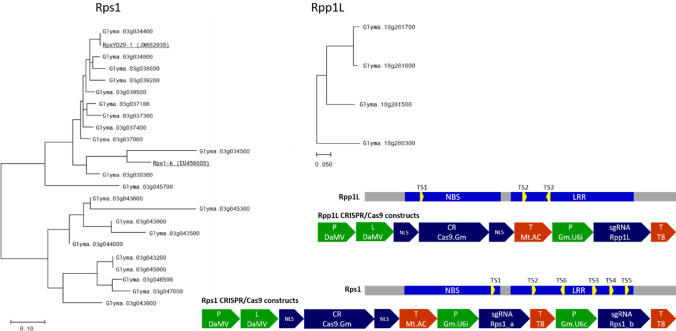
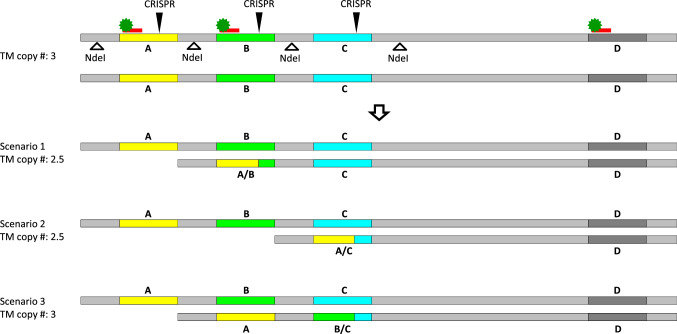
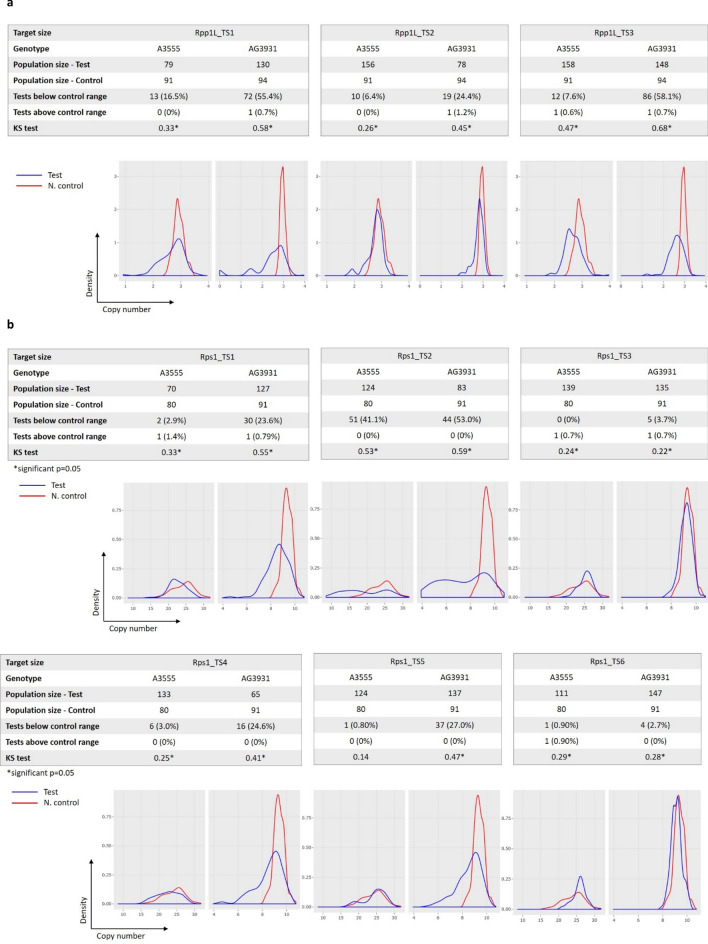
Novel disease resistance gene paralogues are generated by targeted chromosome cleavage of tandem duplicated NBS-LRR gene complexes and subsequent DNA repair in soybean. This study demonstrates accelerated diversification of innate immunity of plants using CRISPR. Nucleotide-binding-site-leucine-rich-repeat (NBS-LRR) gene families are key components of effector-triggered immunity. They are often arranged in tandem duplicated arrays in the genome, a configuration that is conducive to recombinations that will lead to new, chimeric genes. These rearrangements have been recognized as major sources of novel disease resistance phenotypes. Targeted chromosome cleavage by CRISPR/Cas9 can conceivably induce rearrangements and thus emergence of new resistance gene paralogues. Two NBS-LRR families of soy have been selected to demonstrate this concept: a four-copy family in the Rpp1 region (Rpp1L) and a large, complex locus, Rps1 with 22 copies. Copy-number variations suggesting large-scale, CRISPR/Cas9-mediated chromosome rearrangements in the Rpp1L and Rps1 complexes were detected in up to 58.8% of progenies of primary transformants using droplet-digital PCR. Sequencing confirmed development of novel, chimeric paralogs with intact open reading frames. These novel paralogs may confer new disease resistance specificities. This method to diversify innate immunity of plants by genome editing is readily applicable to other disease resistance genes or other repetitive loci.
新型抗病基因的旁系同源物是通过靶向串联重复 NBS-LRR 基因复合物的染色体切割和随后的 DNA 修复在大豆中产生的。本研究展示了利用 CRISPR 加速植物先天免疫的多样化。核苷酸结合位点-富含亮氨酸重复 (NBS-LRR) 基因家族是效应触发免疫的关键组成部分。它们通常在基因组中串联重复排列,这种构象有利于导致新的嵌合基因的重组。这些重排已被认为是新型抗病表型的主要来源。CRISPR/Cas9 的靶向染色体切割可以设想诱导重排,从而产生新的抗病基因旁系同源物。选择了大豆的两个 NBS-LRR 家族来证明这一概念:Rpp1 区域的四拷贝家族 (Rpp1L) 和一个大型复杂基因座 Rps1,其具有 22 个拷贝。使用液滴数字 PCR 检测到多达 58.8%的初级转化体后代中 Rpp1L 和 Rps1 复合物中存在大规模、CRISPR/Cas9 介导的染色体重排的拷贝数变异。测序证实了具有完整开放阅读框的新型嵌合旁系同源物的发育。这些新型的旁系同源物可能赋予新的抗病特异性。通过基因组编辑使植物先天免疫多样化的这种方法易于应用于其他抗病基因或其他重复基因座。