UK Centre for Ecology & Hydrology, Wallingford, United Kingdom.
Ashoka Trust for Research in Ecology and the Environment, Bengaluru, India.
PLoS Negl Trop Dis. 2021 Mar 11;15(3):e0009265. doi: 10.1371/journal.pntd.0009265. eCollection 2021 Mar.
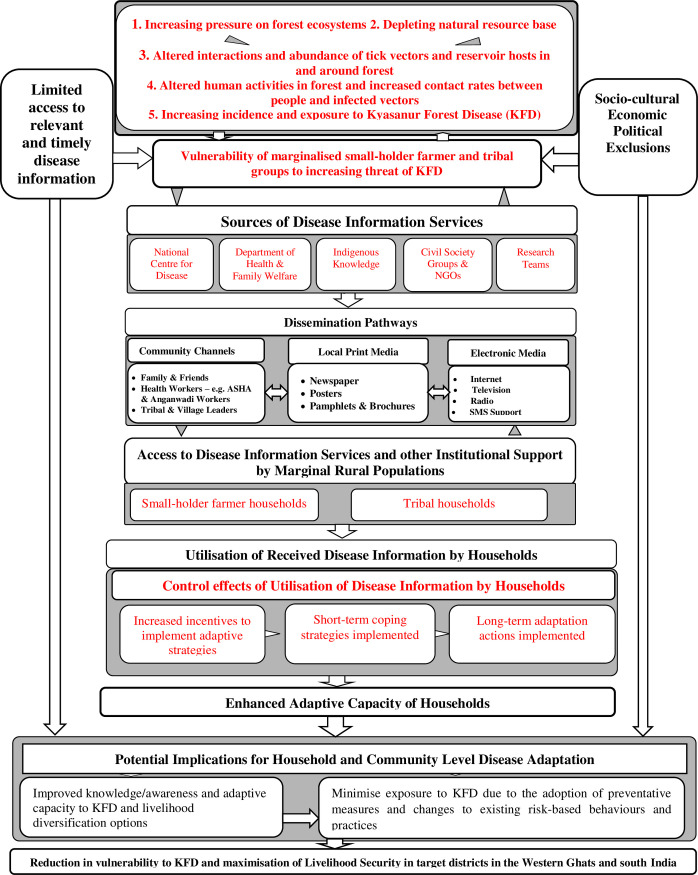
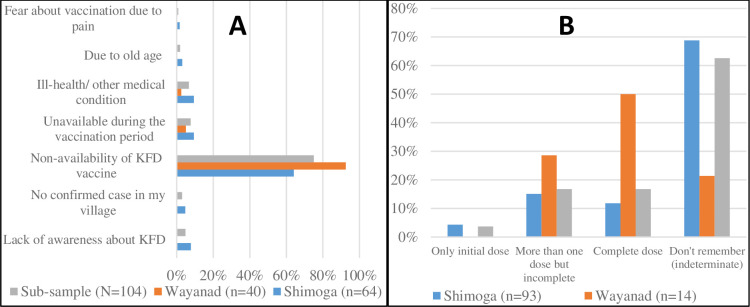
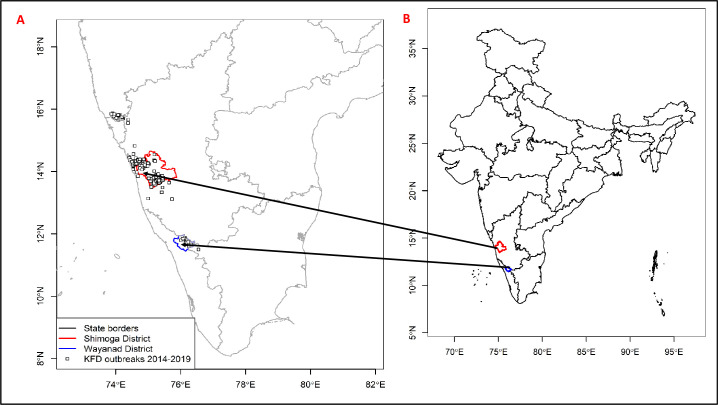
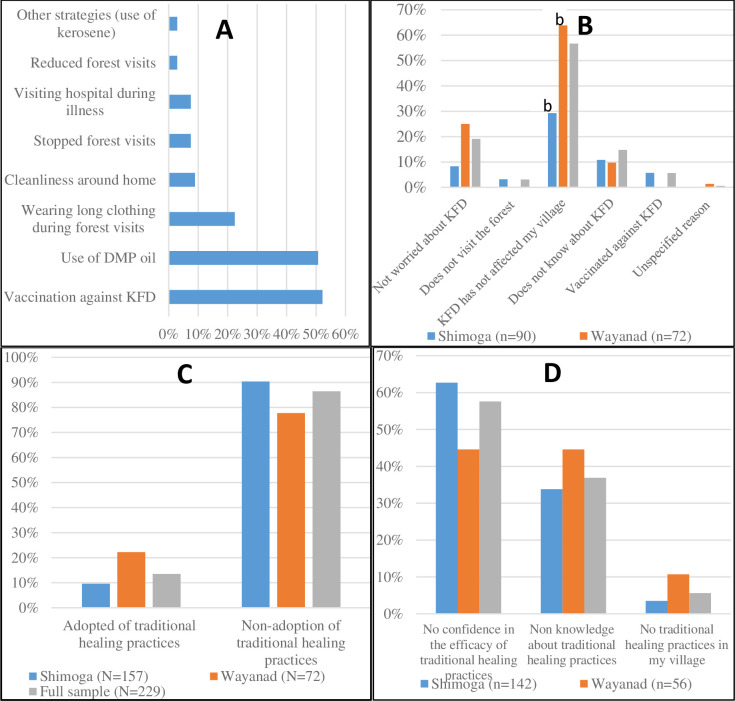
Smallholder farmer and tribal communities are often characterised as marginalised and highly vulnerable to emerging zoonotic diseases due to their relatively poor access to healthcare, worse-off health outcomes, proximity to sources of disease risks, and their social and livelihood organisation. Yet, access to relevant and timely disease information that could strengthen their adaptive capacity remain challenging and poorly characterised in the empirical literature. This paper addresses this gap by exploring the role of disease information in shaping the adaptive capacity of smallholder farmer and tribal groups to Kyasanur Forest Disease (KFD), a tick-borne viral haemorrhagic fever. We carried out household surveys (n = 229) and in-depth interviews (n = 25) in two affected districts-Shimoga and Wayanad-in the Western Ghats region. Our findings suggest that, despite the generally limited awareness about KFD, access to disease information improved households' propensity to implement adaptation strategies relative to households that had no access to it. Of the variety of adaptation strategies implemented, vaccination, avoiding forest visits, wearing of protective clothing and footwear, application of dimethyl phthalate (DMP) oil and income diversification were identified by respondents as important adaptive measures during the outbreak seasons. Even so, we identified significant differences between individuals in exposure to disease information and its contribution to substantive adaptive action. Households reported several barriers to implement adaptation strategies including, lack of disease information, low efficacy of existing vaccine, distrust, religio-cultural sentiments, and livelihood concerns. We also found that informal information sharing presented a promising avenue from a health extension perspective albeit with trade-offs with potential distortion of the messages through misinformation and/or reporting bias. Altogether, our findings stress the importance of contextualising disease information and implementing interventions in a participatory way that sufficiently addresses the social determinants of health in order to bolster households' adaptive capacity to KFD and other neglected endemic zoonoses.
小农和部落社区通常被认为处于边缘地位,由于他们相对较差的医疗保健获取机会、较差的健康状况、接近疾病风险源以及他们的社会和生计组织,他们极易受到新兴人畜共患病的影响。然而,获得可以增强他们适应能力的相关和及时的疾病信息仍然具有挑战性,并且在经验文献中描述得很差。本文通过探讨疾病信息在塑造小农和部落群体对基桑努森林病(KFD)的适应能力方面的作用来解决这一差距,KFD 是一种由蜱传播的病毒性出血热。我们在西高止山脉地区的两个受影响地区(Shimoga 和 Wayanad)进行了家庭调查(n=229)和深入访谈(n=25)。我们的研究结果表明,尽管对 KFD 的认识通常有限,但获得疾病信息可以提高家庭实施适应策略的倾向,而那些无法获得信息的家庭则没有这种倾向。在所实施的各种适应策略中,受访者认为在爆发季节,接种疫苗、避免访问森林、穿着防护服和鞋、涂抹邻苯二甲酸二甲酯(DMP)油和收入多元化是重要的适应措施。即便如此,我们发现个体之间在暴露于疾病信息及其对实质性适应行动的贡献方面存在显著差异。家庭报告了实施适应策略的几个障碍,包括缺乏疾病信息、现有疫苗效果低、不信任、宗教文化观念和生计问题。我们还发现,从健康推广的角度来看,非正式的信息共享提供了一个有前途的途径,尽管存在通过错误信息和/或报告偏差对信息进行扭曲的风险。总之,我们的研究结果强调了根据具体情况提供疾病信息并以参与性的方式实施干预措施的重要性,以充分解决健康的社会决定因素,从而增强家庭对 KFD 和其他被忽视的地方性人畜共患病的适应能力。