Hebei Medical University-National University of Ireland Galway Stem Cell Research Center, Hebei Medical University, Shijiazhuang, Hebei Province, China.
Hebei Research Center for Stem Cell Medical Translational Engineering, Shijiazhuang, Hebei Province, China.
PLoS One. 2021 Mar 11;16(3):e0247662. doi: 10.1371/journal.pone.0247662. eCollection 2021.
Diabetes mellitus as a chronic metabolic disease is threatening human health seriously. Although numerous clinical trials have been registered for the treatment of diabetes with stem cells, no articles have been published to summarize the efficacy and safety of mesenchymal stem cells (MSCs) in randomized controlled trials (RCTs).
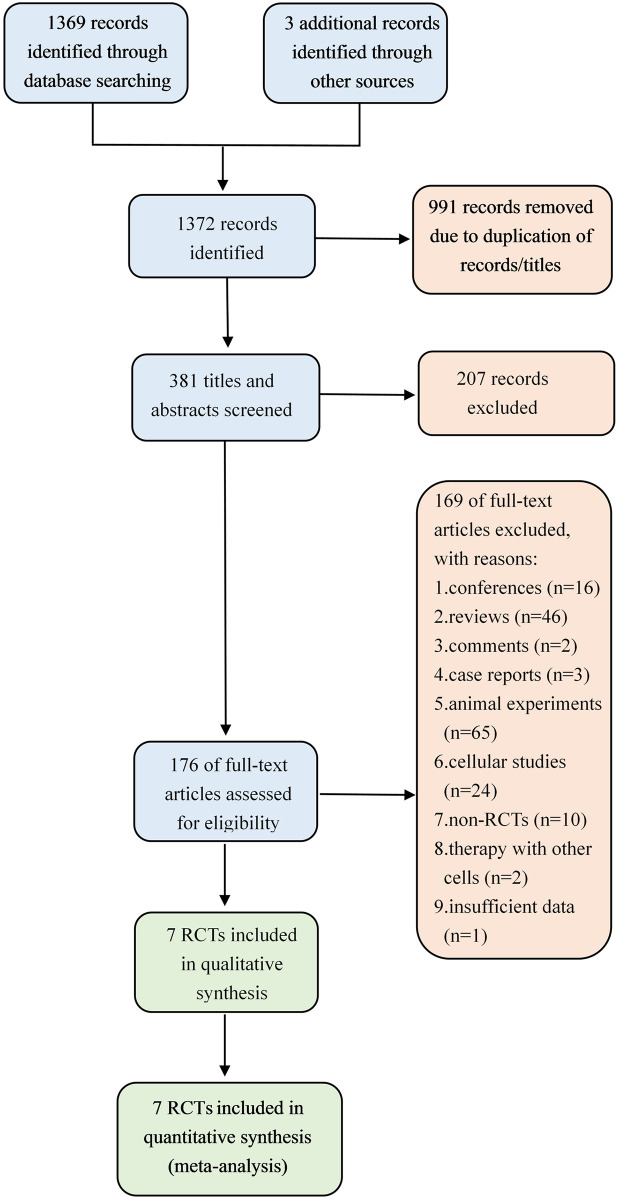
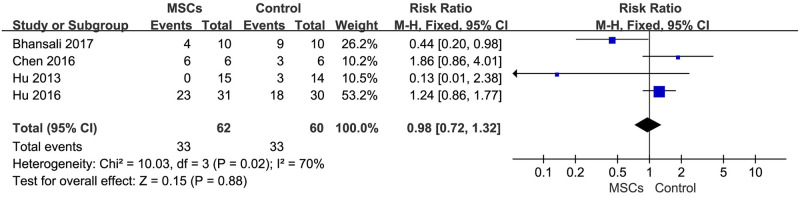
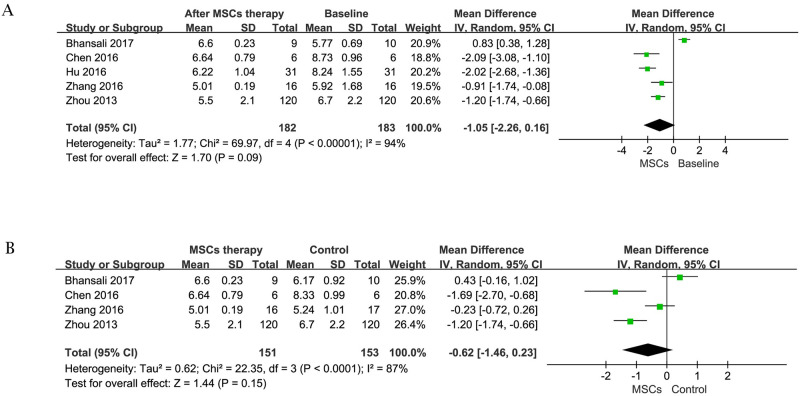
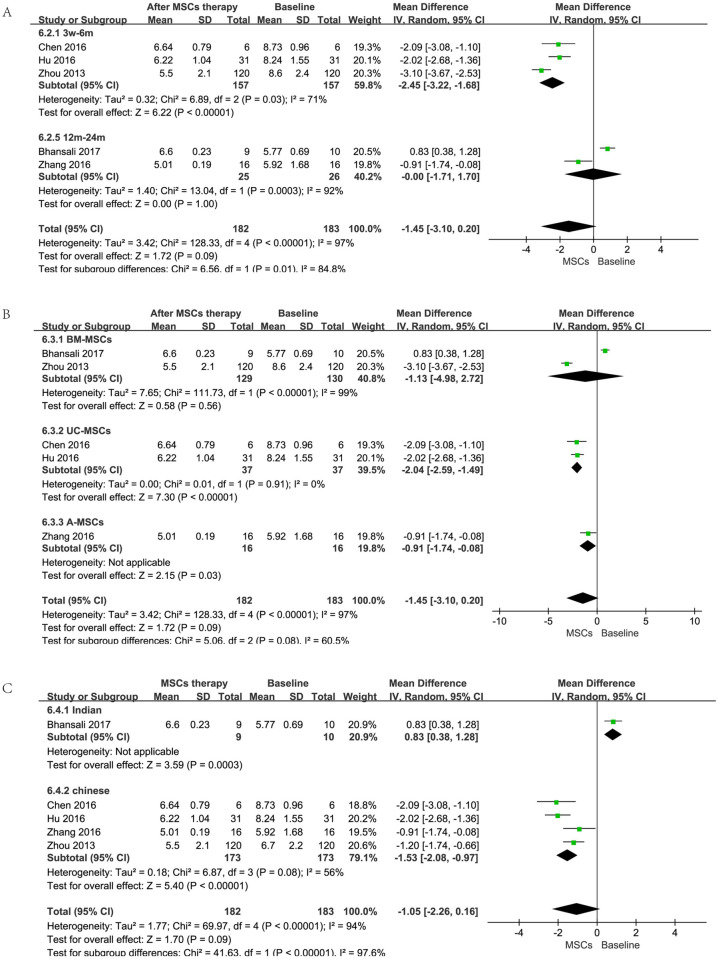
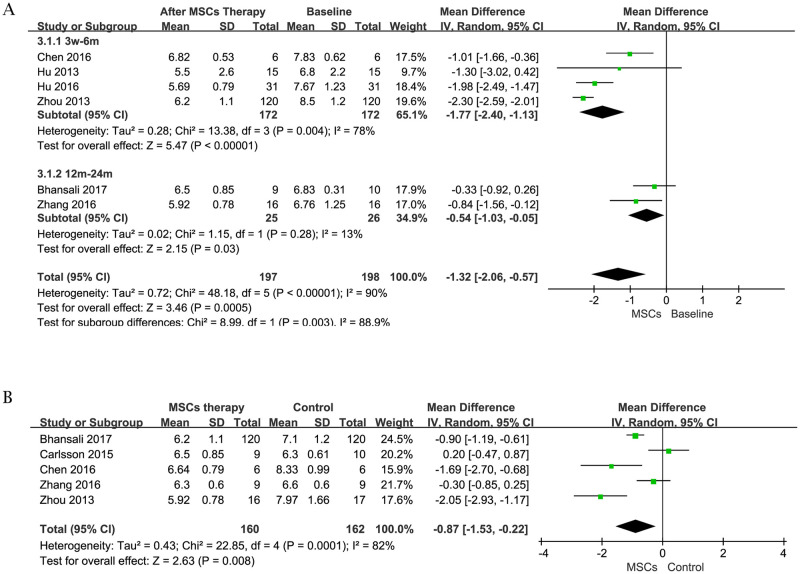
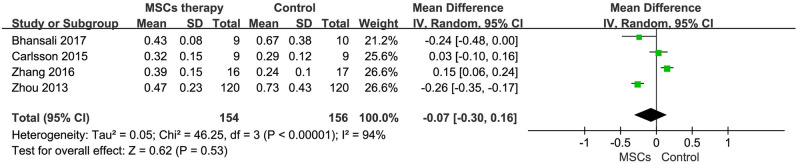
The aim of this study was to systematically review the evidence from RCTs and, where possible, conduct meta-analyses to provide a reliable numerical summary and the most comprehensive assessment of therapeutic efficacy and safety with MSCs in diabetes. PubMed, Web of Science, Ovid, the Cochrane Library and CNKI were searched. The retrieval time was from establishment of these databases to January 4, 2020. Seven RCTs were eligible for analysis, including 413 participants. Meta-analysis results showed that there were no significant differences in the reduction of fasting plasma glucose (FPG) compared to the baseline [mean difference (MD) = -1.05, 95% confidence interval (CI) (-2.26,0.16), P<0.01, I2 = 94%] and the control group [MD = -0.62, 95%CI (-1.46,0.23), P<0.01, I2 = 87%]. The MSCs treatment group showed a significant decrease in hemoglobin (Hb) A1c [random-effects, MD = -1.32, 95%CI (-2.06, -0.57), P<0.01, I2 = 90%] after treatment. Additionally, HbA1c reduced more significantly in MSC treatment group than in control group [random-effects, MD = -0.87, 95%CI (-1.53, -0.22), P<0.01, I2 = 82%] at the end of follow-up. However, as for fasting C-peptide levels, the estimated pooled MD showed that there was no significant increase [MD = -0.07, 95%CI (-0.30, 0.16), P<0.01, I2 = 94%] in MSCs treatment group compared with that in control group. Notably, there was no significant difference in the incidence of adverse events between MSCs treatment group and control group [relative risk (RR) = 0.98, 95%CI (0.72, 1.32), P = 0.02, I2 = 70%]. The most commonly observed adverse reaction in the MSC treatment group was hypoglycemia (29.95%).
This meta-analysis revealed MSCs therapy may be an effective and safe intervention in subjects with diabetes. However, due to the limited studies, a number of high-quality as well as large-scale RCTs should be performed to confirm these conclusions.
糖尿病是一种严重威胁人类健康的慢性代谢性疾病。虽然已经有大量的临床试验注册用于干细胞治疗糖尿病,但没有文章总结间充质干细胞(MSCs)在随机对照试验(RCTs)中的疗效和安全性。
本研究旨在系统评价 RCTs 的证据,并在可能的情况下进行荟萃分析,以提供 MSCs 治疗糖尿病的疗效和安全性的可靠数值总结和最全面的评估。检索了 PubMed、Web of Science、Ovid、Cochrane Library 和中国知网(CNKI)。检索时间从这些数据库建立到 2020 年 1 月 4 日。共有 7 项 RCT 符合分析条件,共纳入 413 名参与者。荟萃分析结果显示,与基线相比,空腹血糖(FPG)的降低[均数差(MD)=-1.05,95%置信区间(CI)(-2.26,0.16),P<0.01,I2=94%]和对照组[MD=-0.62,95%CI(-1.46,0.23),P<0.01,I2=87%]均无显著差异。MSCs 治疗组治疗后血红蛋白(Hb)A1c 显著下降[随机效应,MD=-1.32,95%CI(-2.06,-0.57),P<0.01,I2=90%]。此外,MSCs 治疗组在随访结束时 HbA1c 降低程度明显大于对照组[随机效应,MD=-0.87,95%CI(-1.53,-0.22),P<0.01,I2=82%]。然而,对于空腹 C 肽水平,估计的合并 MD 显示 MSCs 治疗组没有显著增加[MD=-0.07,95%CI(-0.30,0.16),P<0.01,I2=94%]。值得注意的是,MSCs 治疗组与对照组不良事件发生率无显著差异[相对风险(RR)=0.98,95%CI(0.72,1.32),P=0.02,I2=70%]。MSCs 治疗组最常见的不良反应是低血糖(29.95%)。
本荟萃分析显示 MSCs 治疗可能是糖尿病患者有效且安全的干预措施。然而,由于研究数量有限,还需要开展一些高质量和大规模的 RCT 来证实这些结论。