Nigeria Field Epidemiology and Laboratory Training Programme, Decatur, Georgia, United States of America.
Department of Epidemiology and Medical Statistics, University of Ibadan, Ibadan, Nigeria.
PLoS One. 2021 Mar 11;16(3):e0248045. doi: 10.1371/journal.pone.0248045. eCollection 2021.
Hepatitis B virus (HBV) infection is hyper-endemic in Nigeria. Prisons are high-risk environments for the spread of infectious diseases. Worldwide, seroprevalence of HBV infection is substantially higher among individuals in correctional facilities when compared to general population. We determined the seroprevalence and risk factors associated with HBV infection among Kuje prison inmates, Nigeria.
We conducted a prison facility based cross-sectional study. Interviewer administered questionnaires were used to obtain information on participants socio-demographic characteristics, HBV risk factors, previous HBV test and vaccination history. Blood samples collected from participants were analysed for HBsAg, HBsAb, HBcAb, HBeAg and HBeAb markers using rapid lateral chromatographic immunoassay kit. Univariate, bivariate, and multivariate analysis were performed.
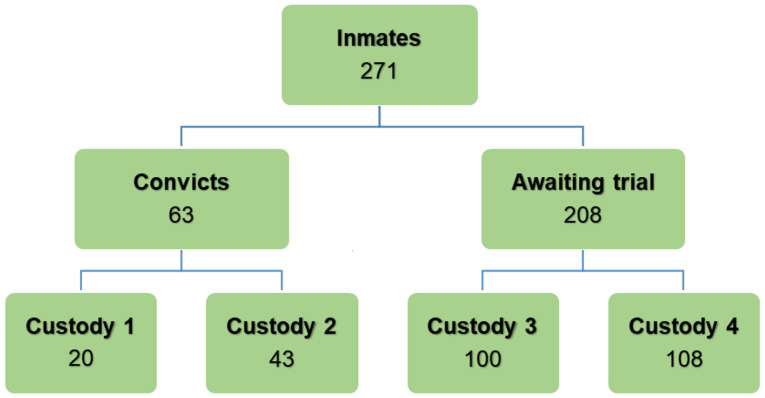
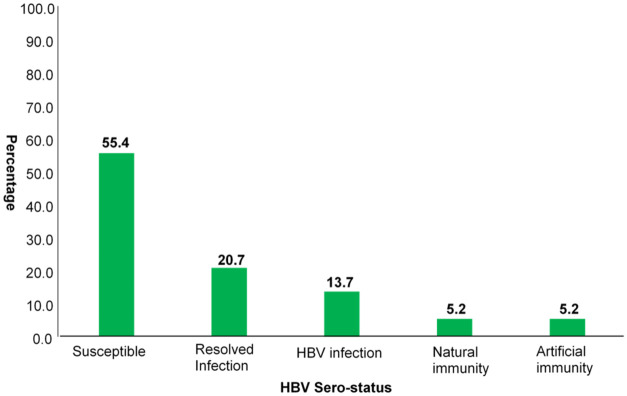
A total of 271 inmates (63 convicts and 208 awaiting trial inmates) were recruited into the study as participants. The mean age of the participants was 32.7 SD±9 years. HBV seroprevalence (HBsAg) of 13.7% (95% CI: 9.8-18.3) was found. 55.4% (95% CI: 49.2-61.4) of inmates were susceptible to HBV infection, 20.7% (95%CI; 16.0-26.0) had past HBV infection while 10.3% (95% CI: 7.0-14.6) had acquired natural or artificial HBV immunity. Factors found to be associated with current HBV infection (HBsAg) include age-group ≤25years (aOR = 8.0,95% CI: 2.9-22.3), being ever married (aOR = 4.2, 95% CI: 1.7-10.4) and history of alcohol consumption (aOR = 3.4, 95% CI: 1.3-8.4).
This study reveals a high seroprevalence of HBV infection among Kuje Prison inmates, hence the need to introduce prison-focused health intervention initiatives such as HBV screening, vaccination and care to reduce the transmission of HBV infection among inmates and ultimately the general population.
乙型肝炎病毒(HBV)感染在尼日利亚高度流行。监狱是传染病传播的高风险环境。在全球范围内,与普通人群相比,监狱中的个体乙型肝炎病毒感染的血清流行率要高得多。我们确定了尼日利亚库杰监狱囚犯中乙型肝炎病毒感染的血清流行率和相关危险因素。
我们进行了一项监狱设施的横断面研究。使用访谈员管理的问卷获取参与者的社会人口统计学特征、乙型肝炎病毒危险因素、既往乙型肝炎病毒检测和疫苗接种史信息。从参与者收集的血液样本使用快速横向层析免疫分析试剂盒分析 HBsAg、HBsAb、HBcAb、HBeAg 和 HBeAb 标志物。进行了单变量、双变量和多变量分析。
共有 271 名囚犯(63 名罪犯和 208 名候审囚犯)被招募为研究对象。参与者的平均年龄为 32.7 岁±9 岁。发现乙型肝炎病毒血清流行率(HBsAg)为 13.7%(95%CI:9.8-18.3)。55.4%(95%CI:49.2-61.4)的囚犯易感染乙型肝炎病毒,20.7%(95%CI;16.0-26.0)有既往乙型肝炎病毒感染史,而 10.3%(95%CI:7.0-14.6)获得了自然或人工乙型肝炎病毒免疫力。与当前乙型肝炎病毒感染(HBsAg)相关的因素包括年龄组≤25 岁(aOR=8.0,95%CI:2.9-22.3)、已婚(aOR=4.2,95%CI:1.7-10.4)和饮酒史(aOR=3.4,95%CI:1.3-8.4)。
这项研究揭示了库杰监狱囚犯中乙型肝炎病毒感染的高血清流行率,因此需要引入以监狱为重点的健康干预措施,如乙型肝炎病毒筛查、疫苗接种和护理,以减少监狱囚犯之间和最终普通人群中乙型肝炎病毒感染的传播。