Department of Work and Social Psychology, Faculty of Psychology and Neuroscience, Maastricht University, Maastricht, The Netherlands.
Department of Agro-Enterprise Development, Faculty of Applied Sciences and Technology, Ho Technical University, Ho, Volta Region, Ghana.
PLoS One. 2021 Mar 11;16(3):e0248392. doi: 10.1371/journal.pone.0248392. eCollection 2021.
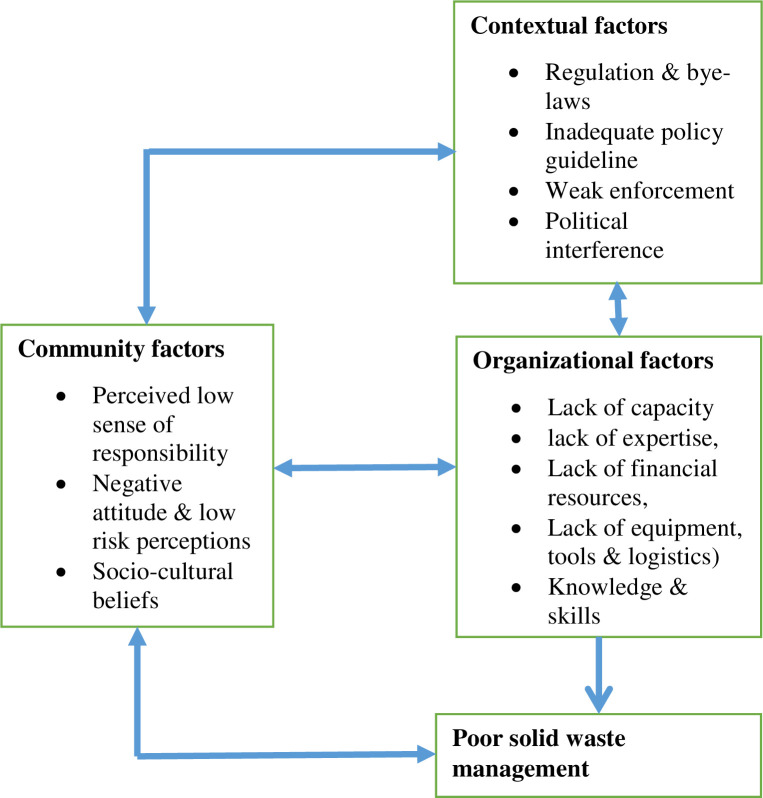
Increased population growth and rapid urbanization have resulted in the generation of large quantities of solid waste across major urban cities in Ghana, outstripping local authorities' ability to manage and dispose of waste in a sanitary manner. This study explored the perspectives and experiences of municipal waste company managers and supervisors in the Ho municipality of Ghana on solid waste management practices. A qualitative inquiry was conducted by adopting a phenomenological approach, using in-depth interviews and focus group discussions for data collection. A total of 35 participants, made up of 12 managers and 23 supervisors took part in the study. Transcribed data were imported into NVivo 11.0 software for coding. Content analysis was applied to analyze all transcribed data using processes of induction and deduction. The results showed that organizational capacity, resources, and expertise; community factors such as socio-cultural beliefs and a low sense of responsibility towards solid waste management among urban residents; contextual factors such as regulations, and weak enforcement all influence and shape the level of efficiency and effectiveness of solid waste management practices in the study setting. The findings suggest that policy frameworks and procedures implemented to curb poor urban waste management practices should be systematic and thorough in order to tackle the issue of solid waste in the study setting and Ghana in general. The nature of the identified issues and challenges requires multidimensional and multilevel interventions to provide sustainable solutions for managing urban waste in Ghana.
人口增长和快速城市化导致加纳主要城市产生了大量固体废物,超过了地方当局以卫生方式管理和处置废物的能力。本研究探讨了加纳霍市市政废物公司经理和主管对固体废物管理实践的看法和经验。采用现象学方法进行了定性研究,通过深入访谈和焦点小组讨论收集数据。共有 35 名参与者,其中包括 12 名经理和 23 名主管参加了研究。转录数据被输入 NVivo 11.0 软件进行编码。使用归纳和演绎过程对所有转录数据进行了内容分析。结果表明,组织能力、资源和专业知识;社区因素,如社会文化信仰和城市居民对固体废物管理的责任感低;以及背景因素,如法规和执行不力,都影响和塑造了研究环境中固体废物管理实践的效率和效果水平。研究结果表明,为遏制城市固体废物管理不善的现象而实施的政策框架和程序应该是系统和全面的,以便解决研究环境和加纳普遍存在的固体废物问题。所确定的问题和挑战的性质需要多维和多层次的干预措施,为加纳的城市废物管理提供可持续的解决方案。