Department of Reproductive Health, School of Medicine, Moi University, Box 4606, Eldoret, 30100, Kenya.
Epidemiology and Social Medicine, Social Epidemiology and Health Policy, University of Antwerp, Universiteitsplein 1, 2610 Wilrijk, Antwerp, Belgium.
BMC Fam Pract. 2021 Mar 11;22(1):52. doi: 10.1186/s12875-021-01395-y.
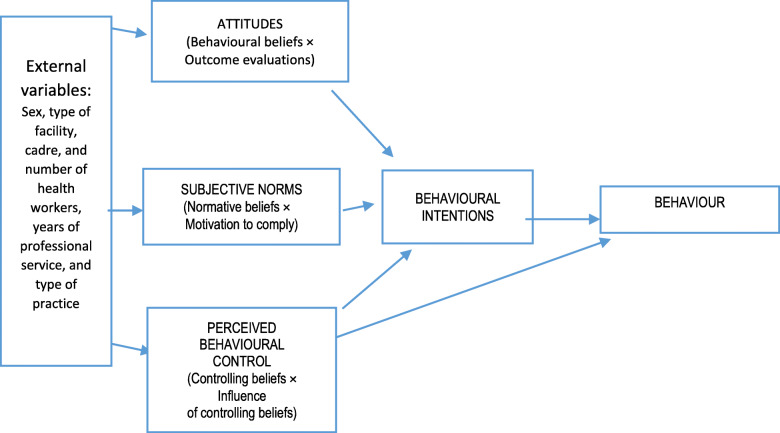
In western Kenya, women often present with late-stage cervical cancer despite prior contact with the health care system. The aim of this study was to predict primary health care providers' behaviour in examining women who present with abnormal discharge or bleeding.
This was a cross-sectional survey using the theory of planned behaviour (TPB). A sample of primary health care practitioners in western Kenya completed a 59-item questionnaire. Structural equation modelling was used to identify the determinants of providers' intention to perform a gynaecological examination. Bivariate analysis was conducted to investigate the relationship between the external variables and intention.
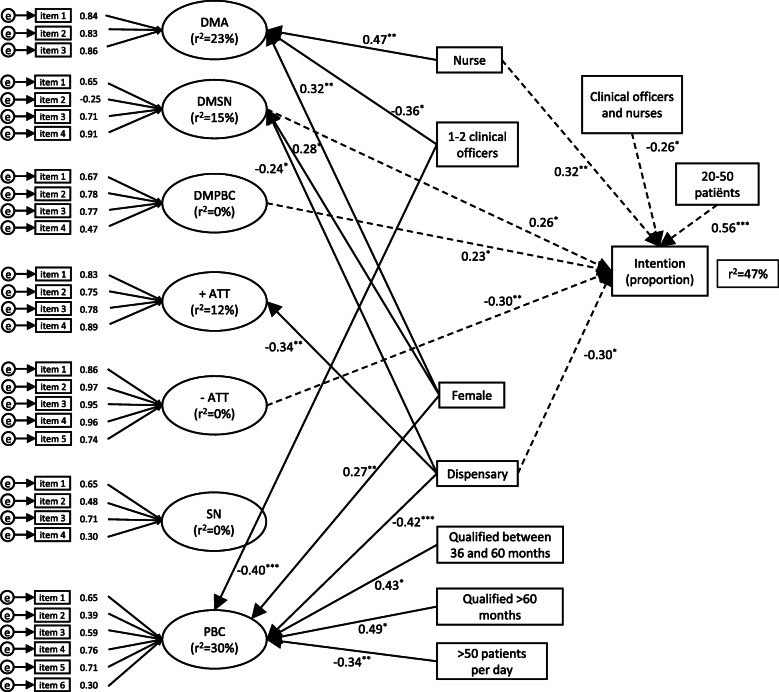
Direct measures of subjective norms (DMSN), direct measures of perceived behavioural control (DMPBC), and indirect measures of attitude predicted the intention to examine patients. Negative attitudes toward examining women had a suppressor effect on the prediction of health workers' intentions. However, the predictors of intention with the highest coefficients were the external variables being a nurse (β = 0.32) as opposed to a clinical officer and workload of attending less than 50 patients per day (β = 0.56). In bivariate analysis with intention to perform a gynaecological examination, there was no evidence that working experience, being female, having a lower workload, or being a private practitioner were associated with a higher intention to conduct vaginal examinations. Clinical officers and nurses were equally likely to examine women.
The TPB is a suitable theoretical basis to predict the intention to perform a gynaecological examination. Overall, the model predicted 47% of the variation in health care providers' intention to examine women who present with recurrent vaginal bleeding or discharge. Direct subjective norms (health provider's conformity with what their colleagues do or expect them to do), PBC (providers need to feel competent and confident in performing examinations in women), and negative attitudes toward conducting vaginal examination accounted for the most variance. External variables in this study also contributed to the overall variance. As the model in this study could not explain 53% of the variance, investigating other external variables that influence the intention to examine women should be undertaken.
在肯尼亚西部,尽管女性已经与医疗保健系统有过接触,但她们仍经常出现晚期宫颈癌。本研究旨在预测初级保健提供者在检查出现异常阴道出血或出血的女性时的行为。
这是一项使用计划行为理论(TPB)的横断面调查。肯尼亚西部的初级保健从业者样本完成了一份 59 项的问卷。结构方程模型用于确定提供者进行妇科检查的意图的决定因素。进行了双变量分析以调查外部变量与意图之间的关系。
直接测量的主观规范(DMSN)、直接测量的感知行为控制(DMPBC)和间接测量的态度预测了检查患者的意图。对检查女性的态度的负面影响对卫生工作者意图的预测有抑制作用。然而,意图的预测指标中,与护士(β=0.32)相比,临床医生和每天接诊少于 50 名患者的工作量(β=0.56)是预测意图的最强外部变量。在与进行妇科检查的意图进行的双变量分析中,没有证据表明工作经验、女性、工作量较低或私人执业与进行阴道检查的更高意图相关。临床医生和护士同样有可能检查女性。
TPB 是预测进行妇科检查意图的合适理论基础。总体而言,该模型预测了 47%的卫生保健提供者检查反复出现阴道出血或出血的女性的意图变化。直接主观规范(卫生提供者与其同事的行为一致或期望他们做什么)、PBC(提供者需要在女性中进行检查时感到有能力和自信)以及对进行阴道检查的负面态度解释了大部分差异。本研究中的外部变量也有助于总体差异。由于本研究中的模型无法解释 53%的差异,因此应研究其他影响检查女性意图的外部变量。