Heller School for Social Policy and Management, Brandeis University, 415 South St, Waltham, MA, 02453, USA.
School of Social Work, Columbia University, 1255 Amsterdam Ave, New York, NY, 10027, USA.
Implement Sci. 2021 Mar 12;16(1):26. doi: 10.1186/s13012-021-01094-3.
This study is a systematic literature review of cost analyses conducted within implementation studies on behavioral health services. Cost analysis of implementing evidence-based practices (EBP) has become important within implementation science and is critical for bridging the research to practice gap to improve access to quality healthcare services. Costing studies in this area are rare but necessary since cost can be a barrier to implementation and sustainment of EBP.
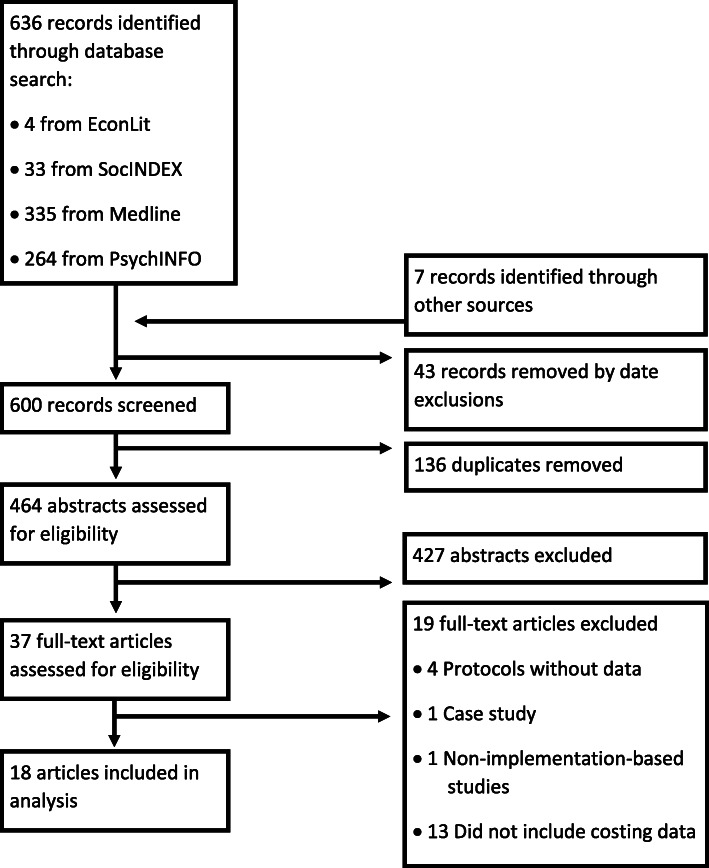
We followed Preferred Reporting Items for Systematic Reviews and Meta-Analyses (PRISMA) methodology and applied the Consolidated Health Economic Evaluation Reporting Standards (CHEERS) checklist. Key search terms included: (1) economics, (2) implementation, (3) EBP, and (4) behavioral health. Terms were searched within article title and abstracts in: EconLit, SocINDEX, Medline, and PsychINFO. A total of 464 abstracts were screened independently by two authors and reduced to 37 articles using inclusion and exclusion criteria. After a full-text review, 18 articles were included.
Findings were used to classify costs into direct implementation, direct services, and indirect implementation. While all studies included phases of implementation as part of their design, only five studies examined resources across multiple phases of an implementation framework. Most studies reported direct service costs associated with adopting a new practice, usually summarized as total EBP cost, cost per client, cost per clinician, and/or cost per agency. For studies with detailed analysis, there were eleven direct cost categories represented. For five studies that reported costs per child served, direct implementation costs varied from $886 to $9470 per child, while indirect implementation costs ranged from $897 to $3805 per child.
This is the first systematic literature review to examine costs of implementing EBP in behavioral healthcare settings. Since 2000, 18 studies were identified that included a cost analysis. Given a wide variation in the study designs and economic methods, comparison across studies was challenging, which is a major limitation in the field, as it becomes difficult to replicate studies or to estimate future costs to inform policy decisions related to budgeting. We recommend future economic implementation studies to consider standard economic costing methods capturing costs across implementation framework phases to support comparisons and replicability.
本研究对行为健康服务实施研究中进行的成本分析进行了系统文献回顾。实施科学领域中,基于证据的实践(EBP)的成本分析变得越来越重要,对于缩小研究与实践之间的差距,改善获得高质量医疗保健服务的机会至关重要。该领域的成本研究虽然很少但很有必要,因为成本可能成为实施和维持 EBP 的障碍。
我们遵循系统评价和荟萃分析的首选报告项目(PRISMA)方法,并应用了健康经济评估报告标准(CHEERS)清单。主要搜索词包括:(1)经济学,(2)实施,(3)EBP 和(4)行为健康。在 EconLit、SocINDEX、Medline 和 PsychINFO 中,在文章标题和摘要中搜索这些术语。两位作者独立筛选了 464 篇摘要,并使用纳入和排除标准将其减少到 37 篇文章。在全文审查后,纳入了 18 篇文章。
研究结果用于将成本分类为直接实施、直接服务和间接实施。虽然所有研究都将实施阶段作为其设计的一部分,但只有五项研究跨实施框架的多个阶段检查了资源。大多数研究报告了与采用新实践相关的直接服务成本,通常总结为总 EBP 成本、每位客户成本、每位临床医生成本和/或每个机构成本。对于有详细分析的研究,有十一个直接成本类别。对于五篇报告每服务儿童成本的研究,直接实施成本从每个儿童 886 美元到 9470 美元不等,而间接实施成本从每个儿童 897 美元到 3805 美元不等。
这是首次对行为医疗保健环境中实施 EBP 的成本进行的系统文献回顾。自 2000 年以来,确定了 18 项包括成本分析的研究。鉴于研究设计和经济方法存在广泛差异,因此跨研究进行比较具有挑战性,这是该领域的主要限制,因为难以复制研究或估计未来成本以为与预算编制相关的政策决策提供信息。我们建议未来的经济实施研究考虑采用标准的经济成本核算方法,以跨实施框架阶段捕捉成本,以支持比较和可复制性。