Departamento de Oceanografía, Universidad de Concepción, 4070386 Concepción, Chile;
Instituto Milenio de Oceanografía, 4070386 Concepción, Chile.
Proc Natl Acad Sci U S A. 2021 Mar 16;118(11). doi: 10.1073/pnas.2025638118.
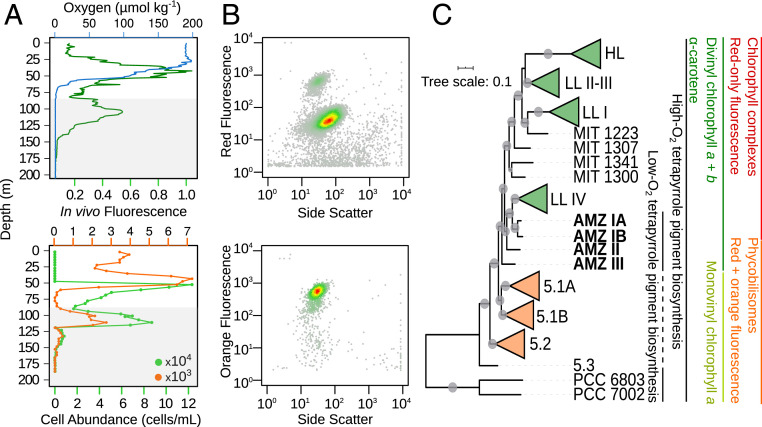
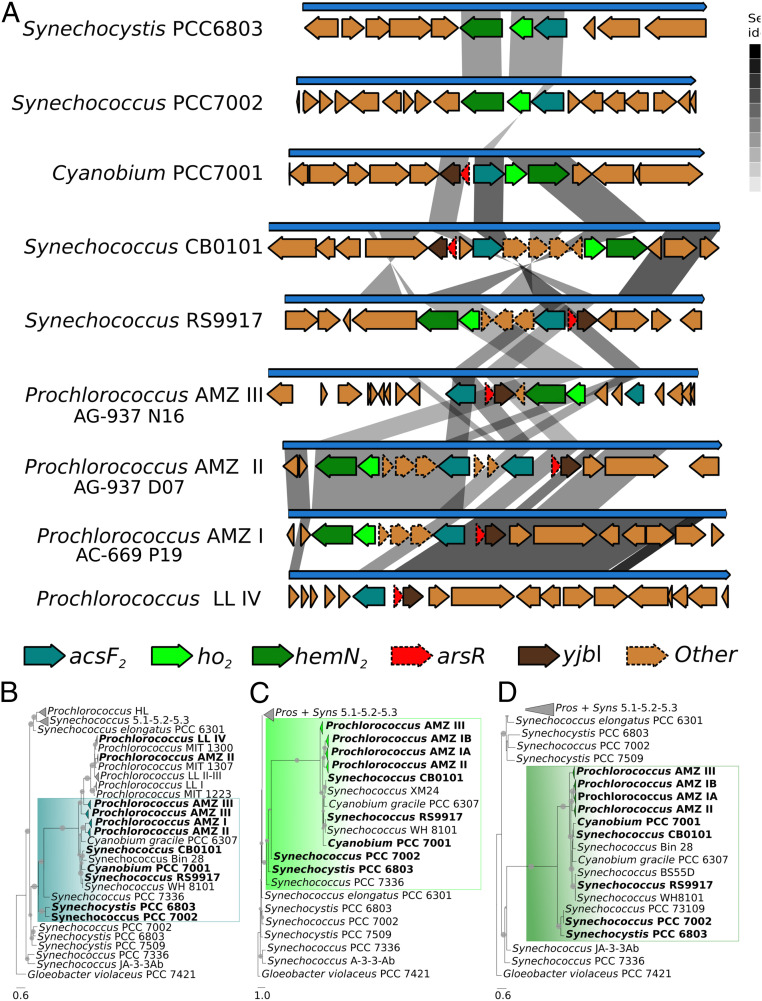
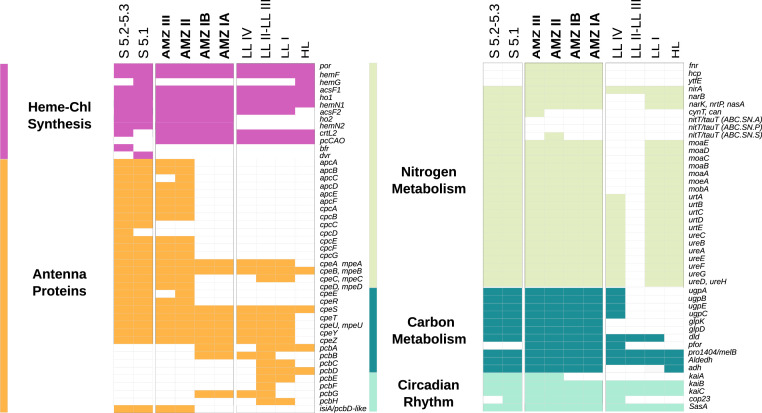
Marine picocyanobacteria of the genus are the most abundant photosynthetic organisms in the modern ocean, where they exert a profound influence on elemental cycling and energy flow. The use of transmembrane chlorophyll complexes instead of phycobilisomes as light-harvesting antennae is considered a defining attribute of Its ecology and evolution are understood in terms of light, temperature, and nutrients. Here, we report single-cell genomic information on previously uncharacterized phylogenetic lineages of this genus from nutrient-rich anoxic waters of the eastern tropical North and South Pacific Ocean. The most basal lineages exhibit optical and genotypic properties of phycobilisome-containing cyanobacteria, indicating that the characteristic light-harvesting antenna of the group is not an ancestral attribute. Additionally, we found that all the indigenous lineages analyzed encode genes for pigment biosynthesis under oxygen-limited conditions, a trait shared with other freshwater and coastal marine cyanobacteria. Our findings thus suggest that diverged from other cyanobacteria under low-oxygen conditions before transitioning from phycobilisomes to transmembrane chlorophyll complexes and may have contributed to the oxidation of the ancient ocean.
海洋微微型蓝细菌属是现代海洋中最丰富的光合生物,它们对元素循环和能量流动有着深远的影响。它们使用跨膜叶绿素复合物而不是藻胆体作为光收集天线,这被认为是该属的一个定义特征。其生态和进化是根据光、温度和营养物质来理解的。在这里,我们报告了来自东热带北太平洋和南太平洋富营养缺氧水域中以前未被描述的属的系统发育谱系的单细胞基因组信息。最基础的谱系表现出含有藻胆体的蓝细菌的光学和基因型特性,这表明该组的特征光收集天线不是一个原始属性。此外,我们还发现所有分析的土著谱系在缺氧条件下都编码色素生物合成基因,这一特性与其他淡水和沿海海洋蓝细菌共享。因此,我们的研究结果表明,微微型蓝细菌属在从藻胆体过渡到跨膜叶绿素复合物之前,在低氧条件下从其他蓝细菌分化出来,并且可能对古代海洋的氧化做出了贡献。