Department of Earth System Science, Stanford University, Stanford, CA 94305.
School of Oceanography, University of Washington, Seattle, WA 98195.
Proc Natl Acad Sci U S A. 2024 Dec 3;121(49):e2418345121. doi: 10.1073/pnas.2418345121. Epub 2024 Nov 25.
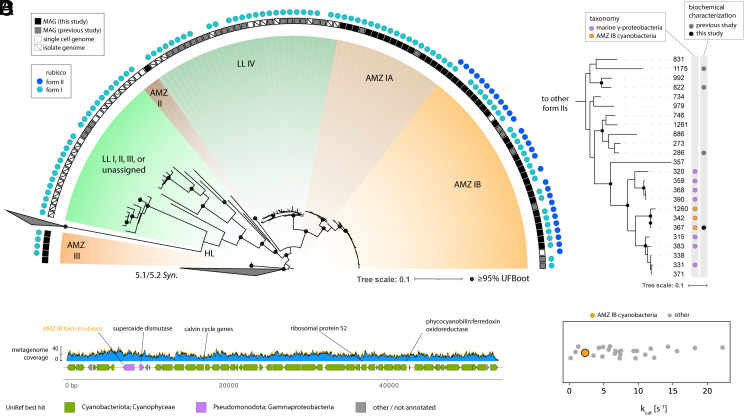
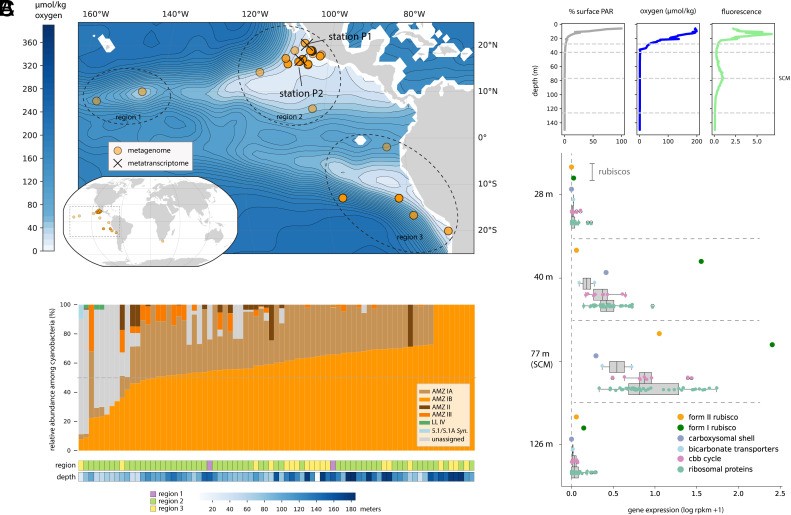
Cyanobacteria are highly abundant in the marine photic zone and primary drivers of the conversion of inorganic carbon into biomass. To date, all studied cyanobacterial lineages encode carbon fixation machinery relying upon form I Rubiscos within a CO-concentrating carboxysome. Here, we report that the uncultivated anoxic marine zone (AMZ) IB lineage of from pelagic oxygen-deficient zones (ODZs) harbors both form I and form II Rubiscos, the latter of which are typically noncarboxysomal and possess biochemical properties tuned toward low-oxygen environments. We demonstrate that these cyanobacterial form II enzymes are functional in vitro and were likely acquired from proteobacteria. Metagenomic analysis reveals that AMZ IB are essentially restricted to ODZs in the Eastern Pacific, suggesting that form II acquisition may confer an advantage under low-O conditions. AMZ IB populations express both forms of Rubisco in situ, with the highest form II expression at depths where oxygen and light are low, possibly as a mechanism to increase the efficiency of photoautotrophy under energy limitation. Our findings expand the diversity of carbon fixation configurations in the microbial world and may have implications for carbon sequestration in natural and engineered systems.
蓝细菌在海洋光区中高度丰富,是将无机碳转化为生物量的主要驱动因素。迄今为止,所有研究过的蓝细菌谱系都在浓缩羧基体(carboxysome)内编码依赖于 I 型 Rubisco 的碳固定机制。在这里,我们报告说,从贫氧区(ODZ)中分离出的未培养的缺氧海洋区(AMZ)IB 谱系同时含有 I 型和 II 型 Rubisco,后者通常是非羧基体的,并且具有针对低氧环境进行调整的生化特性。我们证明这些蓝细菌的 II 型酶在体外是有功能的,并且可能是从变形菌中获得的。宏基因组分析表明,AMZ IB 基本上仅限于东太平洋的 ODZ,这表明 II 型的获得可能在低氧条件下具有优势。AMZ IB 种群原位表达两种形式的 Rubisco,在氧气和光照低的深度,II 型表达最高,这可能是在能量限制下提高光合作用效率的一种机制。我们的发现扩展了微生物世界中碳固定构型的多样性,并可能对自然和工程系统中的碳固存产生影响。