
结直肠癌负担与趋势:中国与世界主要负担国家的比较。
Colorectal cancer burden and trends: Comparison between China and major burden countries in the world.
作者信息
Zhou Jiachen, Zheng Rongshou, Zhang Siwei, Zeng Hongmei, Wang Shaoming, Chen Ru, Sun Kexin, Li Minjuan, Gu Jianhua, Zhuang Guihua, Wei Wenqiang
机构信息
Department of Epidemiology and Biostatistics, School of Public Health, Xi'an Jiaotong University Health Science Center, Xi'an 710061, China.
National Central Cancer Registry, National Cancer Center/National Clinical Research Center for Cancer/Cancer Hospital, Chinese Academy of Medical Sciences and Peking Union Medical College, Beijing 100021, China.
出版信息
Chin J Cancer Res. 2021 Feb 28;33(1):1-10. doi: 10.21147/j.issn.1000-9604.2021.01.01.
OBJECTIVE
To summarize the colorectal cancer (CRC) burden and trend in the world, and compare the difference of CRC burden between other countries and China.
METHODS
Incidence and mortality data were extracted from the GLOBOCAN2018 and Cancer Incidence in Five Continents. Age-specific incidence trend was conducted by Joinpoint analysis and average annual percent changes were calculated.
RESULTS
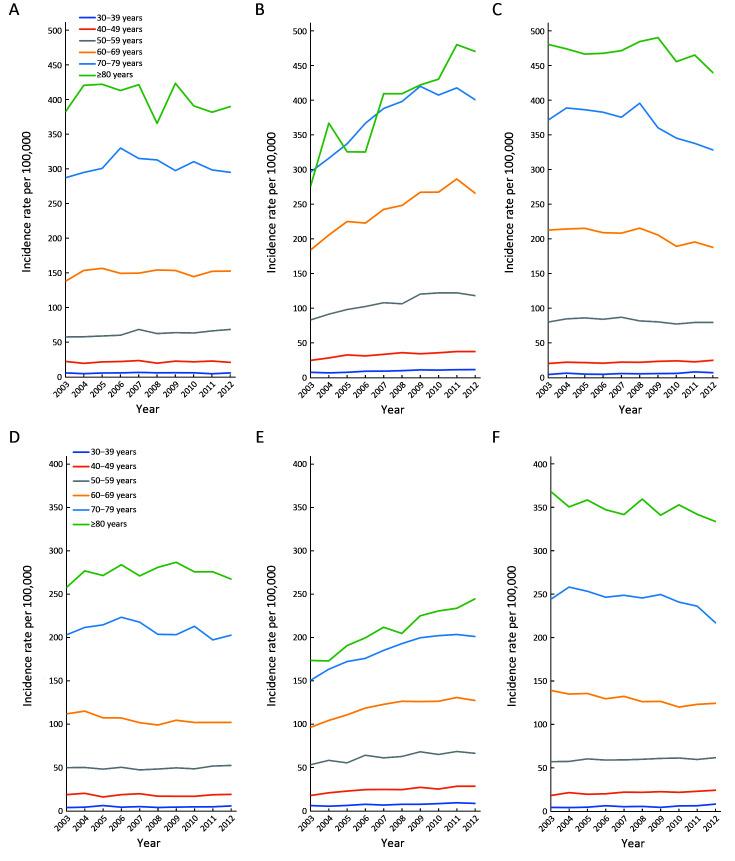
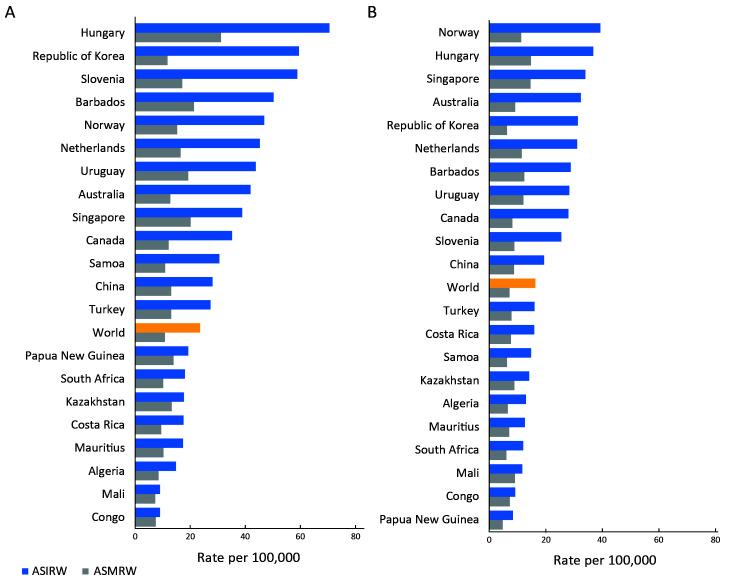
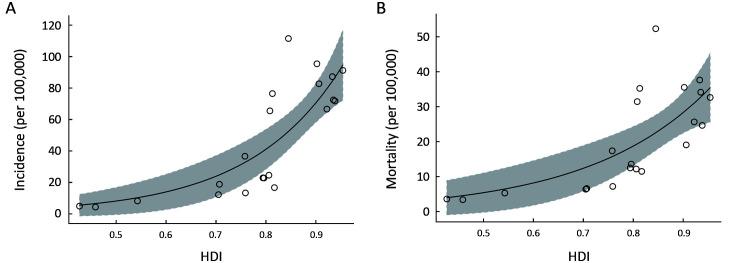
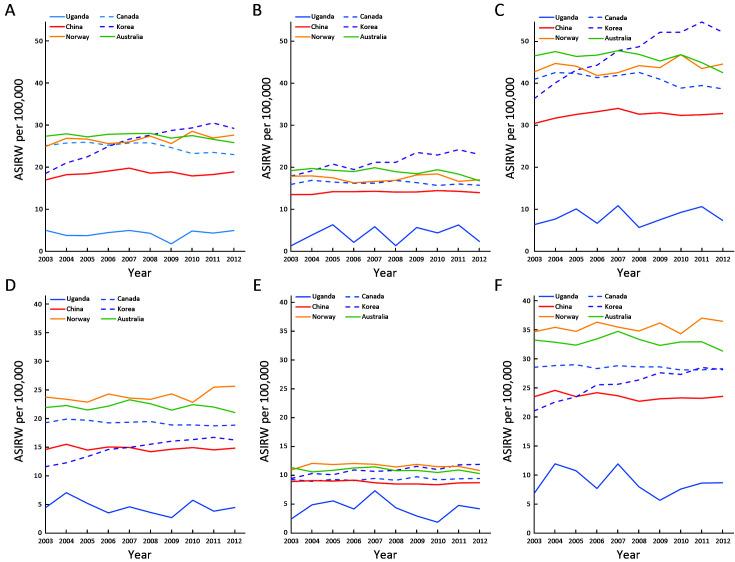
About 1.85 million new cases and 0.88 million deaths were expected in 2018 worldwide, including 0.52 million (28.20%) new cases and 0.25 million (28.11%) deaths in China. Hungary had the highest age-standardized incidence and mortality rates in the world, while for China, the incidence and mortality rates were only half of that. CRC incidence and mortality were highly correlated with human development index (HDI). Unlike the rapid increase in Republic of Korea and the downward trend in Canada and Australia, the age-standardized incidence rates by world standard population in China and Norway were rising gradually. The age-specific incidence rate in the age group of 50-59 years in China was increasing rapidly, while in Republic of Korea and Canada, the fastest growing age group was 30-39 years.
CONCLUSIONS
The variations of CRC burden reflect the difference of risk factors, as well as levels of HDI and screening (early detection activities). The burden of CRC in China is high, and the incidence of CRC continues to increase, which may lead to a sustained increase in the burden of CRC in China in the future. Screening should be expanded to control CRC, and focused on young people in China.
目的
总结全球结直肠癌(CRC)负担及趋势,并比较其他国家与中国CRC负担的差异。
方法
从GLOBOCAN2018和《五大洲癌症发病率》中提取发病率和死亡率数据。通过Joinpoint分析得出年龄别发病率趋势,并计算平均年度百分比变化。
结果
2018年全球预计约有185万新发病例和88万例死亡,其中中国有52万例(28.20%)新发病例和25万例(28.11%)死亡。匈牙利的年龄标准化发病率和死亡率在全球最高,而中国的发病率和死亡率仅为其一半。CRC发病率和死亡率与人类发展指数(HDI)高度相关。与韩国的快速上升以及加拿大和澳大利亚的下降趋势不同,中国和挪威按世界标准人口计算的年龄标准化发病率呈逐渐上升趋势。中国50-59岁年龄组的年龄别发病率增长迅速,而在韩国和加拿大,增长最快的年龄组是30-39岁。
结论
CRC负担的差异反映了风险因素、HDI水平和筛查(早期检测活动)的差异。中国的CRC负担较高,且CRC发病率持续上升,这可能导致未来中国CRC负担持续增加。应扩大筛查以控制CRC,并在中国关注年轻人。
 Zotero 插件