IRMB, University of Montpellier, INSERM, CHU Montpellier, Montpellier, France.
Clinical Research and Epidemiology Unit, CHU Montpellier, Montpellier University, Montpellier, France.
Front Immunol. 2021 Feb 23;12:631539. doi: 10.3389/fimmu.2021.631539. eCollection 2021.
Primary Sjögren's syndrome (pSS) is a complex heterogeneous autoimmune disease (AID) which can mimic rheumatoid arthritis (RA) or systemic lupus erythematosus (SLE). Our exploratory study investigated serum biomarkers that may discriminate pSS from RA and SLE.
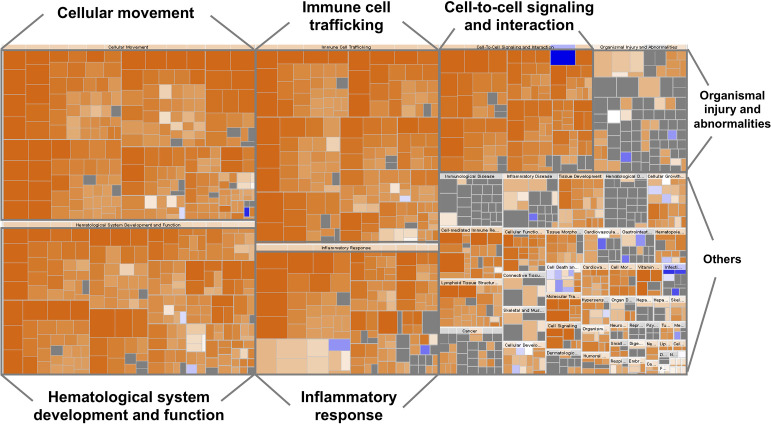
Serum concentrations of 63 biomarkers involved in immune cell trafficking, inflammatory response, cellular movement, and cell-to-cell signaling were measured in AID patients, included prospectively into the study at the Montpellier University Hospital. A multivariate analysis by multiple logistic regression was performed, and discriminative power assessed using logistic regression adjusted on significant demographic factors.
Among the 95 patients enrolled, 42 suffered from pSS, 28 from RA, and 25 from SLE. Statistical analysis showed that concentrations of BDNF (OR = 0.493 with 95% CI [0.273-0.891]; p = 0.0193) and I-TAC/CXCL11 (OR = 1.344 with 95% CI [1.027-1.76]; p = 0.0314) can significantly discriminate pSS from RA. Similarly, greater concentrations of sCD163 (OR = 0.803 with 95% CI [0.649-0.994]; p = 0.0436), Fractalkine/CX3CL1 (OR = 0.534 with 95% CI [0.287-0. 991]; p = 0.0466), MCP-1/CCL2 (OR = 0.839 with 95% CI [0.732-0.962]; p = 0.0121), and TNFa (OR = 0.479 with 95% CI [0.247-0.928]; p = 0.0292) were associated with SLE diagnosis compared to pSS. In addition, the combination of low concentrations of BDNF and Fractalkine/CX3CL1 was highly specific for pSS (specificity 96.2%; positive predictive value 80%) compared to RA and SLE, as well as the combination of high concentrations of I-TAC/CXCL11 and low concentrations of sCD163 (specificity 98.1%; positive predictive value 75%).
Our study highlights biomarkers potentially involved in pSS, RA, and SLE pathophysiology that could be useful for developing a pSS-specific diagnostic tool.
原发性干燥综合征(pSS)是一种复杂的异质性自身免疫性疾病(AID),可模拟类风湿关节炎(RA)或系统性红斑狼疮(SLE)。我们的探索性研究调查了可能将 pSS 与 RA 和 SLE 区分开的血清生物标志物。
在蒙彼利埃大学医院前瞻性纳入研究的 AID 患者中,测量了涉及免疫细胞迁移、炎症反应、细胞运动和细胞间信号传导的 63 种生物标志物的血清浓度。通过多元逻辑回归进行多变量分析,并通过调整有意义的人口统计学因素的逻辑回归评估判别能力。
在纳入的 95 名患者中,42 名患有 pSS,28 名患有 RA,25 名患有 SLE。统计分析表明,BDNF(OR=0.493,95%CI[0.273-0.891];p=0.0193)和 I-TAC/CXCL11(OR=1.344,95%CI[1.027-1.76];p=0.0314)的浓度可显著区分 pSS 和 RA。同样,sCD163(OR=0.803,95%CI[0.649-0.994];p=0.0436)、Fractalkine/CX3CL1(OR=0.534,95%CI[0.287-0.991];p=0.0466)、MCP-1/CCL2(OR=0.839,95%CI[0.732-0.962];p=0.0121)和 TNFa(OR=0.479,95%CI[0.247-0.928];p=0.0292)的浓度较高与 SLE 诊断相关,而不是 pSS。此外,低浓度 BDNF 和 Fractalkine/CX3CL1 的组合对 pSS(特异性 96.2%;阳性预测值 80%)与 RA 和 SLE 的特异性较高,而高浓度 I-TAC/CXCL11 和低浓度 sCD163 的组合(特异性 98.1%;阳性预测值 75%)。
我们的研究强调了可能参与 pSS、RA 和 SLE 病理生理学的生物标志物,这些标志物可能有助于开发 pSS 特异性诊断工具。