Division of Cardiothoracic Surgery, University of Texas Medical Branch at Galveston, Galveston, TX, United States.
Department of Microbiology and Immunology, University of Texas Medical Branch at Galveston, Galveston, TX , United States.
Front Cell Infect Microbiol. 2021 Feb 23;11:555072. doi: 10.3389/fcimb.2021.555072. eCollection 2021.
The microbiome has been increasingly associated with different disease processes, but its role in esophagus is largely unknown. Our goal was to determine the associations of the esophageal microbiota with Barrett's esophagus.
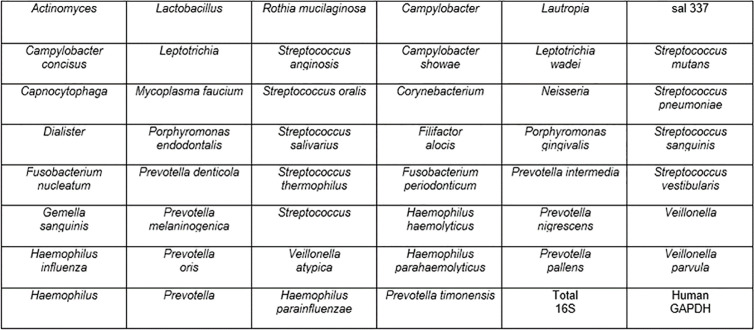
A total of 74 patients were included in this prospective study, including 34 patients with Barrett's esophagus and 40 patients without Barrett's esophagus. Esophageal swabs were obtained from the uvula, and mucosal biopsies were obtained from the proximal esophagus and distal esophagus in each patient. The microbiome of each sample was assessed using a customized Esophageal Microbiome qPCR array (EMB). For each clinical sample, we completed a detection/non-detection analysis for each organism in the EMB. The limit of detection (LOD) for each target was established by analysis of plasmid dilutions.
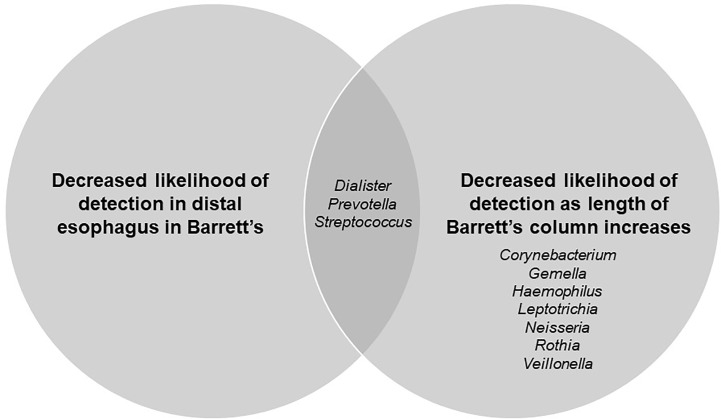
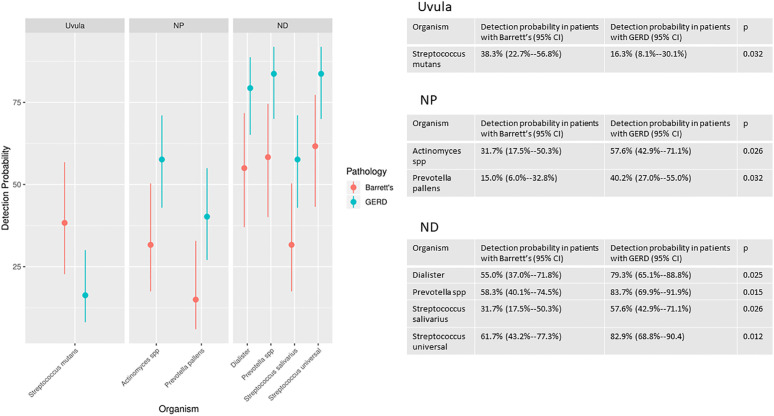
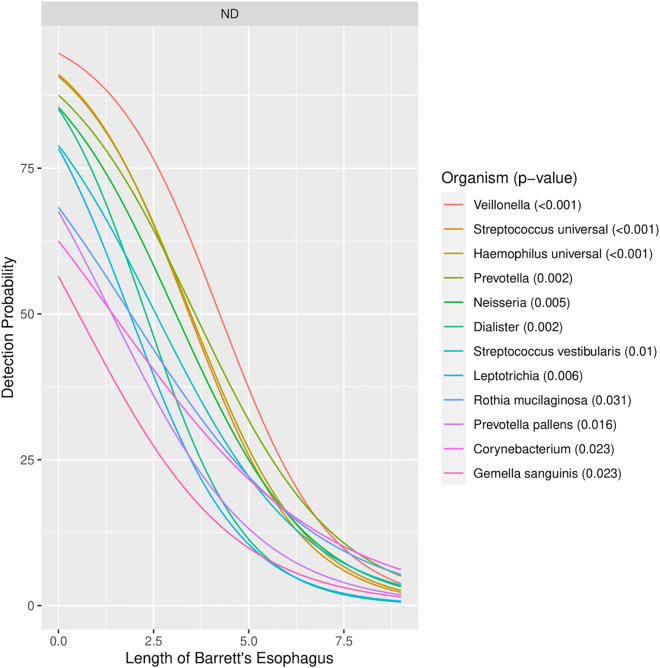
Average age was 60.2 years. There were significantly different microbial detection patterns in patients with Barrett's esophagus compared to the control population. There were a greater number of organisms which had different likelihoods of detection in the distal esophagus, compared to the proximal esophagus or uvula. In addition, as the length of the Barrett's column increased, multiple organisms were less likely to be detected. This decreased likelihood occurred only in the distal esophagus. Beside Barrett's esophagus, no other demographic factors were associated with differences in detection patterns.
Microbial community structures differ between patients with and without Barrett's esophagus. Certain organisms are less likely to be detected as the severity of Barrett's esophagus worsens. These results suggest that particular organisms may have a protective effect against the development of Barrett's esophagus.
微生物组与不同的疾病过程越来越相关,但它在食管中的作用在很大程度上尚不清楚。我们的目标是确定食管微生物群与 Barrett 食管的关联。
这项前瞻性研究共纳入 74 名患者,包括 34 名 Barrett 食管患者和 40 名非 Barrett 食管患者。从悬雍垂获取食管拭子,并从每位患者的食管近端和远端获取黏膜活检。使用定制的食管微生物组 qPCR 阵列 (EMB) 评估每个样本的微生物组。对于每个临床样本,我们对 EMB 中的每个生物体进行了检测/未检测分析。通过质粒稀释分析确定了每个靶标的检测限 (LOD)。
平均年龄为 60.2 岁。与对照组相比, Barrett 食管患者的微生物检测模式存在显著差异。与近端食管或悬雍垂相比,远端食管中具有不同检测可能性的生物体数量更多。此外,随着 Barrett 食管柱的长度增加,多个生物体不太可能被检测到。这种可能性的降低仅发生在远端食管。除了 Barrett 食管,没有其他人口统计学因素与检测模式的差异相关。
患有和不患有 Barrett 食管的患者之间的微生物群落结构不同。随着 Barrett 食管严重程度的恶化,某些生物体不太可能被检测到。这些结果表明,某些生物体可能对 Barrett 食管的发展具有保护作用。