Singh Rahul, Pandey Nityanand, Singh Ramit Chandra
Department of Neurosurgery, Institute of Medical Sciences, Banaras Hindu University, Varanasi, Uttar Pradesh, India.
Asian J Neurosurg. 2020 Dec 21;15(4):882-888. doi: 10.4103/ajns.AJNS_309_20. eCollection 2020 Oct-Dec.
Traumatic cerebellar hematomas are rare in comparison to nontraumatic cerebellar hematomas.
The aim of this study is to evaluate the prognostic factors and outcome determining factors with regard to conservatively managed isolated traumatic cerebellar hematoma.
Retrospective cohort study.
A retrospective study of 23 patients of conservatively managed isolated posterior fossa hematoma, admitted between August 2018 and May 2020, was conducted in the Department of Neurosurgery, Institute of Medical Sciences, Banaras Hindu University, Varanasi. Each of the patients was evaluated in terms of age, sex, mode of injury, clinical presentation, comorbidity, the severity of injury, best motor response, Glasgow Coma Scale (GCS) at admission, computed tomography findings, and Glasgow Outcome Scale at discharge/death.
Chi-square test and unpaired -test were used. < 0.05 was deemed statistically significant.
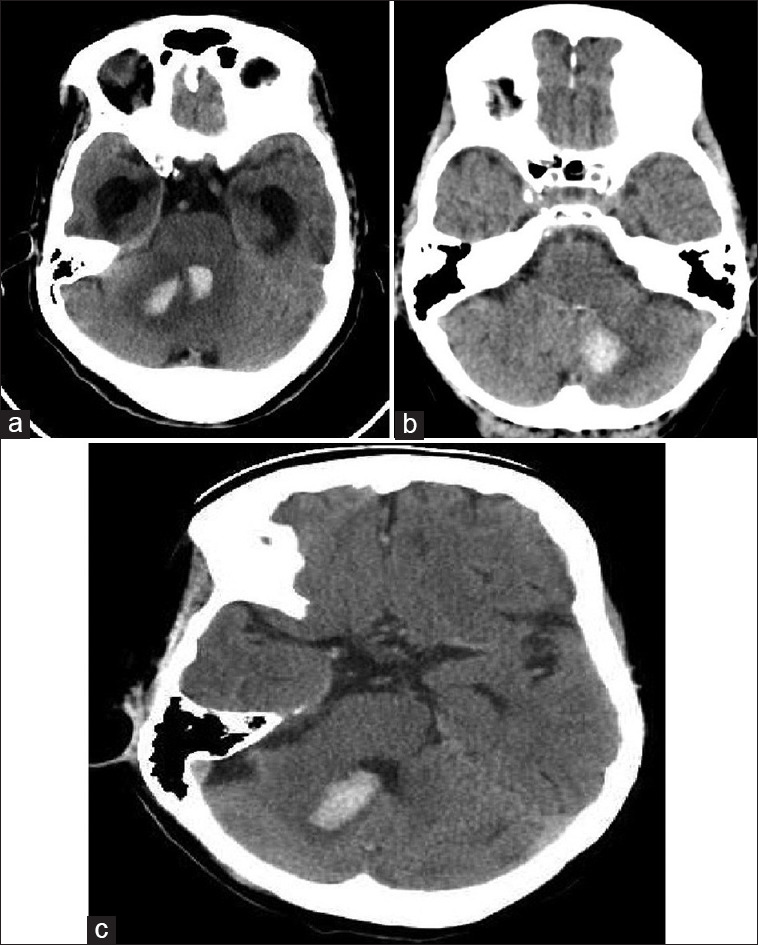
Mean volume of posterior fossa contusion was 8.9 ml. The cerebellar hemispheric (60.9%) location of hematoma was more common. Age at presentation ( = 0.0086), best motor response ( < 0.0001), severity of injury ( = 0.0002), GCS at admission ( < 0.0001), effacement of basal cistern ( < 0.0001), fourth ventricular compression and intraventricular hemorrhage ( = 0.0008), presence of hydrocephalus ( = 0.0142), subarachnoid hemorrhage ( = 0.0008), and volume of posterior fossa contusion ( = 0.0002) were significantly associated with outcome of posterior fossa contusion.
Traumatic cerebellar hematoma is rare. Conservatively managed cerebellar hematoma patients must be monitored closely for neurological and radiological status. Patients who show deterioration in neurological or radiological status require surgical intervention.
与非创伤性小脑血肿相比,创伤性小脑血肿较为罕见。
本研究旨在评估保守治疗的孤立性创伤性小脑血肿的预后因素和结局决定因素。
回顾性队列研究。
对2018年8月至2020年5月间在瓦拉纳西贝拿勒斯印度教大学医学科学研究所神经外科收治的23例接受保守治疗的孤立性后颅窝血肿患者进行了回顾性研究。对每位患者进行了年龄、性别、损伤方式、临床表现、合并症、损伤严重程度、最佳运动反应、入院时格拉斯哥昏迷量表(GCS)、计算机断层扫描结果以及出院/死亡时格拉斯哥预后量表等方面的评估。
采用卡方检验和非配对t检验。P<0.05被认为具有统计学意义。
后颅窝挫伤的平均体积为8.9毫升。血肿位于小脑半球(60.9%)的情况更为常见。就诊时年龄(P = 0.0086)、最佳运动反应(P<0.0001)、损伤严重程度(P = 0.0002)、入院时GCS(P<0.0001)、基底池受压(P<0.0001)、第四脑室受压和脑室内出血(P = 0.0008)、脑积水的存在(P = 0.0142)、蛛网膜下腔出血(P = 0.0008)以及后颅窝挫伤体积(P = 0.0002)与后颅窝挫伤的结局显著相关。
创伤性小脑血肿较为罕见。对于接受保守治疗的小脑血肿患者,必须密切监测其神经和影像学状况。神经或影像学状况出现恶化的患者需要进行手术干预。