Alizadeh Ahad, Omani-Samani Reza, Mansournia Mohammad Ali, Akbari Sene Azadeh, Rahimi Foroushani Abbas
Department of Epidemiology and Biostatistics, School of Public Health, Tehran University of Medical Sciences, Tehran, Iran.
Department of Medical Ethics and Law, Reproductive Biomedicine Research Center, Royan Institute for Reproductive Biomedicine, ACECR, Tehran, Iran.
Iran J Public Health. 2020 Nov;49(11):2161-2169. doi: 10.18502/ijph.v49i11.4734.
Body Mass Index (BMI) and maternal age are related to various disorders of the female reproductive system. This study aimed to estimate the causal effects of BMI and maternal age on the rate of meta-phase II oocytes (MII) using a new statistical method based on Bayesian LASSO and model averaging.
This investigation was a historical cohort study and data were collected from women who underwent assisted reproductive treatments in Tehran, Iran during 2015 to 2018. Exclusion criteria were gestational surrogacy and donor oocyte. We used a new method based on Bayesian LASSO and model average to capture important confounders.
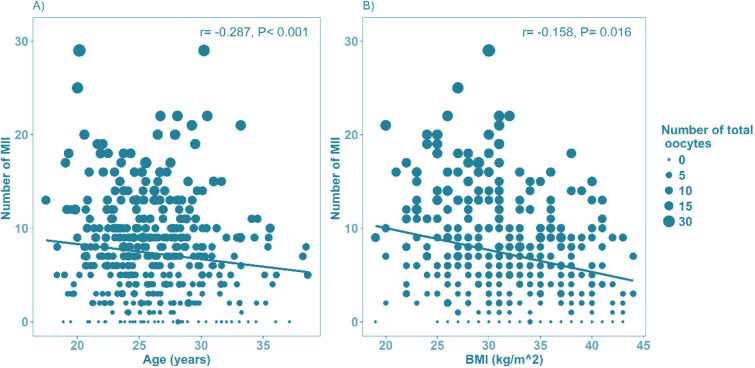
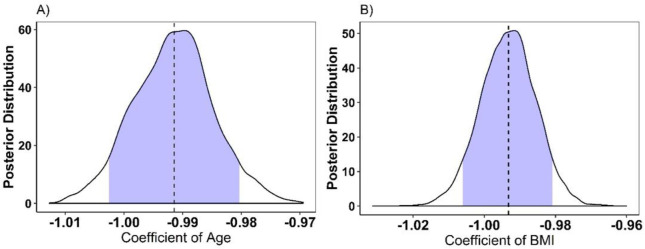
Overall, 536 cycles of 398 women were evaluated. BMI and Age had inverse relationships with the number of MII based on univariate analysis, but after adjusting the effects of other variables, there was just a significant association between age and the number of MII (adjusted incidence rate ratio (aIRR) of age =0.989, 95% CI: [0.979, 0.998], =0.02). The results of causal inference based on the new presented method showed that the overall effects of age and BMI of all patients were significantly and inversely associated with the number of MII (both <0.001). Therefore the expected number of MII decreased by 0.99 for an increase of 1 year (95% CI: [-1.00, -0.97]) and decreased by 0.99 for each 1-unit increase in BMI (95% CI: [-1.01, -0.98]).
Maternal age and BMI have significant adverse casual effects on the rate of MII in patients undergoing ART when the effects of important confounders were adjusted.
体重指数(BMI)和母亲年龄与女性生殖系统的各种疾病相关。本研究旨在使用基于贝叶斯套索和模型平均的新统计方法,估计BMI和母亲年龄对减数分裂II期卵母细胞(MII)率的因果效应。
本调查为历史性队列研究,数据收集自2015年至2018年在伊朗德黑兰接受辅助生殖治疗的女性。排除标准为代孕和供体卵母细胞。我们使用基于贝叶斯套索和模型平均的新方法来捕捉重要的混杂因素。
总体而言,对398名女性的536个周期进行了评估。基于单变量分析,BMI和年龄与MII数量呈负相关,但在调整其他变量的影响后,年龄与MII数量之间仅存在显著关联(年龄的调整发病率比(aIRR)=0.989,95%CI:[0.979,0.998],P=0.02)。基于新提出方法的因果推断结果表明,所有患者年龄和BMI的总体效应均与MII数量显著负相关(均P<0.001)。因此,年龄每增加1岁,MII的预期数量减少0.99(95%CI:[-1.00,-0.97]),BMI每增加1个单位,MII的预期数量减少0.99(95%CI:[-1.01,-0.98])。
在调整重要混杂因素的影响后,母亲年龄和BMI对接受辅助生殖技术治疗的患者的MII率有显著的不良因果效应。