Jeon Dongsub, Son Minkook, Choi Jonggi
Department of Gastroenterology, Liver Center, Asan Medical Center, University of Ulsan College of Medicine, Seoul, South Korea.
Department of Biomedical Science and Engineering, Gwangju Institute of Science and Technology, Gwangju, South Korea.
Front Med (Lausanne). 2021 Feb 23;8:629176. doi: 10.3389/fmed.2021.629176. eCollection 2021.
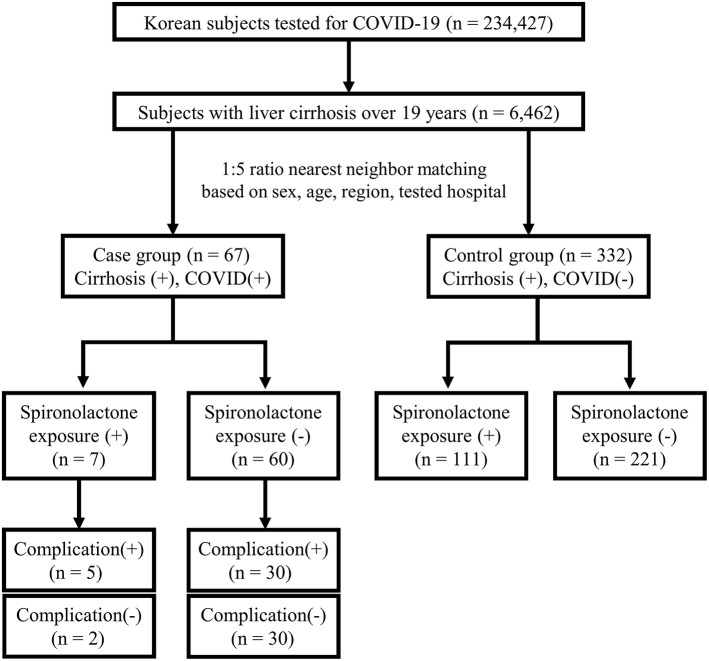
On the basis that spironolactone is involved in ACE2 expression and TMPRSS2 activity, previous studies have suggested that spironolactone may influence the infectivity of COVID-19. Research has suggested that cell entry of SARS-CoV-2, the virus that induces COVID-19, is associated with the ACE2 receptor and TMPRSS2. The purpose of this study was to investigate whether spironolactone has a protective effect against COVID-19 and the development of associated complications in patients with liver cirrhosis. We conducted a nationwide case-control study on liver cirrhosis patients with or without COVID-19 from the population-based data acquired from the National Health Insurance Systems of Republic of Korea. After 1:5 case-control matching, multivariable adjusted conditional logistic regression analysis was performed. Among the patients with liver cirrhosis, the case group with COVID-19 was found to be significantly less exposed to spironolactone compared with the control group without COVID-19. The adjusted odds ratio (OR) and 95% confidence interval (CI) between the two groups was 0.20 (0.07-0.54). In addition, regardless of cumulative dose of spironolactone, exposure to spironolactone was associated with lower COVID-19 infection. In terms of the development of complications due to COVID-19, spironolactone did not show any significant association between the patients with and without complications ( = 0.43). The adjusted OR and 95% CI between the two groups was 1.714 (0.246-11.938). We conclude that spironolactone may reduce susceptibility to COVID-19 but does not affect the development of its associated complications; however, further studies are needed to confirm the exact association between spironolactone and COVID-19 infection.
基于螺内酯与血管紧张素转换酶2(ACE2)表达及跨膜丝氨酸蛋白酶2(TMPRSS2)活性有关,先前的研究表明螺内酯可能会影响新型冠状病毒肺炎(COVID-19)的传染性。研究表明,引发COVID-19的病毒严重急性呼吸综合征冠状病毒2(SARS-CoV-2)进入细胞与ACE2受体和TMPRSS2有关。本研究的目的是调查螺内酯对肝硬化患者的COVID-19是否具有保护作用以及相关并发症的发生情况。我们利用从大韩民国国民健康保险系统获取的基于人群的数据,对患有或未患有COVID-19的肝硬化患者进行了一项全国性病例对照研究。在进行1:5病例对照匹配后,进行了多变量调整条件逻辑回归分析。在肝硬化患者中,发现患有COVID-19的病例组与未患有COVID-19的对照组相比,使用螺内酯的情况明显更少。两组之间的调整比值比(OR)和95%置信区间(CI)为0.20(0.07 - 0.54)。此外,无论螺内酯的累积剂量如何,使用螺内酯都与较低的COVID-19感染率相关。就COVID-19所致并发症的发生情况而言,螺内酯在有并发症和无并发症的患者之间未显示出任何显著关联(P = 0.43)。两组之间的调整OR和95% CI为1.714(0.246 - 11.938)。我们得出结论,螺内酯可能会降低对COVID-19的易感性,但不影响其相关并发症的发生;然而,需要进一步研究来证实螺内酯与COVID-19感染之间的确切关联。