• 文献检索
  • 文档翻译
  • 深度研究
  • 学术资讯
  • Suppr Zotero 插件Zotero 插件
  • 邀请有礼
  • 套餐&价格
  • 历史记录
应用&插件
Suppr Zotero 插件Zotero 插件浏览器插件Mac 客户端Windows 客户端微信小程序
定价
高级版会员购买积分包购买API积分包
服务
文献检索文档翻译深度研究API 文档MCP 服务
关于我们
关于 Suppr公司介绍联系我们用户协议隐私条款
关注我们

Suppr 超能文献

核心技术专利:CN118964589B侵权必究
粤ICP备2023148730 号-1Suppr @ 2026

文献检索

告别复杂PubMed语法,用中文像聊天一样搜索,搜遍4000万医学文献。AI智能推荐,让科研检索更轻松。

立即免费搜索

文件翻译

保留排版,准确专业,支持PDF/Word/PPT等文件格式,支持 12+语言互译。

免费翻译文档

深度研究

AI帮你快速写综述,25分钟生成高质量综述,智能提取关键信息,辅助科研写作。

立即免费体验

评估韩国因时间接触增加而引发的 COVID-19 疫情爆发。

Evaluation of COVID-19 epidemic outbreak caused by temporal contact-increase in South Korea.

机构信息

Department of Mathematics, Pusan National University, 2, Busandaehak-ro 63beon-gil, 46241, Busan, Republic of Korea; Finance∙Fishery∙Manufacture Industrial Mathematics Center on Big Data, Pusan National University, 2, Busandaehak-ro 63beon-gil, 46241, Busan, Republic of Korea.

Department of Mathematics, Pusan National University, 2, Busandaehak-ro 63beon-gil, 46241, Busan, Republic of Korea.

出版信息

Int J Infect Dis. 2020 Jul;96:454-457. doi: 10.1016/j.ijid.2020.05.036. Epub 2020 May 14.

DOI:10.1016/j.ijid.2020.05.036
PMID:32417246
原文链接:https://pmc.ncbi.nlm.nih.gov/articles/PMC7224674/
Abstract

OBJECTIVES

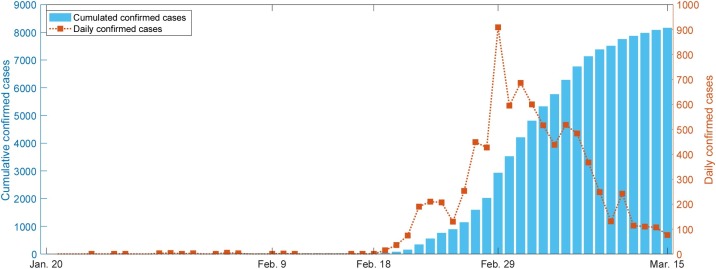
On March 15, 2020, 61.3% of the confirmed cases of COVID-19 infection in South Korea are associated with the worship service that was organized on February 9 in the Shincheonji Church of Jesus in Daegu. We aim to evaluate the effects of mass infection in South Korea and assess the preventive control intervention.

METHOD

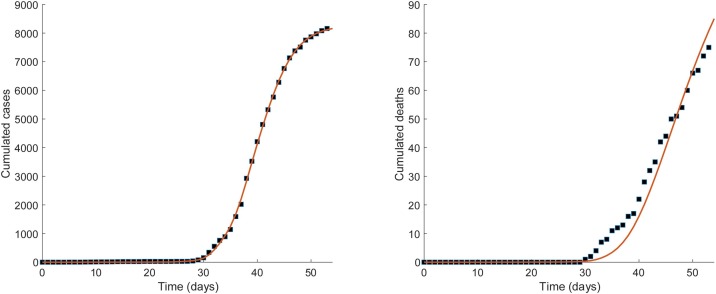
Using openly available data of daily cumulative confirmed cases and deaths, the basic and effective reproduction numbers was estimated using a modified susceptible-exposed-infected-recovered-type epidemic model.

RESULTS

The basic reproduction number was estimated to be  R=1.77. The effective reproduction number increased approximately 20 times after the mass infections from the 31 st patient, which was confirmed on February 9 in the Shincheonji Church of Jesus, Daegu. However, the effective reproduction number decreased to less than unity after February 28 owing to the implementation of high-level preventive control interventions in South Korea, coupled with voluntary prevention actions by citizens.

CONCLUSION

Preventive action and control intervention were successfully established in South Korea.

摘要

目的

2020 年 3 月 15 日,韩国 61.3%的 COVID-19 感染确诊病例与 2 月 9 日在大邱新天地耶稣教见证帐幕圣殿组织的礼拜活动有关。本研究旨在评估韩国大规模感染的影响,并评估预防控制干预措施的效果。

方法

使用公开的每日累计确诊病例和死亡病例数据,使用修正的易感-暴露-感染-恢复型传染病模型估计基本繁殖数和有效繁殖数。

结果

基本繁殖数估计为 R=1.77。2 月 9 日,在大邱新天地耶稣教见证帐幕圣殿,第 31 例确诊病例发生大规模感染后,有效繁殖数增加了约 20 倍。然而,由于韩国实施了高水平的预防控制干预措施,加上公民的自愿预防行动,自 2 月 28 日以来,有效繁殖数已降至 1 以下。

结论

韩国成功建立了预防行动和控制干预措施。

https://cdn.ncbi.nlm.nih.gov/pmc/blobs/f4e4/7224674/8fded662b937/gr2_lrg.jpg
https://cdn.ncbi.nlm.nih.gov/pmc/blobs/f4e4/7224674/90c0ef1189d0/gr1_lrg.jpg
https://cdn.ncbi.nlm.nih.gov/pmc/blobs/f4e4/7224674/8fded662b937/gr2_lrg.jpg
https://cdn.ncbi.nlm.nih.gov/pmc/blobs/f4e4/7224674/90c0ef1189d0/gr1_lrg.jpg
https://cdn.ncbi.nlm.nih.gov/pmc/blobs/f4e4/7224674/8fded662b937/gr2_lrg.jpg

相似文献

1
Evaluation of COVID-19 epidemic outbreak caused by temporal contact-increase in South Korea.评估韩国因时间接触增加而引发的 COVID-19 疫情爆发。
Int J Infect Dis. 2020 Jul;96:454-457. doi: 10.1016/j.ijid.2020.05.036. Epub 2020 May 14.
2
Estimating the reproductive number and the outbreak size of COVID-19 in Korea.估算韩国 COVID-19 的繁殖数和疫情规模。
Epidemiol Health. 2020;42:e2020011. doi: 10.4178/epih.e2020011. Epub 2020 Mar 12.
3
Phase-adjusted estimation of the COVID-19 outbreak in South Korea under multi-source data and adjustment measures: a modelling study.多源数据和调整措施下韩国 COVID-19 疫情的分相估计:建模研究。
Math Biosci Eng. 2020 May 18;17(4):3637-3648. doi: 10.3934/mbe.2020205.
4
Characteristics of the COVID-19 Outbreak in Korea From the Mass Infection Perspective.从大规模感染角度看韩国新冠疫情的特征
J Prev Med Public Health. 2020 May;53(3):168-170. doi: 10.3961/jpmph.20.072. Epub 2020 Mar 19.
5
Preliminary estimates of the reproduction number of the coronavirus disease (COVID-19) outbreak in Republic of Korea and Italy by 5 March 2020.截至 2020 年 3 月 5 日对韩国和意大利冠状病毒病(COVID-19)疫情的基本繁殖数的估计。
Int J Infect Dis. 2020 Jun;95:308-310. doi: 10.1016/j.ijid.2020.04.044. Epub 2020 Apr 22.
6
Response to COVID-19 in South Korea and implications for lifting stringent interventions.韩国对 COVID-19 的应对措施及放宽严格干预措施的影响。
BMC Med. 2020 Oct 9;18(1):321. doi: 10.1186/s12916-020-01791-8.
7
COVID-19 in South Korea: epidemiological and spatiotemporal patterns of the spread and the role of aggressive diagnostic tests in the early phase.韩国的 COVID-19 疫情:传播的流行病学和时空模式,以及在早期阶段积极诊断检测的作用。
Int J Epidemiol. 2020 Aug 1;49(4):1106-1116. doi: 10.1093/ije/dyaa119.
8
Individual-based simulation model for COVID-19 transmission in Daegu, Korea.基于个体的韩国大邱 COVID-19 传播模拟模型。
Epidemiol Health. 2020;42:e2020042. doi: 10.4178/epih.e2020042. Epub 2020 Jun 15.
9
COVID-19 in South Korea.韩国的 COVID-19 疫情。
Postgrad Med J. 2020 Jul;96(1137):399-402. doi: 10.1136/postgradmedj-2020-137738. Epub 2020 May 4.
10
Epidemic curve and reproduction number of COVID-19 in Iran.伊朗新冠肺炎疫情曲线及再生数
J Travel Med. 2020 Aug 20;27(5). doi: 10.1093/jtm/taaa077.

引用本文的文献

1
Mathematical modeling of contact tracing and stability analysis to inform its impact on disease outbreaks; an application to COVID-19.接触者追踪的数学建模及其对疾病爆发影响的稳定性分析;以COVID-19为例的应用
Infect Dis Model. 2024 Feb 2;9(2):329-353. doi: 10.1016/j.idm.2024.01.010. eCollection 2024 Jun.
2
A Novel and Accurate Method for Estimating Deaths and Cases During Outbreaks of Infectious Diseases Including COVID-19.一种用于估计包括COVID-19在内的传染病暴发期间死亡人数和病例数的新颖且准确的方法。
Int J Gen Med. 2023 Oct 18;16:4705-4718. doi: 10.2147/IJGM.S435975. eCollection 2023.
3
Unequal burdens of COVID-19 infection: a nationwide cohort study of COVID-19-related health inequalities in Korea.

本文引用的文献

1
Coronavirus Disease-19: The First 7,755 Cases in the Republic of Korea.新型冠状病毒肺炎:韩国首批7755例病例
Osong Public Health Res Perspect. 2020 Apr;11(2):85-90. doi: 10.24171/j.phrp.2020.11.2.05.
2
Transmission potential and severity of COVID-19 in South Korea.韩国 COVID-19 的传播潜力和严重程度。
Int J Infect Dis. 2020 Apr;93:339-344. doi: 10.1016/j.ijid.2020.03.031. Epub 2020 Mar 18.
3
The Incubation Period of Coronavirus Disease 2019 (COVID-19) From Publicly Reported Confirmed Cases: Estimation and Application.
COVID-19 感染的不平等负担:韩国 COVID-19 相关健康不平等的全国队列研究。
Epidemiol Health. 2023;45:e2023068. doi: 10.4178/epih.e2023068. Epub 2023 Jul 31.
4
An exploration of the political, social, economic and cultural factors affecting how different global regions initially reacted to the COVID-19 pandemic.对影响全球不同地区最初应对新冠疫情方式的政治、社会、经济和文化因素的探究。
Interface Focus. 2022 Feb 11;12(2):20210079. doi: 10.1098/rsfs.2021.0079. eCollection 2022 Apr 6.
5
Comparative study of a mathematical epidemic model, statistical modeling, and deep learning for COVID-19 forecasting and management.用于 COVID-19 预测与管理的数学流行病模型、统计建模和深度学习的比较研究。
Socioecon Plann Sci. 2022 Mar;80:101249. doi: 10.1016/j.seps.2022.101249. Epub 2022 Jan 29.
6
Discovering spatiotemporal patterns of COVID-19 pandemic in South Korea.揭示韩国 COVID-19 大流行的时空模式。
Sci Rep. 2021 Dec 28;11(1):24470. doi: 10.1038/s41598-021-03487-2.
7
Spatiotemporal droplet dispersion measurements demonstrate face masks reduce risks from singing.时空液滴分散测量表明,口罩可降低唱歌带来的风险。
Sci Rep. 2021 Dec 17;11(1):24183. doi: 10.1038/s41598-021-03519-x.
8
Superspreading in the emergence of COVID-19 variants.新冠病毒变异株的超级传播。
Trends Genet. 2021 Dec;37(12):1069-1080. doi: 10.1016/j.tig.2021.09.003. Epub 2021 Sep 8.
9
Effect of Non-lockdown Social Distancing and Testing-Contact Tracing During a COVID-19 Outbreak in Daegu, South Korea, February to April 2020: A Modeling Study.2020 年 2 月至 4 月韩国大邱市新冠肺炎疫情期间非封锁社交距离和检测接触者追踪的效果:一项建模研究。
Int J Infect Dis. 2021 Sep;110:213-221. doi: 10.1016/j.ijid.2021.07.058. Epub 2021 Jul 29.
10
Investigation of the Efficiency of Mask Wearing, Contact Tracing, and Case Isolation during the COVID-19 Outbreak.新冠疫情期间口罩佩戴、接触者追踪及病例隔离的效率调查
J Clin Med. 2021 Jun 23;10(13):2761. doi: 10.3390/jcm10132761.
新型冠状病毒肺炎(COVID-19)的潜伏期来自公开报告的确诊病例:估计和应用。
Ann Intern Med. 2020 May 5;172(9):577-582. doi: 10.7326/M20-0504. Epub 2020 Mar 10.
4
Preliminary estimation of the basic reproduction number of novel coronavirus (2019-nCoV) in China, from 2019 to 2020: A data-driven analysis in the early phase of the outbreak.2019 年至 2020 年中国新型冠状病毒(2019-nCoV)基本繁殖数的初步估计:疫情早期的基于数据的分析。
Int J Infect Dis. 2020 Mar;92:214-217. doi: 10.1016/j.ijid.2020.01.050. Epub 2020 Jan 30.
5
Epidemiological and clinical characteristics of 99 cases of 2019 novel coronavirus pneumonia in Wuhan, China: a descriptive study.中国武汉 99 例 2019 年新型冠状病毒肺炎患者的流行病学和临床特征:描述性研究。
Lancet. 2020 Feb 15;395(10223):507-513. doi: 10.1016/S0140-6736(20)30211-7. Epub 2020 Jan 30.
6
A mathematical model for assessing the effectiveness of controlling relapse in Plasmodium vivax malaria endemic in the Republic of Korea.评估韩国流行的间日疟原虫复发控制效果的数学模型。
PLoS One. 2020 Jan 24;15(1):e0227919. doi: 10.1371/journal.pone.0227919. eCollection 2020.
7
Estimating the Reproduction Number of Ebola Virus (EBOV) During the 2014 Outbreak in West Africa.估算2014年西非埃博拉病毒(EBOV)疫情期间的繁殖数
PLoS Curr. 2014 Sep 2;6:ecurrents.outbreaks.91afb5e0f279e7f29e7056095255b288. doi: 10.1371/currents.outbreaks.91afb5e0f279e7f29e7056095255b288.