Pu Ning, Habib Joseph R, Bejjani Michael, Yin Hanlin, Nagai Minako, Chen Jianan, Kinny-Köster Benedict, Chen Qiangda, Zhang Jicheng, Yu Jun, Wu Wenchuan, Lou Wenhui
Department of General Surgery, Zhongshan Hospital, Fudan University, Shanghai, China.
Department of Surgery, The Sol Goldman Pancreatic Cancer Research Center, The Johns Hopkins University School of Medicine, Baltimore, MD, USA.
Ann Transl Med. 2021 Feb;9(4):329. doi: 10.21037/atm-20-5348.
The incidence of indolent gastroenteropancreatic neuroendocrine neoplasms (GEP-NENs) has increased dramatically. GEP-NENs often present late with concomitant liver metastasis, which is associated with poorer outcomes.
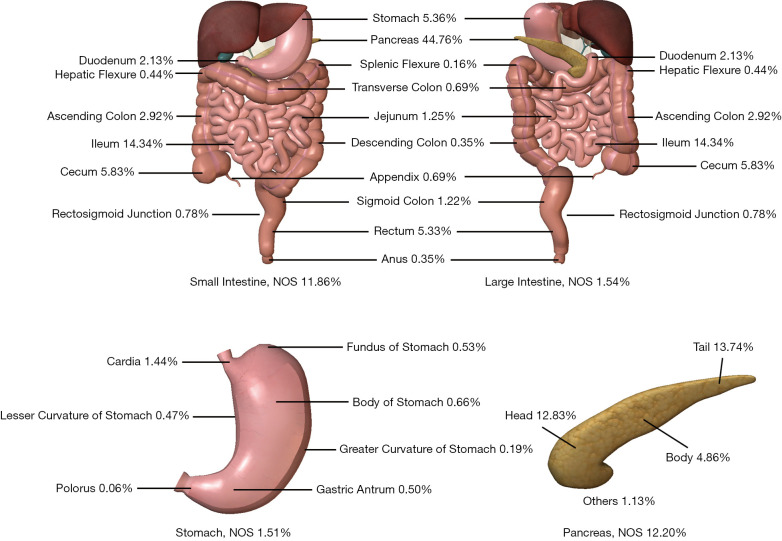
This is a retrospective cohort study of 3,188 patients with liver metastatic GEP-NENs from the national scale Surveillance, Epidemiology, and End Results (SEER) database in the USA between 2010 and 2016. The population-based sample of GEP-NENs with liver metastasis was stratified by primary site (intestinal, pancreatic or gastric), surgical intervention and functional status.
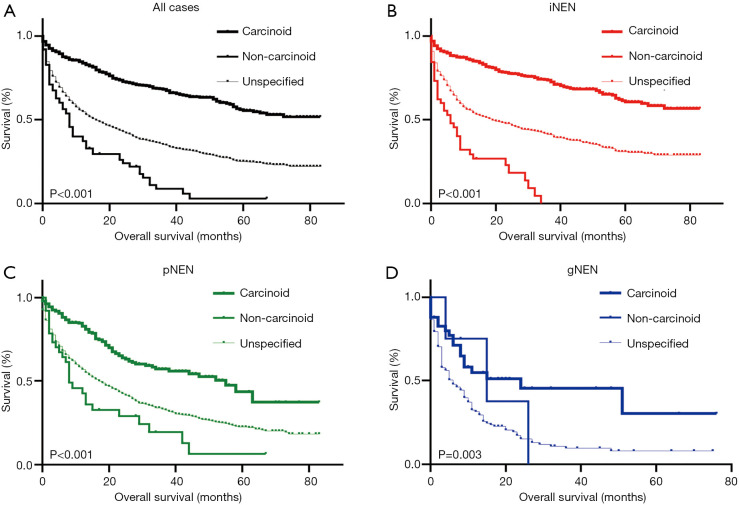
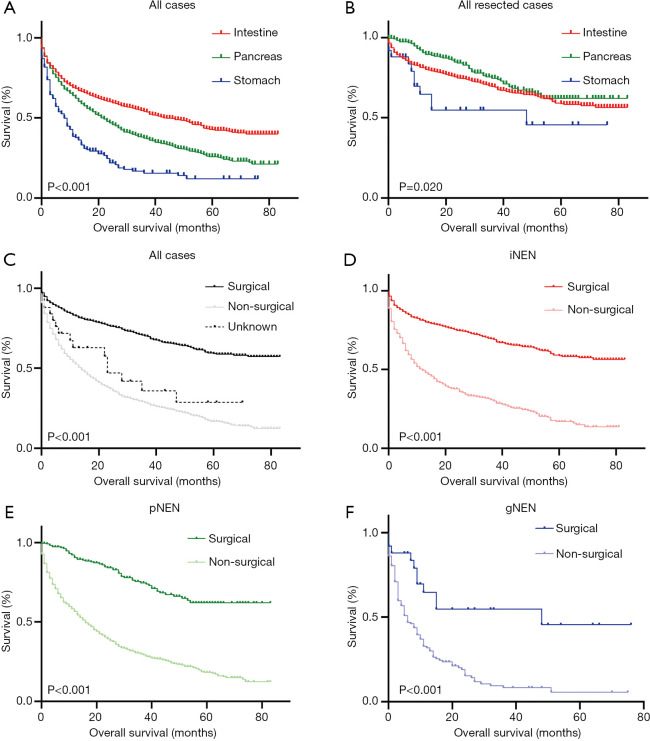
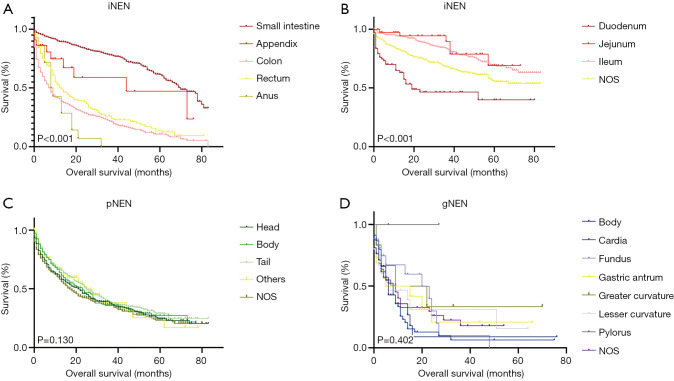
Of the 3,188 patients with liver metastatic GEP-NENs in this study, intestinal NENs (iNENs) were the most common and displayed the best 5-year survival of 42.6% compared to 25.8% in pancreatic NENs (pNENs) and 12.0% in gastric NENs (gNENs). Surgical intervention [hazard ratio (HR): 0.46, 95% CI: (0.40-0.53), P<0.001] and carcinoid subtype showed robust survival advantages across all groups. pNENs with liver metastasis were associated with the greatest benefit of surgery [HR: 0.55, 95% CI: (0.41-0.75), P<0.001] while iNENs were the most commonly treated by surgery. After risk adjustment, primary site was not associated with outcome in the non-surgical group.
Taken collectively, when diagnosed with liver metastasis, iNENs conferred a better overall prognosis than both pNENs and gNENs. Primary surgical resection, especially of carcinoid type tumors, emerged as a robust prognostic indicator of better outcomes irrespective of primary site. This finding was most pronounced in liver metastatic pNENs. When possible, we recommend surgical intervention in GEP-NENs with liver metastasis.
惰性胃肠胰神经内分泌肿瘤(GEP-NENs)的发病率急剧上升。GEP-NENs通常出现较晚并伴有肝转移,这与较差的预后相关。
这是一项回顾性队列研究,研究对象为2010年至2016年期间来自美国国家规模的监测、流行病学和最终结果(SEER)数据库的3188例肝转移GEP-NENs患者。以人群为基础的肝转移GEP-NENs样本按原发部位(肠道、胰腺或胃)、手术干预和功能状态进行分层。
在本研究的3188例肝转移GEP-NENs患者中,肠道神经内分泌肿瘤(iNENs)最为常见,5年生存率最佳,为42.6%,而胰腺神经内分泌肿瘤(pNENs)为25.8%,胃神经内分泌肿瘤(gNENs)为12.0%。手术干预[风险比(HR):0.46,95%置信区间:(0.40-0.53),P<0.001]和类癌亚型在所有组中均显示出强大的生存优势。肝转移的pNENs手术获益最大[HR:0.55,95%置信区间:(0.41-0.75),P<0.001],而iNENs是最常接受手术治疗的。风险调整后,非手术组的原发部位与预后无关。
总体而言,当诊断为肝转移时,iNENs的总体预后优于pNENs和gNENs。原发性手术切除,尤其是类癌型肿瘤的手术切除,无论原发部位如何,都是预后较好的有力预后指标。这一发现在肝转移pNENs中最为明显。如果可能,我们建议对肝转移的GEP-NENs进行手术干预。