Zhao Hongwei, Meng Yiting, Zhang Peng, Zhang Qian, Wang Feng, Li Yuanxin
Department of Gastrointestinal Surgery, Beijing Tsinghua Changgung Hospital, School of Clinical Medicine, Tsinghua University, Beijing, China.
Ann Transl Med. 2021 Feb;9(4):337. doi: 10.21037/atm-20-8154.
Mesenteric ischemia results in blood flow that is insufficient to meet metabolic demands and subsequent dysfunction of visceral organs, including arterial obstruction and venous thrombosis. Sustained mesenteric ischemia exhausts the ability of capillaries to provide oxygen and initiate an inflammatory reaction, and eventually leads to intestinal mucosal necrosis, a serious and potentially life-threatening condition. Therefore, it is essential that the predictors and risk factors for intestinal necrosis in patients with mesenteric thrombus are explored.
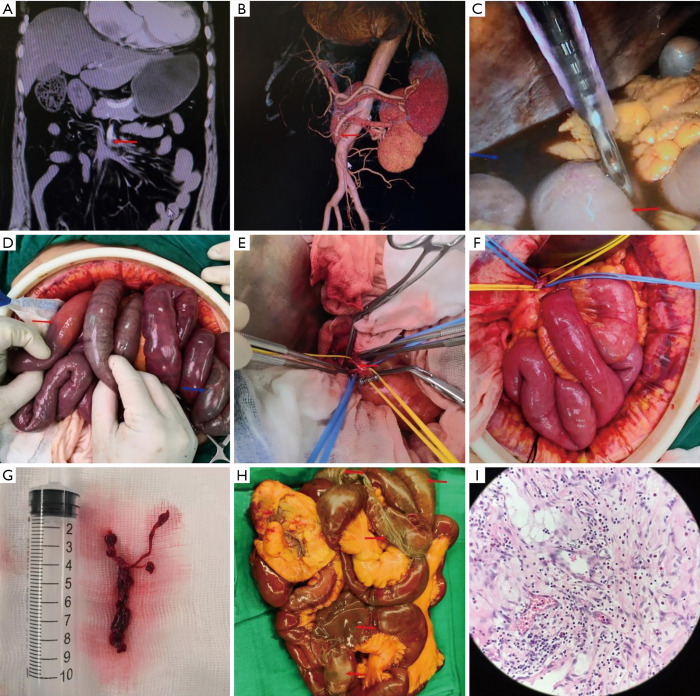
This study retrospectively enrolled 41 patients with mesenteric ischemia (including mesenteric vein embolism, mesenteric artery thrombosis, and portal vein thrombosis) who were admitted to the Department of Gastrointestinal Surgery, Beijing Tsinghua Changgung Hospital between May 2016 and October 2019; of the patients, 18 were further diagnosed with intestinal necrosis. Comparisons of symptoms, computed tomography angiography (CTA) features, and laboratory examination results were performed between mesenteric ischemia patients with and without intestinal necrosis.
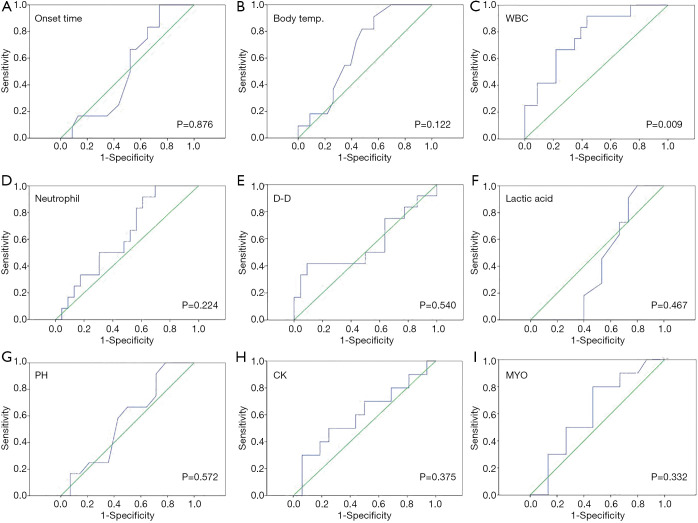
White blood cell count showed an excellent predictive ability for intestinal necrosis in patients with mesenteric ischemia, with an area under the receiver operating characteristic (ROC) curve of 0.772 (P=0.009). The four CTA features [pneumatosis (P=0.016), intestinal swelling (P=0.006), ascitic fluid (P<0.001), and decreased intestinal wall enhancement (P=0.004)] differed significantly between patients with and without intestinal necrosis. Peritonitis showed a strong association with intestinal necrosis (P=0.006) in the univariate analysis, and multivariate analysis further showed their association [odds ratio (OR): 8.53; 95%CI: 1.46-49.81; P=0.017].
White blood cell count is a potential predictor of intestinal necrosis. Peritonitis is a possible risk factor for intestinal necrosis in patients with mesenteric ischemia. A multi-center prospective study with a larger sample size needs to be performed to further investigate these findings.
肠系膜缺血导致血流量不足以满足代谢需求,进而引起包括动脉阻塞和静脉血栓形成在内的内脏器官功能障碍。持续性肠系膜缺血会耗尽毛细血管提供氧气的能力并引发炎症反应,最终导致肠黏膜坏死,这是一种严重且可能危及生命的状况。因此,探索肠系膜血栓形成患者肠坏死的预测指标和危险因素至关重要。
本研究回顾性纳入了2016年5月至2019年10月期间在北京清华长庚医院胃肠外科住院的41例肠系膜缺血患者(包括肠系膜静脉栓塞、肠系膜动脉血栓形成和门静脉血栓形成);其中18例患者进一步被诊断为肠坏死。对有和没有肠坏死的肠系膜缺血患者的症状、计算机断层血管造影(CTA)特征和实验室检查结果进行了比较。
白细胞计数对肠系膜缺血患者的肠坏死具有良好的预测能力,受试者工作特征(ROC)曲线下面积为0.772(P = 0.009)。有和没有肠坏死的患者之间的四个CTA特征[积气(P = 0.016)、肠扩张(P = 0.006)、腹水(P < 0.001)和肠壁强化减弱(P = 0.004)]存在显著差异。在单因素分析中,腹膜炎与肠坏死有很强的相关性(P = 0.006),多因素分析进一步显示了它们之间的相关性[比值比(OR):8.53;95%置信区间:1.46 - 49.81;P = 0.017]。
白细胞计数是肠坏死的潜在预测指标。腹膜炎是肠系膜缺血患者肠坏死的可能危险因素。需要进行更大样本量的多中心前瞻性研究以进一步探究这些发现。