Rademakers Rosa, Nicholson Alexandra M, Ren Yingxue, Koga Shunsuke, Nguyen Hung Phuoc, Brooks Mieu, Qiao Wenhui, Quicksall Zachary S, Matchett Billie, Perkerson Ralph B, Kurti Aishe, Castanedes-Casey Monica, Phillips Virginia, Librero Ariston L, Fernandez De Castro Cristhoper H, Baker Matthew C, Roemer Shanu F, Murray Melissa E, Asmann Yan, Fryer John D, Bu Guojun, Dickson Dennis W, Zhou Xiaolai
Department of Neuroscience, Mayo Clinic, Jacksonville, FL, USA.
Applied and Translational Neurogenomics, VIB Center for Molecular Neurology, VIB, Antwerp, Belgium.
Brain Pathol. 2021 May;31(3):e12945. doi: 10.1111/bpa.12945. Epub 2021 Mar 11.
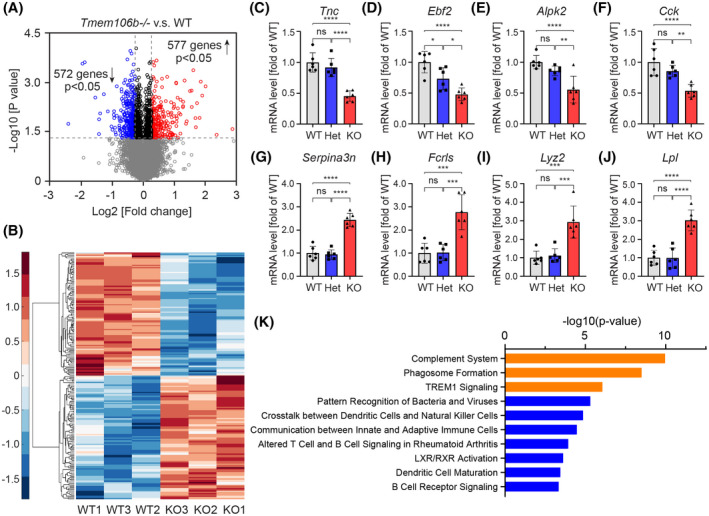
TMEM106B has been recently implicated in multiple neurodegenerative diseases. Here, Rademakers et al. report a late-onset cerebellar Purkinje cell loss and progressive decline in motor function and gait deficits in a conventional Tmem106b-/- mouse model. By using high-power microscopy and bulk RNA sequencing, the authors further identify lysosomal and immune dysfunction as potential underlying mechanisms of the Purkinje cell loss.
TMEM106B最近被认为与多种神经退行性疾病有关。在此,拉德梅克斯等人报告了在传统的Tmem106b基因敲除小鼠模型中出现迟发性小脑浦肯野细胞丢失、运动功能逐渐衰退和步态缺陷。通过使用高倍显微镜和大量RNA测序,作者进一步确定溶酶体和免疫功能障碍是浦肯野细胞丢失的潜在潜在机制。