Chytrosz Paulina, Golda-Cepa Monika, Wlodarczyk Janusz, Kuzdzal Jarosław, El Fray Miroslawa, Kotarba Andrzej
Faculty of Chemistry, Jagiellonian University, 31-007 Kraków, Poland.
Department of Thoracic and Surgical Oncology, Jagiellonian University Medical College, John Paul II Hospital, 30-387 Kraków, Poland.
ACS Biomater Sci Eng. 2021 Apr 12;7(4):1403-1413. doi: 10.1021/acsbiomaterials.0c01773. Epub 2021 Mar 12.
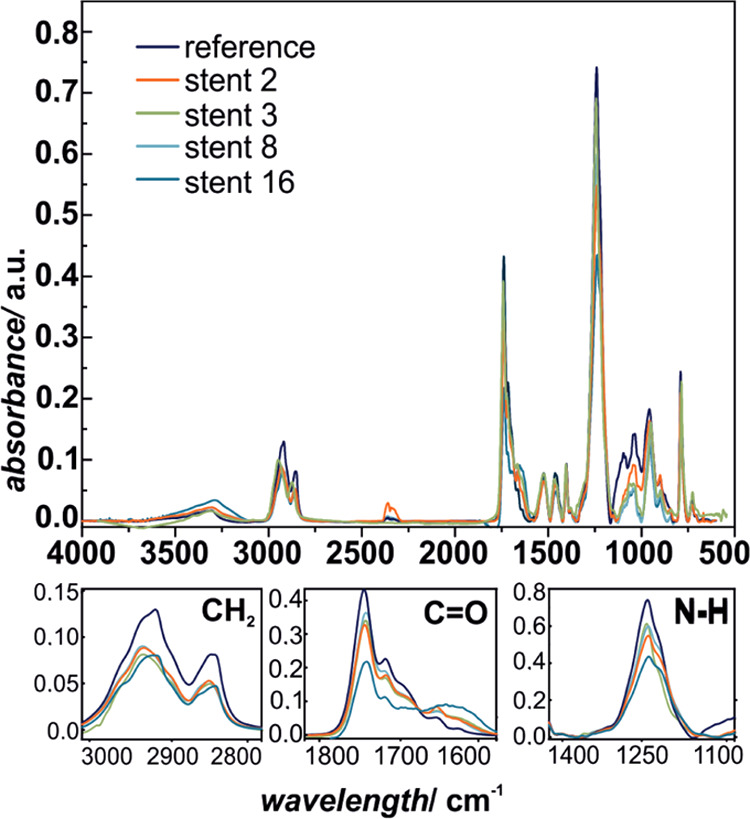
Partially covered self-expandable metallic esophageal stent (SEMS) placement is the most frequently applied palliative treatment in esophageal cancer. Structural characterization of explanted 16 nitinol-polyurethane SEMS (the group of 6 females, 10 males, age 40-80) was performed after their removal due to dysfunction. The adverse bulk changes in the polymer structure were identified using differential scanning calorimetry (DSC), differential mechanical thermal analysis (DMTA), and attenuated total reflectance infrared spectroscopy (ATR-IR) and discussed in terms of melting point shift (9 °C), glass-transition shift (4 °C), differences in viscoelastic behavior, and systematic decrease of peaks intensities corresponding to C-H, C═O, and C-N polyurethane structural bonds. The scanning electron and confocal microscopic observations revealed all major types of surface degradation, i.e., surface cracks, peeling off of the polymer material, and surface etching. The changes in the hydrophobic polyurethane surfaces were also revealed by a significant decrease in wettability (74°) and the corresponding increase of the surface free energy (31 mJ/m). To understand the degradation, the tests in simulated salivary and gastric fluids were performed, which mimic the environments of proximal and distal ends, respectively. It was concluded that the differences in the degradation of the proximal and distal ends of prostheses strongly depend on the physiological environment, in particular stomach content. Finally, the necessity of the tests for SEMS degradation is pointed out.
部分覆盖式自膨式金属食管支架(SEMS)置入是食管癌最常用的姑息治疗方法。对16个镍钛诺-聚氨酯SEMS(6名女性、10名男性,年龄40 - 80岁)在因功能障碍取出后进行结构表征。使用差示扫描量热法(DSC)、动态热机械分析(DMTA)和衰减全反射红外光谱(ATR-IR)识别聚合物结构中的不良体积变化,并从熔点偏移(9℃)、玻璃化转变偏移(4℃)、粘弹性行为差异以及对应于C-H、C═O和C-N聚氨酯结构键的峰强度的系统性降低方面进行讨论。扫描电子显微镜和共聚焦显微镜观察揭示了所有主要类型的表面降解,即表面裂纹、聚合物材料剥落和表面蚀刻。疏水性聚氨酯表面的变化还表现为润湿性显著降低(74°)以及表面自由能相应增加(31 mJ/m)。为了解降解情况,分别在模拟唾液和胃液中进行测试,以模拟近端和远端的环境。得出结论,假体近端和远端降解的差异强烈依赖于生理环境,特别是胃内容物。最后,指出了对SEMS降解进行测试的必要性。