Department of Psychology and Neuroscience, Duke University, Durham, NC, United States of America.
Program in Educational Neuroscience, Gallaudet University, Washington, D.C., United States of America.
PLoS One. 2021 Mar 12;16(3):e0247246. doi: 10.1371/journal.pone.0247246. eCollection 2021.
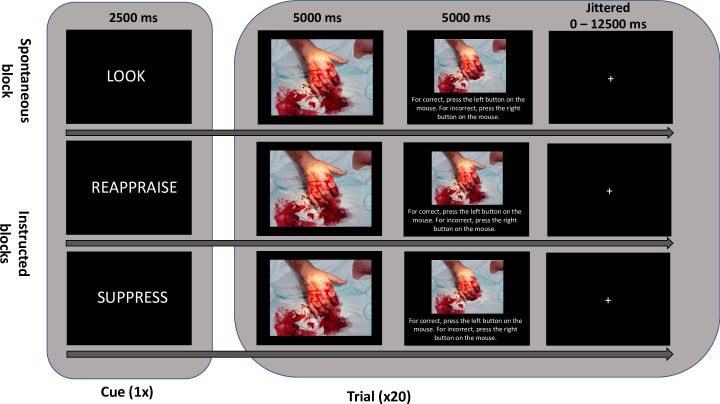
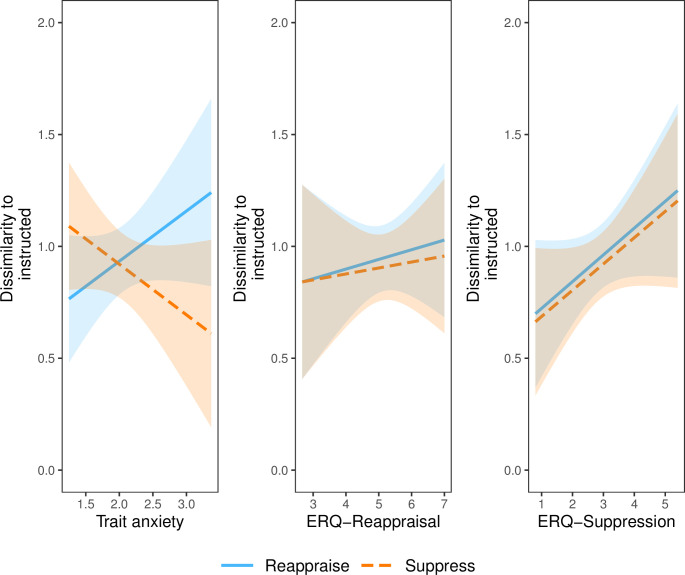
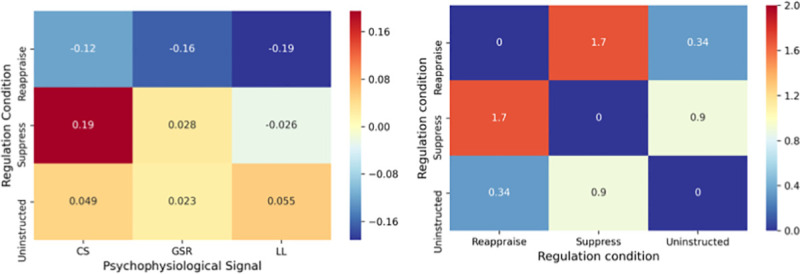
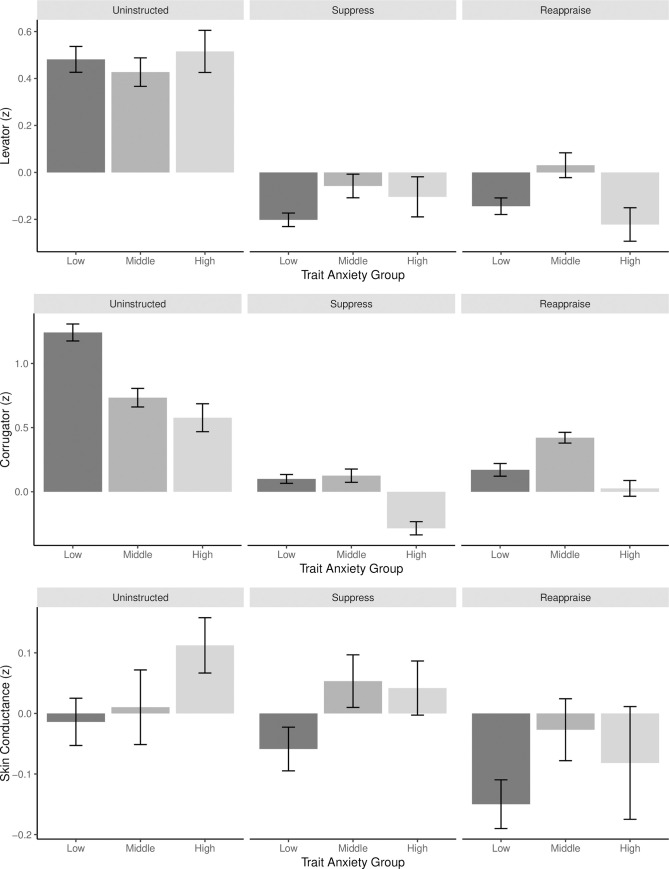
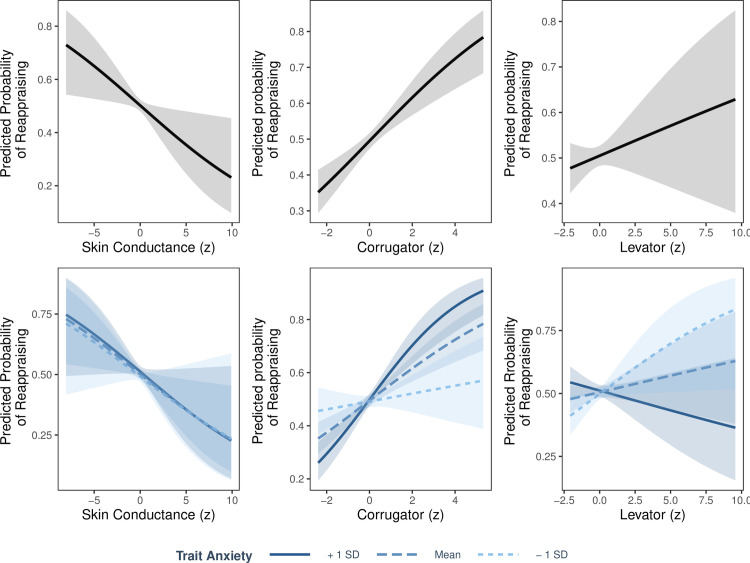
Anxiety influences how individuals experience and regulate emotions in a variety of ways. For example, individuals with lower anxiety tend to cognitively reframe (reappraise) negative emotion and those with higher anxiety tend to suppress negative emotion. Research has also investigated these individual differences with psychophysiology. These lines of research assume coherence between how individuals regulate outside the laboratory, typically measured with self-report, and how they regulate during an experiment. Indeed, performance during experiments is interpreted as an indication of future behavior outside the laboratory, yet this relationship is seldom directly explored. To address this gap, we computed psychophysiological profiles of uninstructed (natural) regulation in the laboratory and explored the coherence between these profiles and a) self-reported anxiety and b) self-reported regulation tendency. Participants viewed negative images and were instructed to reappraise, suppress or naturally engage. Electrodermal and facial electromyography signals were recorded to compute a multivariate psychophysiological profile of regulation. Participants with lower anxiety exhibited similar profiles when naturally regulating and following instructions to reappraise, suggesting they naturally reappraised more. Participants with higher anxiety exhibited similar profiles when naturally regulating and following instructions to suppress, suggesting they naturally suppressed more. However, there was no association between self-reported reappraisal or suppression tendency and psychophysiology. These exploratory results indicate that anxiety, but not regulation tendency, predicts how individuals regulate emotion in the laboratory. These findings suggest that how individuals report regulating in the real world does not map on to how they regulate in the laboratory. Taken together, this underscores the importance of developing emotion-regulation interventions and paradigms that more closely align to and predict real-world outcomes.
焦虑以多种方式影响个体体验和调节情绪的方式。例如,焦虑程度较低的个体往往会从认知上重新构建(重新评估)负面情绪,而焦虑程度较高的个体往往会抑制负面情绪。研究还从心理生理学的角度研究了这些个体差异。这些研究线假设个体在实验室外(通常通过自我报告测量)调节的方式与他们在实验中调节的方式之间存在一致性。事实上,实验中的表现被解释为实验室外未来行为的指示,但这种关系很少被直接探索。为了解决这一差距,我们计算了实验室中非指令(自然)调节的心理生理学特征,并探讨了这些特征与 a)自我报告的焦虑和 b)自我报告的调节倾向之间的一致性。参与者观看负面图像,并被指示重新评估、抑制或自然参与。记录皮肤电和面部肌电图信号以计算调节的多元心理生理学特征。焦虑程度较低的参与者在自然调节和遵循重新评估指令时表现出相似的特征,这表明他们自然地重新评估更多。焦虑程度较高的参与者在自然调节和遵循抑制指令时表现出相似的特征,这表明他们自然地抑制更多。然而,自我报告的重新评估或抑制倾向与心理生理学之间没有关联。这些探索性结果表明,焦虑但不是调节倾向可以预测个体在实验室中如何调节情绪。这些发现表明,个体在现实世界中报告的调节方式与他们在实验室中的调节方式不相符。总的来说,这强调了开发更紧密符合并预测现实世界结果的情绪调节干预措施和范式的重要性。