McColl Jeanine, Semalulu Teresa, Beattie Karen A, Alam Arzoo, Thomas Steffy, Herrington Julie, Gorter Jan Willem, Cellucci Tania, Garner Stephanie, Heale Liane, Matsos Mark, Batthish Michelle
McMaster University, Hamilton, Ontario, Canada.
ACR Open Rheumatol. 2021 Apr;3(4):260-265. doi: 10.1002/acr2.11237. Epub 2021 Mar 12.
The transition from pediatric to adult rheumatology care represents a particularly vulnerable time for patients with juvenile idiopathic arthritis (JIA) and childhood-onset systemic lupus erythematosus (cSLE). Improving self-management skills is important in optimizing health care transition. The study's objectives were to 1) examine variability in transition readiness of adolescents and young adults within and between different ages, sexes, and disease types; 2) determine the association between age and transition readiness; and 3) identify specific challenges to transition readiness for adolescents.
Over 1 year, patients 14 to 20 years of age with JIA or cSLE were recruited from pediatric transition and young adult clinics at a single academic institution. Participants completed the 14-item Transition-Q at a single time point. Total scores range from 0 to 100; higher scores indicate greater health care self-management skills as a proxy for transition readiness. Descriptive statistics summarized patient characteristics and Transition-Q scores for the population. Regression analyses determined the association between age, sex, and disease type and Transition-Q score.
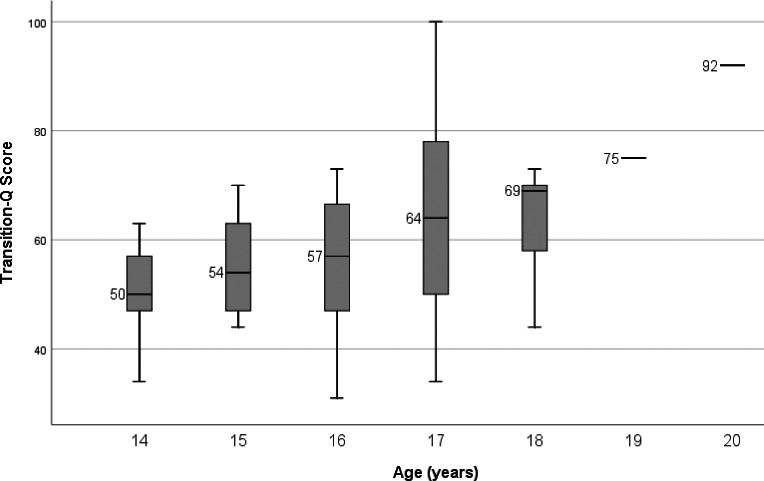
Among 70 participants, 61 had JIA and 9 cSLE (mean disease duration 4.6 years). The mean (SD) total Transition-Q score was 59.8 (14.9). Age was significantly associated with Transition-Q score (standardized β = 0.372l P = 0.002). The most commonly reported challenges were seeing the physician alone (without parents), making one's own appointments, picking up prescriptions, and independent transportation for appointments.
Transition readiness appears to increase with patient age. There is significant variability in Transition-Q scores between patients of the same age, suggesting that an individualized approach to improving self-management skills is necessary.
从儿科风湿病护理过渡到成人风湿病护理,对于幼年特发性关节炎(JIA)和儿童期起病的系统性红斑狼疮(cSLE)患者而言,是一个特别脆弱的时期。提高自我管理技能对于优化医疗护理过渡至关重要。本研究的目的是:1)检查不同年龄、性别和疾病类型的青少年和青年在过渡准备方面的差异;2)确定年龄与过渡准备之间的关联;3)确定青少年在过渡准备方面面临的具体挑战。
在1年多的时间里,从一家学术机构的儿科过渡诊所和青年成人诊所招募了14至20岁的JIA或cSLE患者。参与者在单一时间点完成了14项的过渡问卷(Transition-Q)。总分范围为0至100分;分数越高表明医疗自我管理技能越强,可作为过渡准备的指标。描述性统计总结了研究人群的患者特征和过渡问卷分数。回归分析确定了年龄、性别、疾病类型与过渡问卷分数之间的关联。
70名参与者中,61人患有JIA,9人患有cSLE(平均病程4.6年)。过渡问卷的平均(标准差)总分是59.8(14.9)。年龄与过渡问卷分数显著相关(标准化β = 0.372,P = 0.002)。最常报告的挑战是独自看医生(无父母陪同)、自己预约、取药以及独立前往预约地点。
过渡准备似乎随着患者年龄的增长而提高。同一年龄的患者在过渡问卷分数上存在显著差异,这表明需要采取个性化方法来提高自我管理技能。