Medical Technology, School of Allied Health Sciences, Walailak University, Tha Sala, Nakhon Si Thammarat, Thailand.
Department of Medical Technology, Institute of Arts and Sciences, Far Eastern University-Manila, Manila, Philippines.
BMC Infect Dis. 2021 Mar 12;21(1):259. doi: 10.1186/s12879-021-05941-y.
Plasmodium cynomolgi is a simian malaria parasite that has been reported as a naturally acquired human infection. The present study aims to systematically review reports on naturally acquired P. cynomolgi in humans, mosquitoes, and macaques to provide relevant data for pre-emptive surveillance and preparation in the event of an outbreak of zoonotic malaria in Southeast Asia.
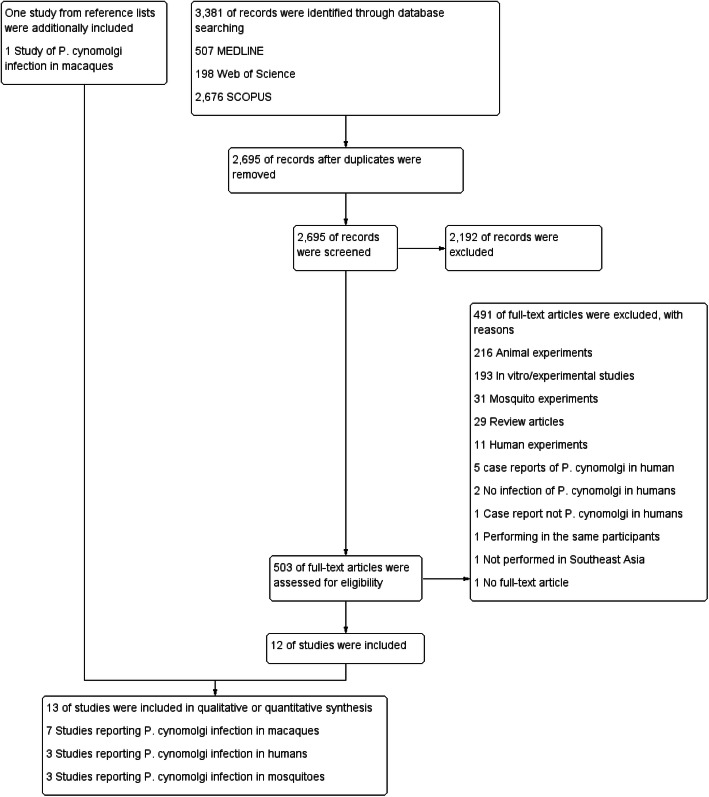
The protocol of the systematic review was registered at PROSPERO with approval ID CRD42020203046. Three databases (Web of Science, Scopus, and MEDLINE) were searched for studies reporting the prevalence of P. cynomolgi infections in Southeast Asian countries between 1946 and 2020. The pooled prevalence or pooled proportion of P. cynomolgi parasitemia in humans, mosquitoes, and macaques was estimated using a random-effects model. Differences in the clinical characteristics of P. cynomolgi infections were also estimated using a random-effects model and presented as pooled odds ratios (ORs) or mean differences (MDs) with 95% confidence intervals (CIs).
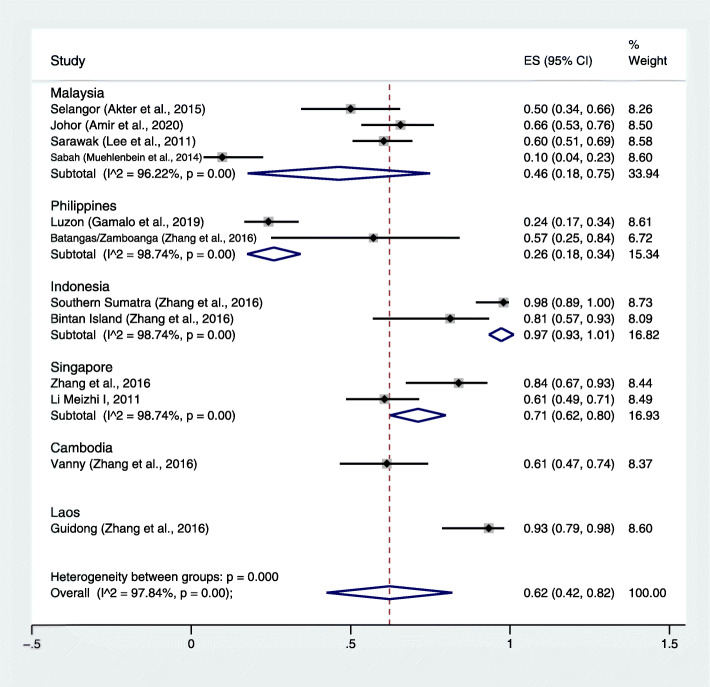
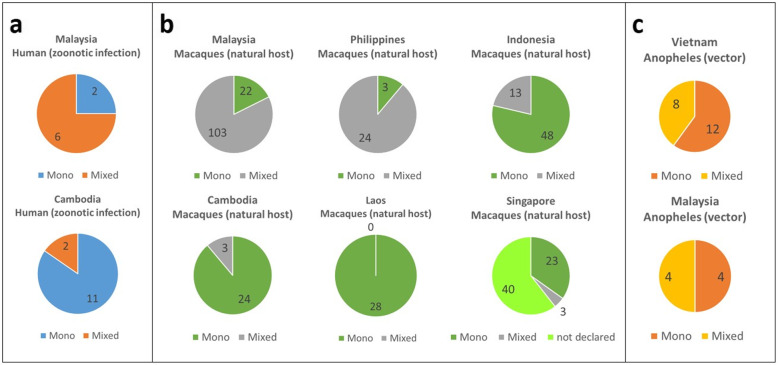
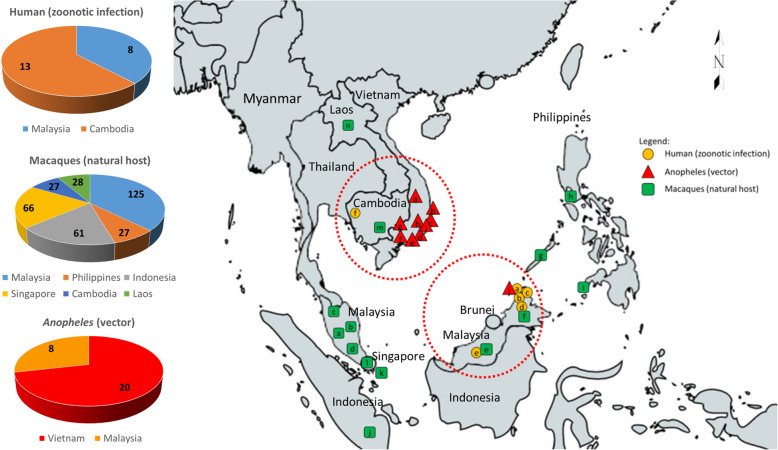
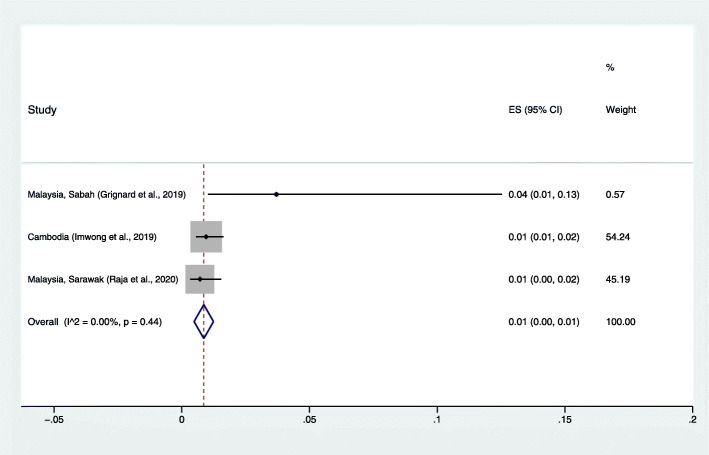
Thirteen studies reporting on the prevalence of naturally acquired P. cynomolgi in humans (3 studies, 21 cases), mosquitoes (3 studies, 28 cases), and macaques (7 studies, 334 cases) were included. The results demonstrated that the pooled proportion of naturally acquired P. cynomolgi in humans was 1% (95% CI, 0.1%, I, 0%), while the pooled proportion of P. cynomolgi infecting mosquitoes was 18% (95% CI, 10-26%, I, 32.7%). The pooled prevalence of naturally acquired P. cynomolgi in macaques was 47% (95% CI, 27-67%, I, 98.3%). Most of the cases of naturally acquired P. cynomolgi in humans were reported in Cambodia (62%) and Malaysia (38%), while cases of P. cynomolgi in macaques were reported in Malaysia (35.4%), Singapore (23.2%), Indonesia (17.3%), Philippines (8.5%), Laos (7.93%), and Cambodia (7.65%). Cases of P. cynomolgi in mosquitoes were reported in Vietnam (76.9%) and Malaysia (23.1%).
This study demonstrated the occurrence of naturally acquired P. cynomolgi infection in humans, mosquitoes, and macaques. Further studies of P. cynomolgi in asymptomatic human cases in areas where vectors and natural hosts are endemic are extensively needed if human infections with P. cynomolgi do become public health problems.
食蟹猴疟原虫是一种灵长类疟原虫,已被报道为一种自然获得性人类感染。本研究旨在系统回顾报告在东南亚地区自然感染食蟹猴疟原虫的人类、蚊子和猕猴,为在东南亚发生动物源性疟疾爆发时进行先发制人的监测和准备提供相关数据。
本系统综述的方案已在 PROSPERO 上注册,注册号为 CRD42020203046。在 1946 年至 2020 年间,使用 Web of Science、Scopus 和 MEDLINE 三个数据库搜索报告东南亚国家食蟹猴疟原虫感染流行率的研究。使用随机效应模型估计人类、蚊子和猕猴中食蟹猴疟原虫寄生虫血症的总流行率或总比例。还使用随机效应模型估计食蟹猴疟原虫感染的临床特征差异,并以 95%置信区间(CI)的合并比值比(OR)或平均差异(MD)表示。
纳入了 13 项关于人类(3 项研究,21 例)、蚊子(3 项研究,28 例)和猕猴(7 项研究,334 例)自然感染食蟹猴疟原虫流行率的研究。结果表明,人类自然感染食蟹猴疟原虫的总比例为 1%(95%CI,0.1%,I,0%),而感染蚊子的食蟹猴疟原虫比例为 18%(95%CI,10-26%,I,32.7%)。猕猴自然感染食蟹猴疟原虫的总流行率为 47%(95%CI,27-67%,I,98.3%)。人类自然感染食蟹猴疟原虫的大多数病例发生在柬埔寨(62%)和马来西亚(38%),而猕猴自然感染食蟹猴疟原虫的病例发生在马来西亚(35.4%)、新加坡(23.2%)、印度尼西亚(17.3%)、菲律宾(8.5%)、老挝(7.93%)和柬埔寨(7.65%)。蚊子感染食蟹猴疟原虫的病例发生在越南(76.9%)和马来西亚(23.1%)。
本研究证明了人类、蚊子和猕猴中自然获得性食蟹猴疟原虫感染的发生。如果食蟹猴疟原虫感染确实成为公共卫生问题,需要在蚊子和自然宿主流行地区对无症状人类病例中的食蟹猴疟原虫进行广泛的研究。