Department of Paediatric Endocrinology and Diabetology, Charité-Universitätsmedizin Berlin, Corporate Member of Freie Universität Berlin, Humboldt-Universität zu Berlin, and Berlin Institute of Health, Berlin, Germany.
Sozialpädiatrisches Zentrum, Center for Chronically Sick Children, Charité-Universitätsmedizin Berlin, Corporate Member of Freie Universität Berlin, Humboldt-Universität zu Berlin, and Berlin Institute of Health, Berlin, Germany.
Arch Sex Behav. 2021 Apr;50(3):913-923. doi: 10.1007/s10508-021-01953-6. Epub 2021 Mar 12.
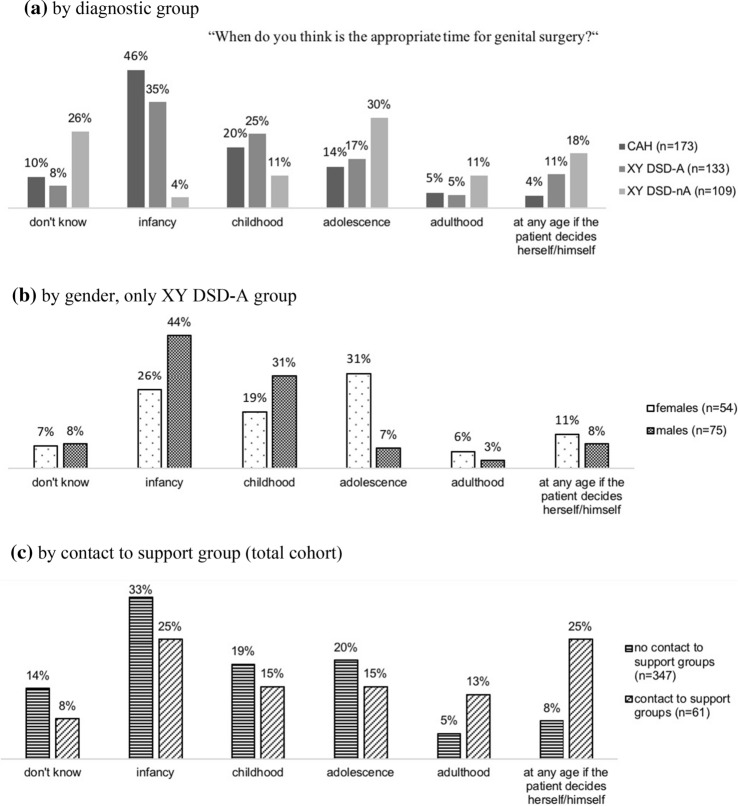
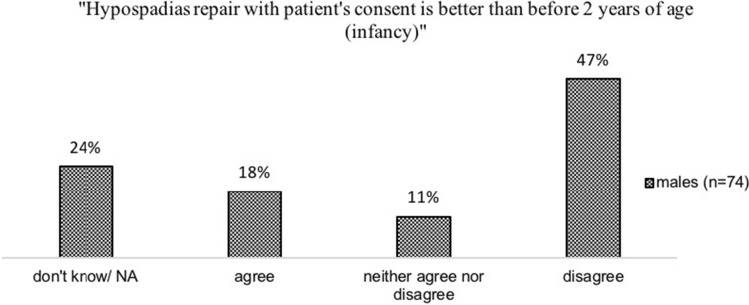
Controversy continues over a proposed moratorium on elective genital surgery in childhood for disorders/differences of sex development (DSD). Empirical evidence on patient preference is needed to inform decision-making. We conducted a multicentre survey by cross-sectional questionnaire in 14 specialized clinics in six European countries. The sample comprised 459 individuals (≥ 16 years) with a DSD diagnosis, including individuals with congenital adrenal hyperplasia (CAH) (n = 192), XY DSD with prenatal androgen effect (A) (n = 150), and without (nA) (n = 117). Main outcome measures were level of agreement with given statements regarding genital surgery, including clitoris reduction, vaginoplasty, and hypospadias repair. A total of 66% of individuals with CAH and 60% of those with XY DSD-A thought that infancy or childhood were the appropriate age for genital surgery. Females with XY DSD were divided on this issue and tended to prefer vaginoplasty at a later age (XY DSD-A 39%, XY DSD-nA 32%). A total of 47% of males preferred early hypospadias surgery. Only 12% (CAH), 11% (XY DSD-A), and 21% (XY DSD-nA) thought they would have been better off without any surgery in childhood or adolescence. Individuals who had early genital surgery were more likely to approve of it. Outcome data failed to support a general moratorium on early elective genital surgery. Participant perspectives varied considerably by diagnostic category, gender, history of surgery, and contact with support groups. Case-by-case decision-making is better suited to grasping the ethical complexity of the issues at stake.Trial registration: German Clinical Trials Register DRKS00006072.
对于儿童性别发育障碍/差异(DSD)的选择性生殖器手术,争议仍在继续。需要有关于患者偏好的经验证据来为决策提供信息。我们在六个欧洲国家的 14 个专门诊所进行了一项多中心横断面问卷调查。样本包括 459 名(≥16 岁)患有 DSD 诊断的个体,包括先天性肾上腺增生(CAH)(n=192)、有产前雄激素作用(A)的 XY DSD(n=150)和无雄激素作用(nA)(n=117)。主要结局指标是对生殖器手术的特定陈述的同意程度,包括阴蒂缩小、阴道成形术和尿道下裂修复。66%的 CAH 个体和 60%的 XY DSD-A 个体认为婴儿期或儿童期是生殖器手术的适当年龄。XY DSD 女性对此问题存在分歧,倾向于以后的年龄进行阴道成形术(XY DSD-A 39%,XY DSD-nA 32%)。47%的男性更喜欢早期尿道下裂手术。只有 12%(CAH)、11%(XY DSD-A)和 21%(XY DSD-nA)认为他们在儿童或青少年时期没有接受任何手术会更好。早期进行生殖器手术的个体更有可能对此表示赞同。结果数据不支持普遍暂停早期选择性生殖器手术。参与者的观点因诊断类别、性别、手术史和与支持团体的接触而异。个案决策更适合把握所涉问题的伦理复杂性。试验注册:德国临床试验注册 DRKS00006072。