Mertz Marcel, Inthorn Julia, Renz Günter, Rothenberger Lillian Geza, Salloch Sabine, Schildmann Jan, Wöhlke Sabine, Schicktanz Silke
Department of Medical Ethics and History of Medicine, University Medical Center Göttingen, Humboldtallee 36, D-37073 Göttingen, Germany.
BMC Med Ethics. 2014 Mar 1;15:17. doi: 10.1186/1472-6939-15-17.
Research in the field of Empirical Ethics (EE) uses a broad variety of empirical methodologies, such as surveys, interviews and observation, developed in disciplines such as sociology, anthropology, and psychology. Whereas these empirical disciplines see themselves as purely descriptive, EE also aims at normative reflection. Currently there is literature about the quality of empirical research in ethics, but little or no reflection on specific methodological aspects that must be considered when conducting interdisciplinary empirical ethics. Furthermore, poor methodology in an EE study results in misleading ethical analyses, evaluations or recommendations. This not only deprives the study of scientific and social value, but also risks ethical misjudgement.
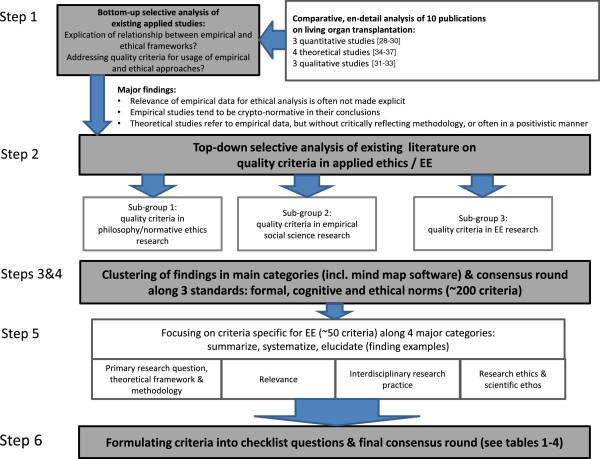
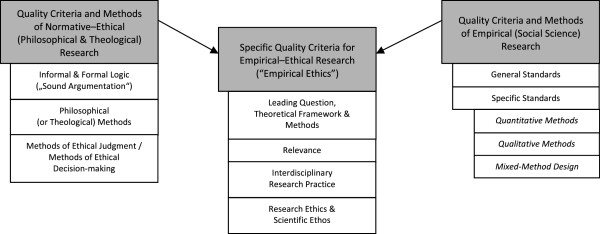
While empirical and normative-ethical research projects have quality criteria in their own right, we focus on the specific quality criteria for EE research. We develop a tentative list of quality criteria--a "road map"--tailored to interdisciplinary research in EE, to guide assessments of research quality. These quality criteria fall into the categories of primary research question, theoretical framework and methods, relevance, interdisciplinary research practice and research ethics and scientific ethos.
EE research is an important and innovative development in bioethics. However, a lack of standards has led to concerns about and even rejection of EE by various scholars. Our suggested orientation list of criteria, presented in the form of reflective questions, cannot be considered definitive, but serves as a tool to provoke systematic reflection during the planning and composition of an EE research study. These criteria need to be tested in different EE research settings and further refined.
实证伦理学(EE)领域的研究采用了广泛的实证方法,如社会学、人类学和心理学等学科所开发的调查、访谈和观察法。虽然这些实证学科将自身视为纯粹描述性的,但EE还旨在进行规范性反思。目前有关于伦理学实证研究质量的文献,但对于跨学科实证伦理学研究中必须考虑的特定方法论方面,几乎没有或根本没有反思。此外,EE研究中糟糕的方法论会导致误导性的伦理分析、评估或建议。这不仅会使研究失去科学和社会价值,还存在伦理判断错误的风险。
虽然实证和规范伦理学研究项目本身都有质量标准,但我们关注的是EE研究的特定质量标准。我们制定了一份暂定的质量标准清单——一张“路线图”——专门针对EE的跨学科研究,以指导对研究质量的评估。这些质量标准分为主要研究问题、理论框架与方法、相关性、跨学科研究实践以及研究伦理与科学风气等类别。
EE研究是生物伦理学中一项重要且创新的发展。然而,缺乏标准导致了各学者对EE的担忧甚至排斥。我们以反思性问题的形式呈现的建议性标准导向清单,虽不能被视为定论,但可作为一种工具,在EE研究的规划和撰写过程中引发系统性反思。这些标准需要在不同的EE研究环境中进行检验并进一步完善。