Division of Pediatric Allergy and Immunology, Johns Hopkins University School of Medicine, Baltimore, Md.
Division of Biomedical Informatics and Personalized Medicine, University of Colorado, Denver, Colo.
J Allergy Clin Immunol. 2021 Dec;148(6):1493-1504. doi: 10.1016/j.jaci.2021.02.035. Epub 2021 Mar 10.
Genetic ancestry plays a role in asthma health disparities.
Our aim was to evaluate the impact of ancestry on and identify genetic variants associated with asthma, total serum IgE level, and lung function.
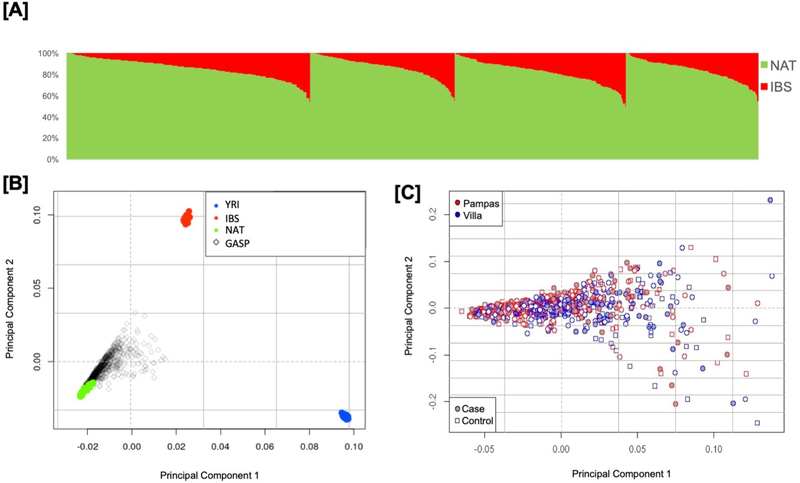
A total of 436 Peruvian children (aged 9-19 years) with asthma and 291 without asthma were genotyped by using the Illumina Multi-Ethnic Global Array. Genome-wide proportions of indigenous ancestry populations from continental America (NAT) and European ancestry from the Iberian populations in Spain (IBS) were estimated by using ADMIXTURE. We assessed the relationship between ancestry and the phenotypes and performed a genome-wide association study.
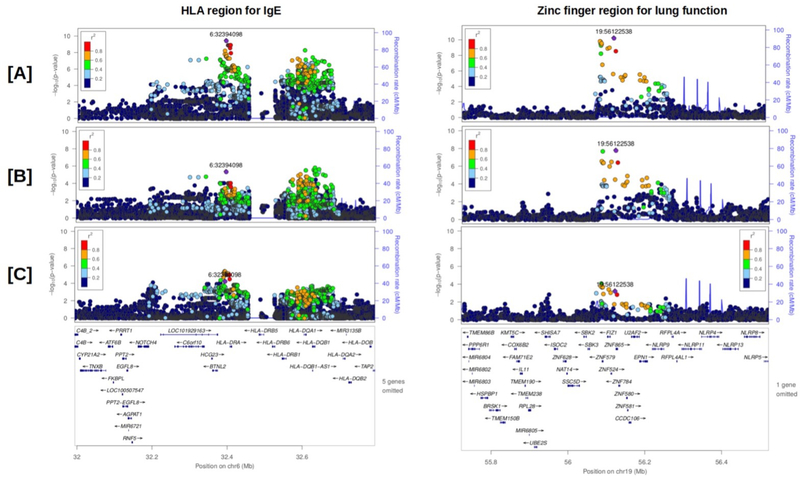
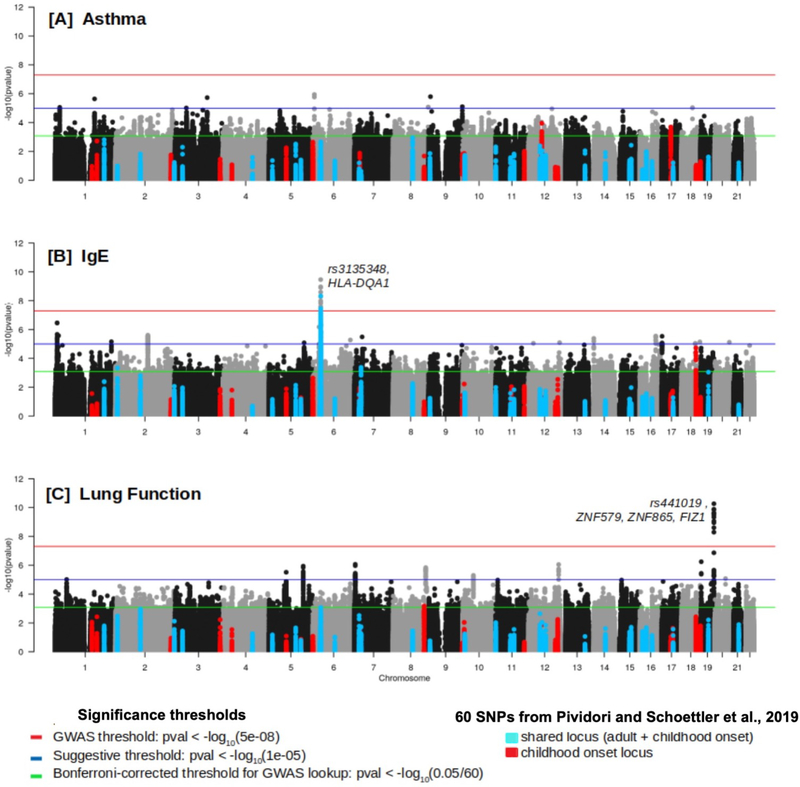
The mean ancestry proportions were 84.7% NAT (case patients, 84.2%; controls, 85.4%) and 15.3% IBS (15.8%; 14.6%). With adjustment for asthma, NAT was associated with higher total serum IgE levels (P < .001) and IBS was associated with lower total serum IgE levels (P < .001). NAT was associated with higher FEV percent predicted values (P < .001), whereas IBS was associated with lower FEV values in the controls but not in the case patients. The HLA-DR/DQ region on chromosome 6 (Chr6) was strongly associated with total serum IgE (rs3135348; P = 3.438 × 10) and was independent of an association with the haplotype HLA-DQA1∼HLA-DQB1:04.01∼04.02 (P = 1.55 × 10). For lung function, we identified a locus (rs4410198; P = 5.536 × 10) mapping to Chr19, near a cluster of zinc finger interacting genes that colocalizes to the long noncoding RNA CTD-2537I9.5. This novel locus was replicated in an independent sample of pediatric case patients with asthma with similar admixture from Brazil (P = .005).
This study confirms the role of HLA in atopy, and identifies a novel locus mapping to a long noncoding RNA for lung function that may be specific to children with NAT.
遗传血统在哮喘健康差异中起着作用。
我们旨在评估血统对哮喘、总血清 IgE 水平和肺功能的影响,并确定与这些表型相关的遗传变异。
共对 436 名秘鲁哮喘儿童(9-19 岁)和 291 名非哮喘儿童进行了全基因组 Illumina 多民族全球阵列基因分型。使用 ADMIXTURE 估计来自美洲大陆的土著血统人群(NAT)和来自西班牙伊比利亚人群的欧洲血统人群(IBS)的全基因组比例。我们评估了血统与表型之间的关系,并进行了全基因组关联研究。
平均血统比例为 84.7%NAT(病例患者为 84.2%;对照组为 85.4%)和 15.3%IBS(15.8%;14.6%)。调整哮喘因素后,NAT 与较高的总血清 IgE 水平相关(P<0.001),而 IBS 与较低的总血清 IgE 水平相关(P<0.001)。NAT 与较高的 FEV%预计值相关(P<0.001),而 IBS 与对照组而非病例患者的较低 FEV 值相关。染色体 6(Chr6)上的 HLA-DR/DQ 区域与总血清 IgE 强烈相关(rs3135348;P=3.438×10),且与 HLA-DQA1∼HLA-DQB1:04.01∼04.02 单倍型的关联无关(P=1.55×10)。对于肺功能,我们鉴定到一个位于 Chr19 的位点(rs4410198;P=5.536×10),该位点靠近锌指相互作用基因簇,该基因簇与长非编码 RNA CTD-2537I9.5 共定位。该新位点在来自巴西的具有相似混合血统的哮喘儿童的另一项独立病例患者样本中得到了复制(P=0.005)。
本研究证实了 HLA 在过敏中的作用,并确定了一个映射到长非编码 RNA 的新位点,该位点可能与具有 NAT 的儿童的肺功能有关。