Division of Allergy and Clinical Immunology, Department of Medicine, Johns Hopkins University, Baltimore, Md.
Department of Human Genetics, The University of Chicago, Chicago, Ill.
J Allergy Clin Immunol. 2021 Jan;147(1):15-28. doi: 10.1016/j.jaci.2020.10.039. Epub 2021 Jan 5.
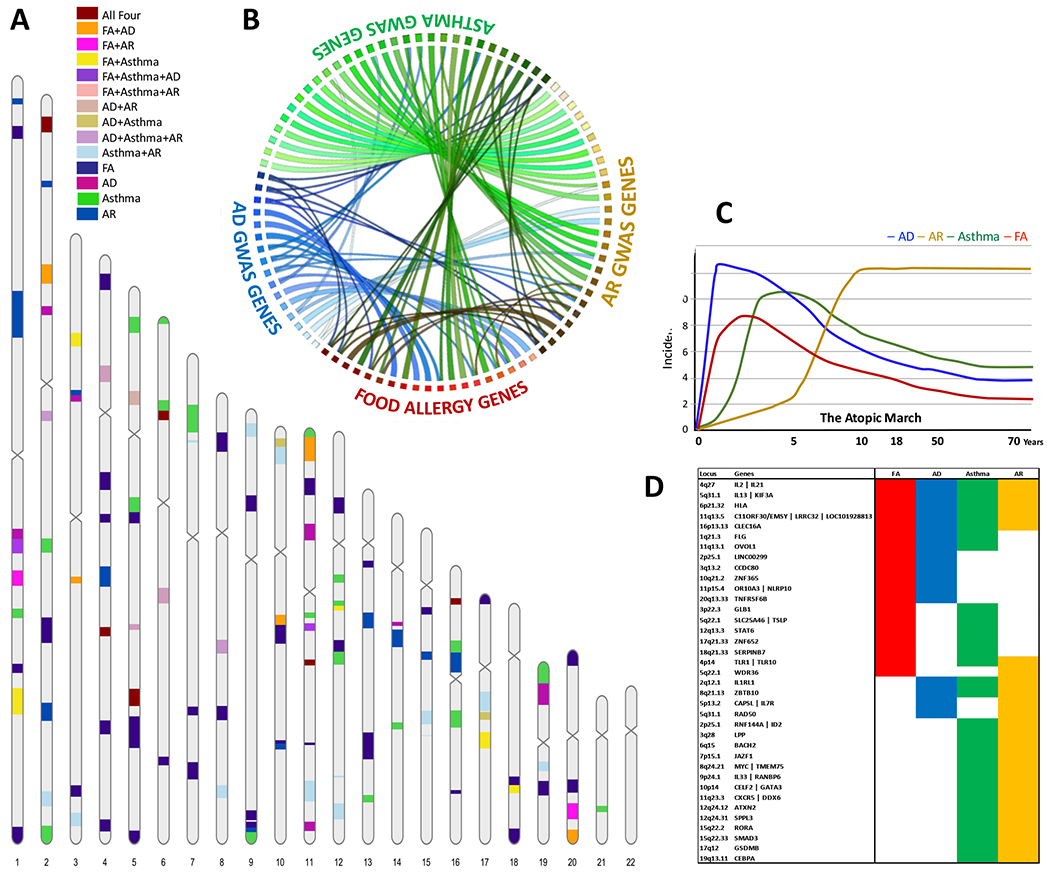
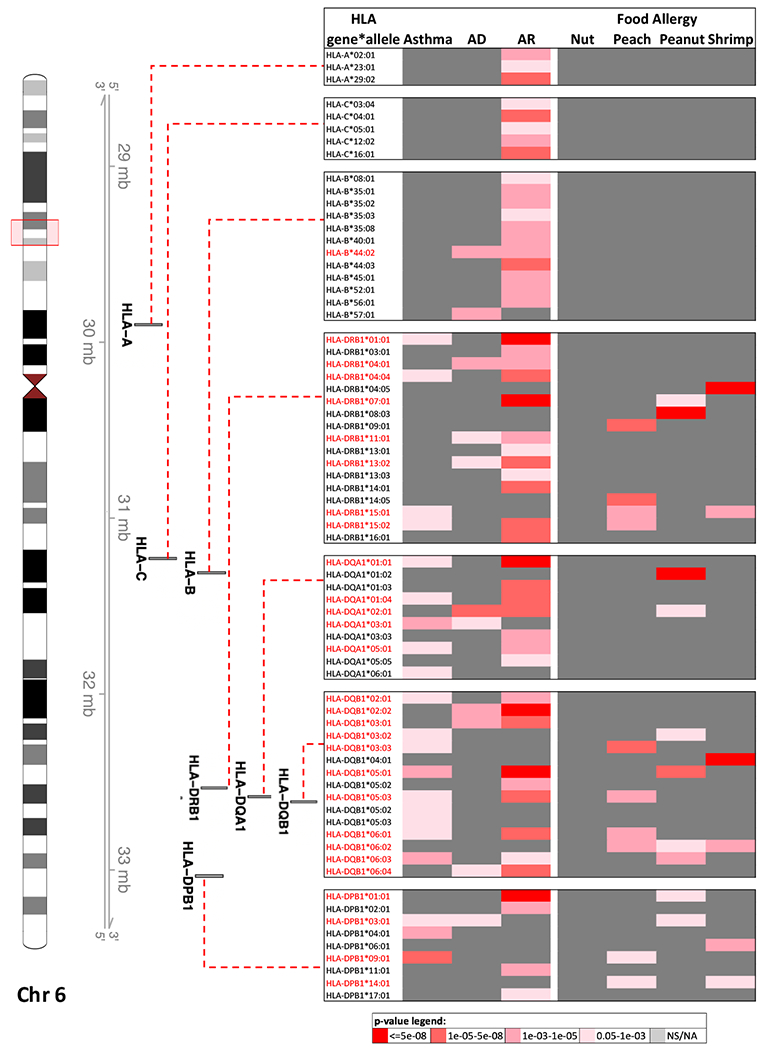
Food allergy (FA), a growing public health burden in the United States, and familial aggregation studies support strong roles for both genes and environment in FA risk. Deepening our understanding of the molecular and cellular mechanisms driving FAs is paramount to improving its prevention, diagnosis, and clinical management. In this review, we document lessons learned from the genetics of FA that have aided our understanding of these mechanisms. Although current genetic association studies suffer from low power, heterogeneity in definition of FA, and difficulty in our ability to truly disentangle FA from food sensitization (FS) and general atopy genetics, they reveal a set of genetic loci, genes, and variants that continue to implicate the importance of barrier and immune function genes across the atopic march, and FA in particular. The largest reported effects on FA are from MALT1 (odds ratio, 10.99), FLG (average odds ratio, ∼2.9), and HLA (average odds ratio, ∼2.03). The biggest challenge in the field of FA genetics is to elucidate the specific mechanism of action on FA risk and pathogenesis for these loci, and integrative approaches including genetics/genomics with transcriptomics, proteomics, and metabolomics will be critical next steps to translating these genetic insights into practice.
食物过敏(FA)是美国日益严重的公共卫生负担,家族聚集研究支持 FA 风险的基因和环境都起着重要作用。深入了解导致 FA 的分子和细胞机制对于改善其预防、诊断和临床管理至关重要。在这篇综述中,我们记录了从 FA 的遗传学中获得的经验教训,这些经验教训有助于我们理解这些机制。尽管目前的遗传关联研究受到低效能、FA 定义的异质性以及我们真正将 FA 与食物致敏(FS)和一般特应性遗传学区分开来的能力的困难的限制,但它们揭示了一系列遗传位点、基因和变体,这些仍然表明在特应性进展过程中以及 FA 中,屏障和免疫功能基因的重要性。对 FA 影响最大的报告是来自 MALT1(优势比,10.99)、FLG(平均优势比,2.9)和 HLA(平均优势比,2.03)。FA 遗传学领域最大的挑战是阐明这些基因座对 FA 风险和发病机制的具体作用机制,包括遗传学/基因组学与转录组学、蛋白质组学和代谢组学的综合方法将是将这些遗传见解转化为实践的关键下一步。