Aix Marseille Université, IRD, MEPHI, IHU Méditerranée Infection, Marseille, France.
Aix Marseille Université, CNRS, Laboratory of Cognitive Psychology (UMR 7290), Marseille, France.
J Hosp Infect. 2021 May;111:27-34. doi: 10.1016/j.jhin.2021.03.004. Epub 2021 Mar 11.
The coronavirus disease (COVID-19) pandemic has affected healthcare workers (HCWs) in their clinical practice. HCWs were challenged with new guidelines and practices to protect themselves from occupational risks.
To determine whether hand hygiene behaviour by real-time measurement was related to the dynamic of the epidemic, and the type of patient being cared for in France.
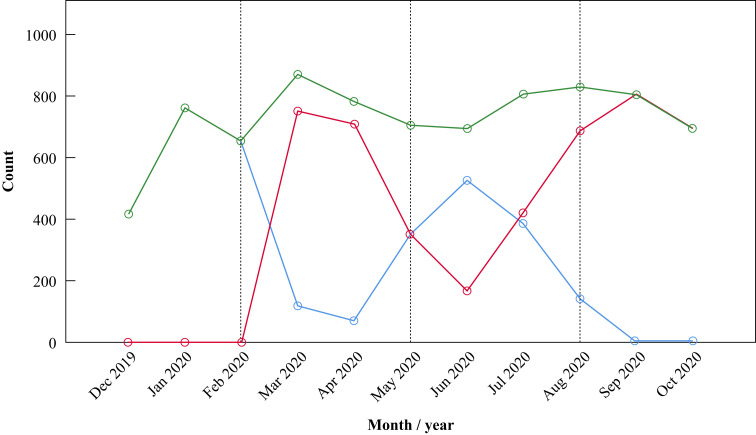
This study used an automated hand hygiene recording system to measure HCW hand hygiene on entry to and exit from patient rooms throughout the COVID-19 pandemic. The correlation between hand hygiene compliance and COVID-19 epidemiological data was analysed. Analysis of variance was performed to compare compliance rate during the different periods of the epidemic.
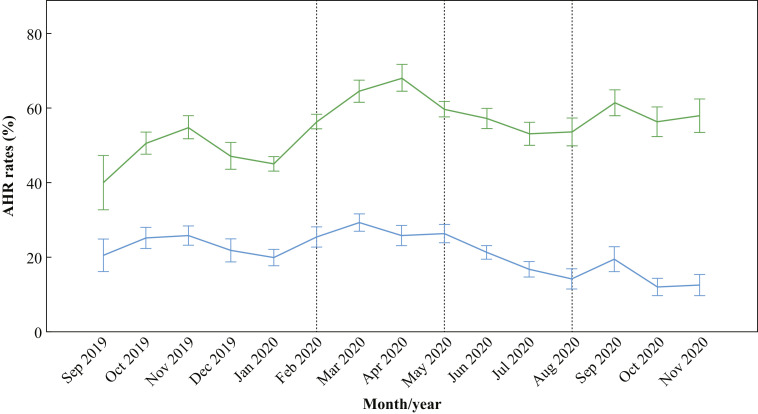
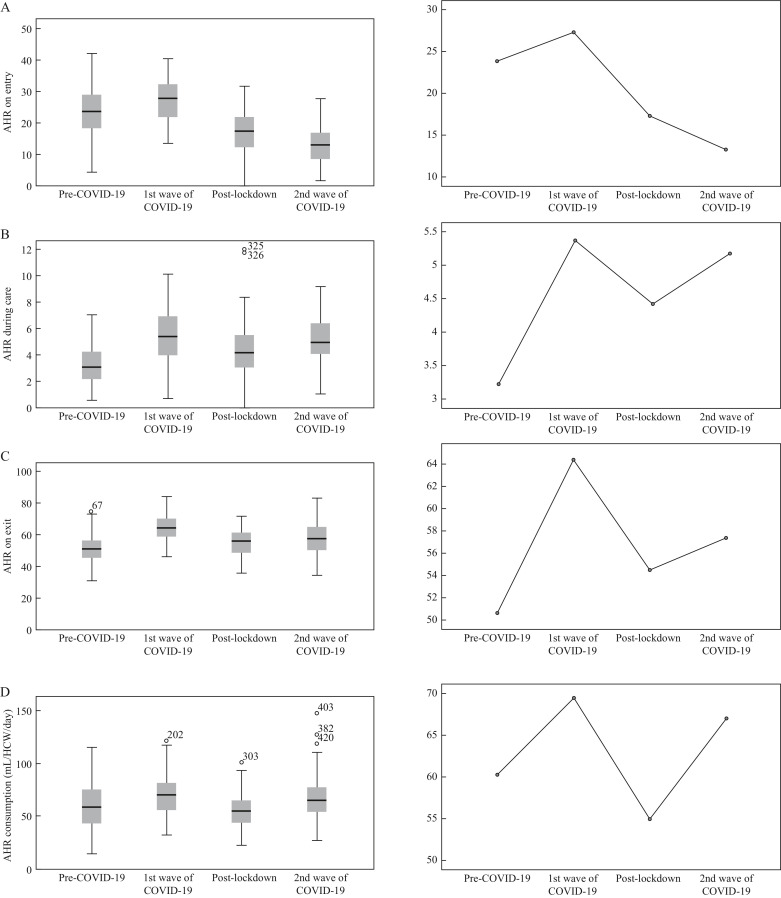
HCW hand hygiene rate on room entry decreased over time; on room exit, it increased by 13.73% during the first wave of COVID-19, decreased by 9.87% during the post-lockdown period, then rebounded by 2.82% during the second wave of the epidemic. Hand hygiene during patient care and hand hygiene on room exit had a positive relationship with the local COVID-19 epidemic; conversely, hand hygiene on room entry did not depend on the trend of the epidemic, nor on nursing of COVID-19 patients, and it decreased over time.
HCWs modified their behaviours to face the risk propensity of the pandemic. However, to improve the poor compliance at room entry, reducing confusion between the hand hygiene recommendation and glove recommendation may be necessary; disinfection of gloving hands might solve this issue.
冠状病毒病(COVID-19)大流行影响了医护人员(HCWs)的临床实践。HCWs 面临着新的指南和实践,以保护自己免受职业风险。
确定实时测量的手卫生行为是否与法国流行的动态和所照顾的患者类型有关。
本研究使用自动化手卫生记录系统来测量 COVID-19 大流行期间 HCW 在进入和离开患者房间时的手卫生情况。分析了手卫生依从性与 COVID-19 流行病学数据之间的相关性。采用方差分析比较了流行不同阶段的依从率。
HCW 进入房间时的手卫生率随时间下降;而在离开房间时,COVID-19 第一波期间增加了 13.73%,封锁后期间减少了 9.87%,然后在第二波疫情期间反弹了 2.82%。在患者护理期间进行手卫生和离开房间时进行手卫生与当地 COVID-19 疫情呈正相关;相反,进入房间时的手卫生并不取决于疫情趋势,也不取决于 COVID-19 患者的护理,并且随时间下降。
HCWs 改变了他们的行为以应对大流行的风险倾向。然而,为了提高进入房间时的依从性差的问题,减少对手卫生建议和手套建议的混淆可能是必要的;对戴手套的手进行消毒可能会解决这个问题。