Department of Public Health, Institute of Health Sciences, Dokuz Eylul University, Izmir, Turkey.
BMC Infect Dis. 2024 Sep 27;24(1):1046. doi: 10.1186/s12879-024-09819-7.
Healthcare workers are a high-risk group for COVID-19 and protecting them is crucial for healthcare delivery. Limited studies have explored compliance with infection prevention and control (IPC) practices among Somali healthcare workers. This study aimed to determine compliance with IPC practices among healthcare workers in De Martino Public Hospital, Somalia.
A cross-sectional study was conducted at the De Martino Public Hospital, Mogadishu, Somalia from August to October 2022, with the participation of 204 healthcare workers (response rate = 97%). Compliance was assessed using responses to 25 questions on a five-point Likert-type scale, and a median score of 20 was used to dichotomize compliance scores. A chi-square test and logistic regression analysis were performed to check the associations between healthcare workers' socio-demographic information, IPC-related factors, work conditions and practices on COVID-19, and IPC compliance during healthcare interventions using SPSS 23 version.
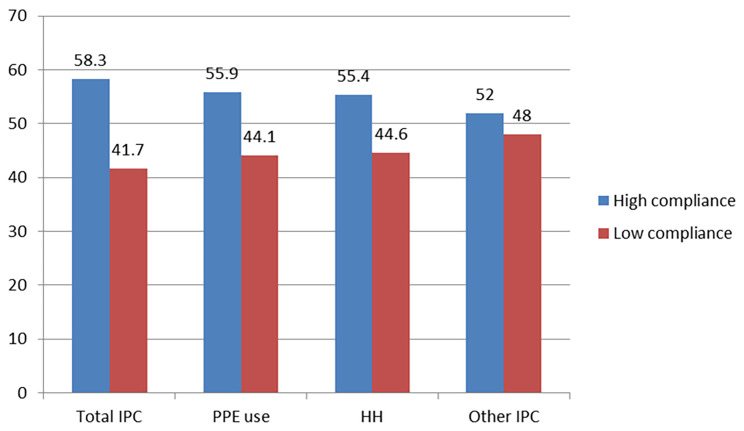
In total, 58.3% of the participants had good compliance with IPC. There were significant associations between IPC compliance and the type of healthcare worker (doctors and doctor assistants: 72.3%, nurses and paramedical staff: 67.3%, non-clinical staff: 5.7%, p < 0.01). After adjusting for potential confounding factors, compared to non-clinical staff, doctors and doctor assistants (OR: 12.11, 95% CI: 2.23-65.84) and nurses and paramedical staff (OR: 21.38, 95% CI: 4.23-108.01) had higher compliance with IPC measures. There were no significant associations between compliance and sex, marital status, vaccination status, or smoking (p > 0.05 for all).
Low levels of compliance with COVID-19 IPC measures were observed among hospital workers. Prioritizing awareness campaigns and behavior change interventions, especially among non-clinical staff, is crucial for effective COVID-19 infection prevention and control within hospitals.
医护人员是 COVID-19 的高风险人群,保护他们对于医疗服务的提供至关重要。有限的研究探讨了索马里医护人员对感染预防和控制(IPC)措施的遵守情况。本研究旨在确定索马里德马尔蒂诺公立医院医护人员对 IPC 措施的遵守情况。
2022 年 8 月至 10 月,在索马里摩加迪沙的德马尔蒂诺公立医院进行了一项横断面研究,共有 204 名医护人员参与(应答率=97%)。使用五点李克特量表对 25 个问题的回答来评估依从性,将 20 的中位数得分用于将依从性得分二分为两类。使用 SPSS 23 版本,通过卡方检验和逻辑回归分析检查医护人员的社会人口统计学信息、IPC 相关因素、工作条件和 COVID-19 相关实践与 IPC 依从性之间的关联。
总共有 58.3%的参与者对 IPC 的依从性较好。在 IPC 依从性方面,医护人员的类型存在显著差异(医生和医生助理:72.3%,护士和辅助医务人员:67.3%,非临床人员:5.7%,p<0.01)。在调整潜在混杂因素后,与非临床人员相比,医生和医生助理(OR:12.11,95%CI:2.23-65.84)和护士和辅助医务人员(OR:21.38,95%CI:4.23-108.01)对 IPC 措施的依从性更高。依从性与性别、婚姻状况、疫苗接种状况或吸烟状况之间无显著关联(p>0.05)。
医院工作人员对 COVID-19 IPC 措施的依从性水平较低。优先开展提高认识运动和行为改变干预措施,特别是针对非临床人员,对于在医院内有效预防和控制 COVID-19 感染至关重要。