Pell Bethan, Williams Denitza, Phillips Rhiannon, Sanders Julia, Edwards Adrian, Choy Ernest, Grant Aimee
Centre for Trials Research, College of Biomedical & Life Sciences, Cardiff University, Cardiff, United Kingdom .
Division of Population Medicine, School of Medicine, Cardiff University, Cardiff, United Kingdom.
Int J Qual Methods. 2020 Mar 30;19:1609406920913675. doi: 10.1177/1609406920913675. eCollection 2020.
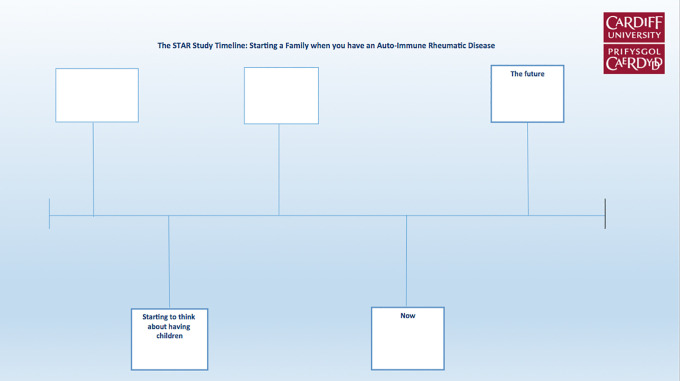
Visual timeline methods have been used as part of face-to-face qualitative interviewing with vulnerable populations to uncover the intricacies of lived experiences, but little is known about whether visual timelines can be effectively used in telephone interviews. In this article, we reflect on the process of using visual timelines in 16 telephone interviews with women as part of the "STarting a family when you have an Autoimmune Rheumatic disease" study (STAR Family Study). The visual timeline method was used to empower women to organize and share their narratives about the sensitive and complex topic of starting a family. We conducted a thematic analysis of the audio-recorded interview data, using researchers' field notes and reflections to provide context for our understanding of the benefits of using timelines and to understand the process of using visual timelines during telephone interviews. Resource packs were sent to women before study participation; 11 of the 16 women completed a version of the timeline activity. Six themes were identified in the methodological data analysis: (1) use and adaptation of the timeline tool, (2) timeline exchange, (3) framing the interview: emphasizing that women are in control, (4) jumping straight in, (5) taking a lead, and (6) disclosing personal and sensitive experiences. The use of visual timelines facilitated interviewee control and elicited rich narratives of participants' experiences in telephone interviews. Women created their visual timelines autonomously and retained ownership of their timeline data; these features of the data generation process need to be considered when using visual timelines in telephone rather than face-to-face interviews. Use of visual methods within telephone interviews is feasible, can generate rich data, and should be further explored in a wider range of settings.
视觉时间线方法已被用作与弱势群体进行面对面定性访谈的一部分,以揭示生活经历的复杂性,但对于视觉时间线是否能有效地用于电话访谈,人们知之甚少。在本文中,我们反思了在“患有自身免疫性风湿病时组建家庭”研究(STAR家庭研究)中,在对16名女性进行的电话访谈中使用视觉时间线的过程。视觉时间线方法被用于增强女性的能力,使她们能够组织并分享关于组建家庭这一敏感而复杂话题的叙述。我们对录音访谈数据进行了主题分析,利用研究人员的实地笔记和反思,为我们理解使用时间线的益处以及理解电话访谈中使用视觉时间线的过程提供背景信息。在研究参与前,向女性发送了资源包;16名女性中有11名完成了一个版本的时间线活动。在方法学数据分析中确定了六个主题:(1)时间线工具的使用和调整,(2)时间线交流,(3)构建访谈框架:强调女性处于主导地位,(4)直接切入,(5)发挥主导作用,以及(6)披露个人和敏感经历。视觉时间线的使用促进了受访者的主导权,并在电话访谈中引出了参与者丰富的经历叙述。女性自主创建了她们的视觉时间线,并保留了时间线数据的所有权;在电话而非面对面访谈中使用视觉时间线时,需要考虑数据生成过程的这些特征。在电话访谈中使用视觉方法是可行的,可以生成丰富的数据,并且应该在更广泛的环境中进一步探索。