Klinik für Hals-, Nasen-, Ohrenheilkunde, Kopf- und Halschirurgie, Arnold-Heller-Straße 3, Haus 27, 24105, Kiel, Germany.
Cochlear Deutschland GmbH & Co. KG, Karl-Wiechert-Allee 76 A, 30625, Hannover, Germany.
Eur Arch Otorhinolaryngol. 2020 Jun;277(6):1625-1635. doi: 10.1007/s00405-020-05893-0. Epub 2020 Mar 5.
Hearing performance data was collected from a large heterogeneous group of subjects implanted with the Cochlear™ Nucleus® CI532 with Slim Modiolar Electrode, for the purposes of postmarket clinical follow-up. Data was analysed for factors which may predict postoperative speech recognition scores.
Data was collected retrospectively from five German clinics for 159 subjects from March 2017 to August 2018. Hearing thresholds and recognition scores for monosyllabic words in quiet and sentences in noise were measured preoperatively and at 3 and 6 months postoperatively.
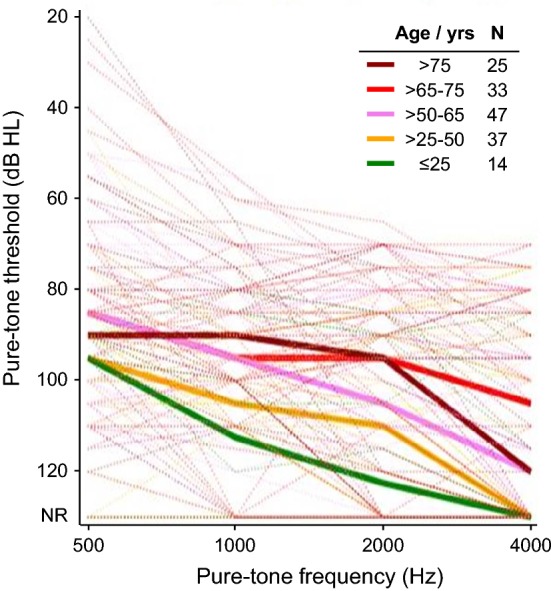
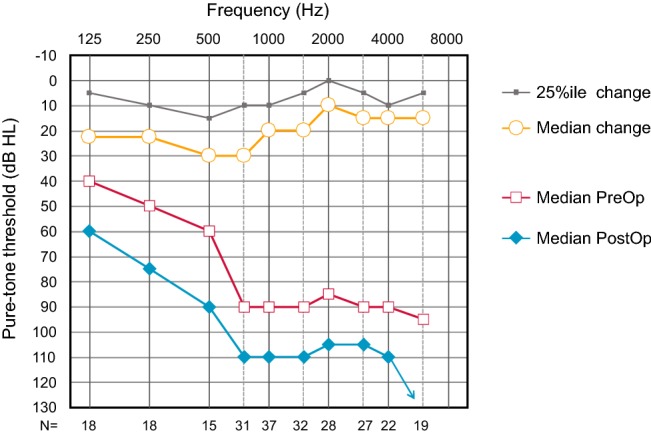
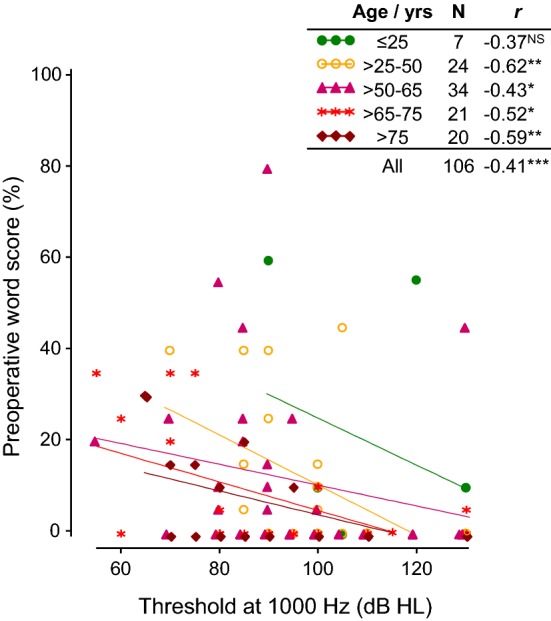
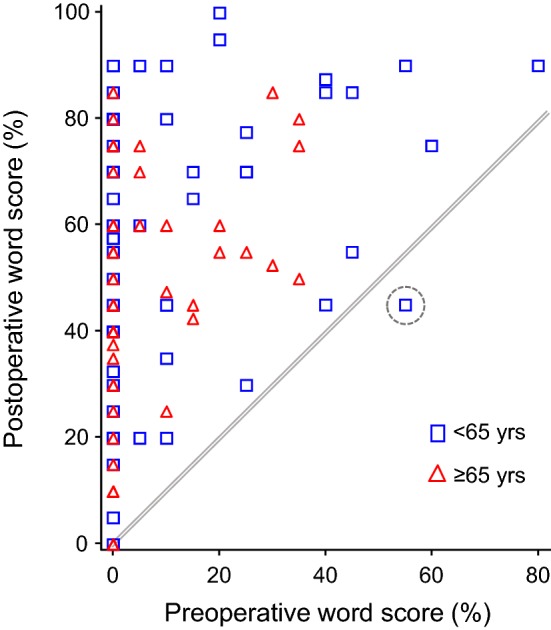
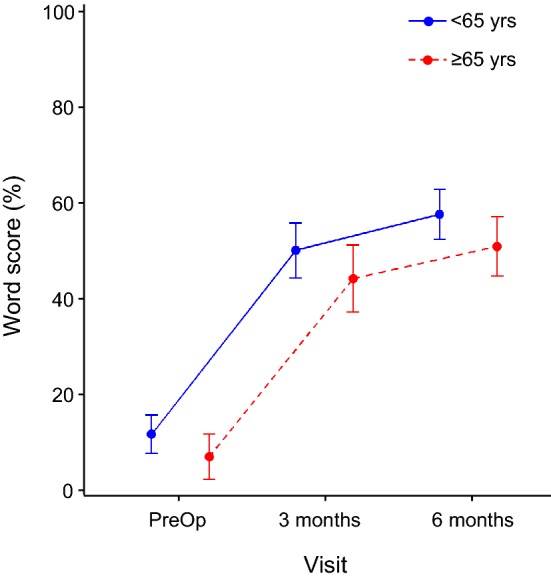
There was a mean gain of 44% points (95% CI 39-49%) at 6 months in monosyllable scores in quiet for implanted ears. Preoperative hearing thresholds in implant ears increased systematically with decreasing age; however, younger subjects had better baseline monosyllable scores with hearing aids compared with older subjects. Baseline performance alone explained 14% of the variation in postoperative scores. Residual hearing was preserved on average to within 22 dB at 250 Hz and 30 dB at 500 Hz of preoperative levels.
In a large and varied cohort of routinely treated hearing-impaired adults, speech recognition with the CI532 for German monosyllabic words in quiet at 6 months was equivalent to performance reported at one year or more in other published studies. Although younger subjects had poorer preoperative pure-tone thresholds, they had better preoperative word recognition scores compared with older subjects, and also had higher post implant scores. Further research is required to identify if this phenomenon is just applicable to German health system assessment and referral practices.
从植入 Cochlear Nucleus CI532 与 Slim 耳蜗内电极的大量异质受试者中收集听力表现数据,以进行上市后临床随访。分析了可能预测术后言语识别评分的因素。
从 2017 年 3 月至 2018 年 8 月,从 5 家德国诊所回顾性收集了 159 名受试者的数据。在术前和术后 3 个月和 6 个月测量了单音节词在安静和噪声中的听力阈值和识别得分。
植入耳在 6 个月时,单音节得分平均提高了 44%(95%CI 39-49%)。植入耳的术前听力阈值随年龄的降低而系统增加;然而,与年龄较大的受试者相比,年龄较小的受试者在使用助听器时的基线单音节得分更好。基线表现单独解释了术后评分变化的 14%。残余听力平均保留在术前水平的 250 Hz 内 22 dB 和 500 Hz 内 30 dB。
在一个常规治疗的听力受损成年人大样本中,植入 CI532 后 6 个月的单音节词安静言语识别能力与其他已发表研究中报告的 1 年或更长时间的表现相当。尽管年轻受试者的术前纯音阈值较差,但与年龄较大的受试者相比,他们的术前单词识别得分更好,且植入后得分也更高。需要进一步研究以确定这种现象是否仅适用于德国卫生系统评估和转诊实践。