Teoh Siew Li, Letchumanan Vengadesh, Lee Learn-Han
School of Pharmacy, Monash University Malaysia, Selangor, Malaysia.
Novel Bacteria and Drug Discovery (NBDD) Research Group, Microbiome and Bioresource Research Strength, Jeffrey Cheah School of Medicine and Health Sciences, Monash University Malaysia, Selangor, Malaysia.
Front Psychol. 2021 Feb 25;12:633319. doi: 10.3389/fpsyg.2021.633319. eCollection 2021.
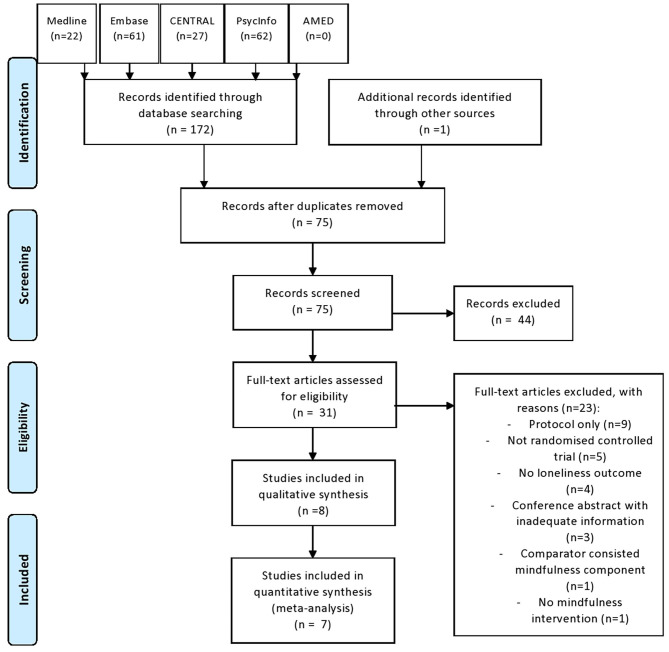
Mindfulness-based intervention (MBI) has been proposed to alleviate loneliness and improve social connectedness. Several randomized controlled trials (RCTs) have been conducted to evaluate the effectiveness of MBI. This study aimed to critically evaluate and determine the effectiveness and safety of MBI in alleviating the feeling of loneliness. We searched Medline, Embase, PsycInfo, Cochrane CENTRAL, and AMED for publications from inception to May 2020. We included RCTs with human subjects who were enrolled in MBI with loneliness as an outcome. The quality of evidence was assessed using Cochrane's Risk of Bias (ROB) tool and Grading of Recommendations Assessment, Development, and Evaluation (GRADE). A random-effects model was used for meta-analysis. Out of 92 articles identified, eight studies involving 815 participants were included in this study. Most (7/8) trials conducted a minimum of 8 weeks of MBI. Most of the trials (5/8) used UCLA-Loneliness Scale. A pooled analysis combining three trials and compared with wait-list showed significant improvement in loneliness score reduction using the UCLA-R scale with MD of -6.33 [95% confidence interval (CI): -9.39, -3.26]. Subgroup analysis with only two Cognitively-Based Compassion Training (CBCT) trials also showed similar MD of -6.05 (95% CI: -9.53, 2.58). The overall quality of evidence (GRADE) was low. Mindfulness intervention with an average length of 8-week duration significantly improved the population's loneliness level with no mental health issue. However, this evidence had a low GRADE level.
基于正念的干预措施(MBI)已被提出用于缓解孤独感并改善社交联系。已经进行了多项随机对照试验(RCT)来评估MBI的有效性。本研究旨在严格评估并确定MBI在减轻孤独感方面的有效性和安全性。我们检索了Medline、Embase、PsycInfo、Cochrane CENTRAL和AMED数据库,以获取从数据库建立至2020年5月的出版物。我们纳入了以孤独感为结局指标、将人类受试者纳入MBI的随机对照试验。使用Cochrane偏倚风险(ROB)工具和推荐分级评估、制定与评价(GRADE)对证据质量进行评估。采用随机效应模型进行荟萃分析。在识别出的92篇文章中,本研究纳入了8项涉及815名参与者的研究。大多数(7/8)试验进行了至少8周的MBI。大多数试验(5/8)使用了加州大学洛杉矶分校孤独量表。一项合并三项试验并与等待名单组进行比较的汇总分析显示,使用加州大学洛杉矶分校-R量表时,孤独感得分降低有显著改善,平均差为-6.33[95%置信区间(CI):-9.39,-3.26]。仅两项基于认知的慈悲训练(CBCT)试验的亚组分析也显示了类似的平均差-6.05(95%CI:-9.53,-2.58)。证据的总体质量(GRADE)较低。平均为期8周的正念干预显著改善了无心理健康问题人群的孤独水平。然而,这一证据的GRADE水平较低。