Chen Jingyao, Liu Siyu, Wang Chunli, Zhang Cun, Cai Huanhuan, Zhang Min, Si Li, Zhang Shujun, Xu Yuanhong, Zhu Jiajia, Yu Yongqiang
Department of Radiology, The First Affiliated Hospital of Anhui Medical University, Hefei, China.
Department of Clinical Laboratory, The First Affiliated Hospital of Anhui Medical University, Hefei, China.
Front Neurol. 2021 Feb 25;12:606094. doi: 10.3389/fneur.2021.606094. eCollection 2021.
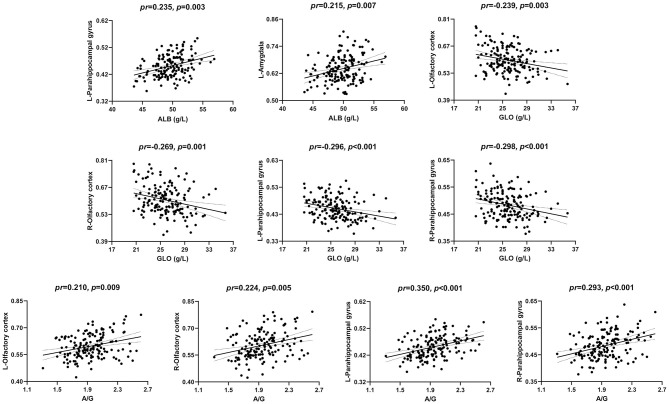
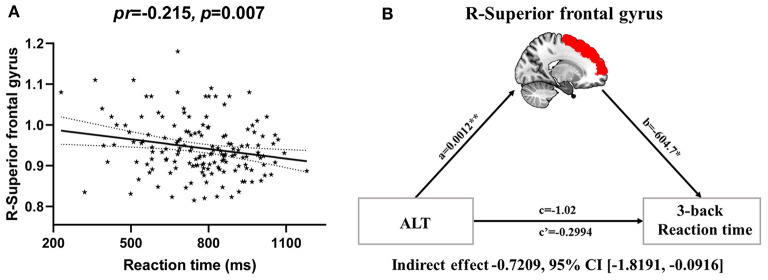
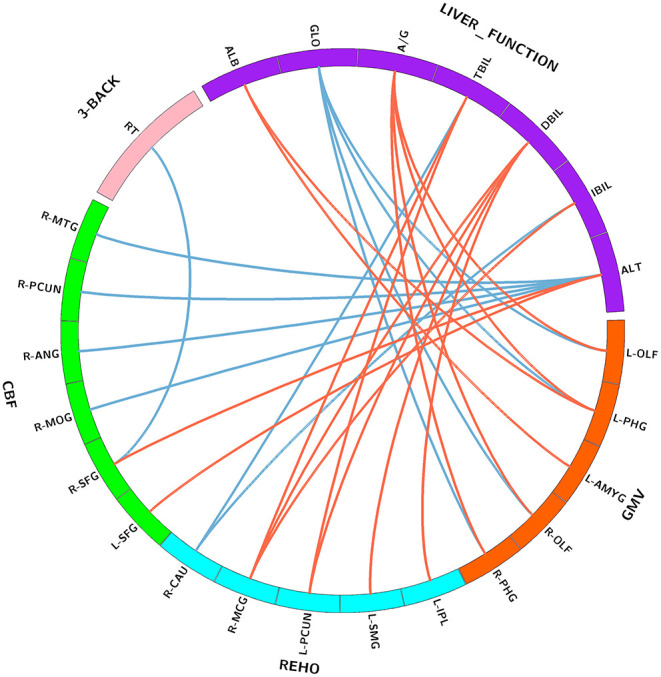
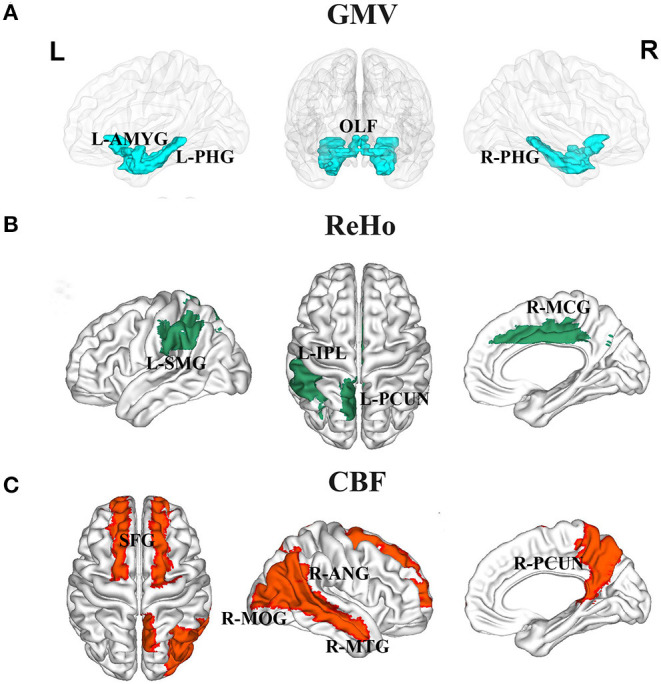
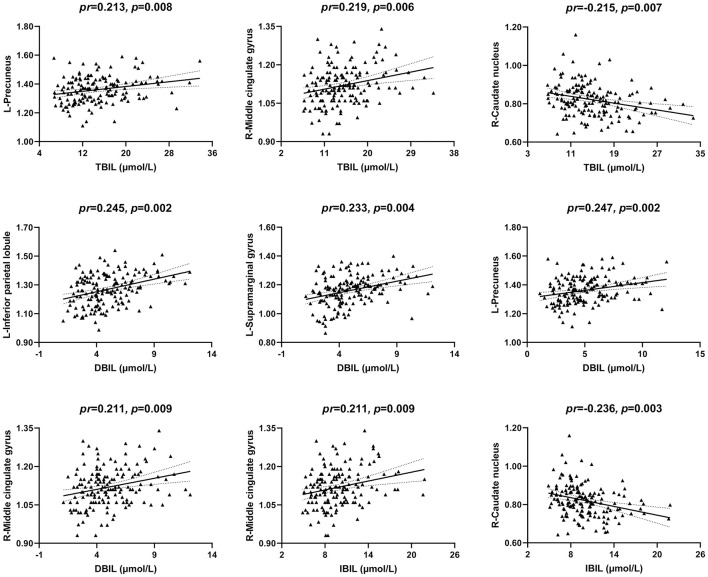
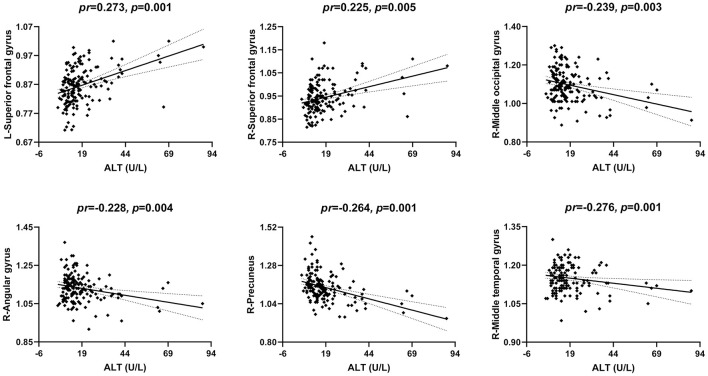
Previous neuroimaging studies have demonstrated brain abnormalities in patients with hepatic diseases. However, the identified liver-brain associations are largely limited to disease-affected populations, and the nature and extent of such relations in healthy subjects remain unclear. We hypothesized that serum liver function markers within a normal level would affect brain properties. One hundred fifty-seven healthy young adults underwent structural, resting-state functional, and arterial spin labeling MRI scans. Gray matter volume (GMV), regional homogeneity (ReHo), and cerebral blood flow (CBF) analyses were performed to assess brain structure, function, and perfusion, respectively. Peripheral venous blood samples were collected to measure serum liver function markers. Correlation analyses were conducted to test potential associations between liver function markers and brain imaging parameters. First, serum proteins showed relations to brain structure characterized by higher albumin associated with increased GMV in the parahippocampal gyrus and amygdala and lower globulin and a higher albumin/globulin ratio with increased GMV in the olfactory cortex and parahippocampal gyrus. Second, serum bilirubin was linked to brain function characterized by higher bilirubin associated with increased ReHo in the precuneus, middle cingulate gyrus, inferior parietal lobule, and supramarginal gyrus and decreased ReHo in the caudate nucleus. Third, serum alanine transaminase (ALT) was related to brain perfusion characterized by higher ALT associated with increased CBF in the superior frontal gyrus and decreased CBF in the middle occipital gyrus, angular gyrus, precuneus, and middle temporal gyrus. More importantly, we found that CBF in the superior frontal gyrus was a significant mediator of the association between serum ALT level and working memory performance. These findings may not only expand existing knowledge about the relationship between the liver and the brain but also have clinical implications for studying brain impairments secondary to liver diseases as well as providing potential neural targets for their diagnosis and treatment.
以往的神经影像学研究已证实肝病患者存在脑部异常。然而,已确定的肝脑关联在很大程度上仅限于疾病影响人群,健康受试者中这种关系的性质和程度仍不清楚。我们假设正常水平的血清肝功能标志物会影响脑特性。157名健康年轻成年人接受了结构、静息态功能和动脉自旋标记磁共振成像扫描。分别进行灰质体积(GMV)、局部一致性(ReHo)和脑血流量(CBF)分析以评估脑结构、功能和灌注。采集外周静脉血样本以测量血清肝功能标志物。进行相关性分析以测试肝功能标志物与脑成像参数之间的潜在关联。首先,血清蛋白与脑结构有关,表现为较高的白蛋白与海马旁回和杏仁核中GMV增加相关,较低的球蛋白以及较高的白蛋白/球蛋白比值与嗅皮质和海马旁回中GMV增加相关。其次,血清胆红素与脑功能有关,表现为较高的胆红素与楔前叶、中扣带回、顶下小叶和缘上回中ReHo增加相关,而尾状核中ReHo降低。第三,血清丙氨酸转氨酶(ALT)与脑灌注有关,表现为较高的ALT与额上回中CBF增加以及枕中回、角回、楔前叶和颞中回中CBF降低相关。更重要的是,我们发现额上回中的CBF是血清ALT水平与工作记忆表现之间关联的重要中介。这些发现不仅可能扩展关于肝脏与大脑之间关系的现有知识,而且对研究肝病继发的脑损伤具有临床意义,并为其诊断和治疗提供潜在的神经靶点。