Department of Endocrinology, Beijing Hospital, The Key Laboratory of Geriatrics, Beijing Institute of Geriatrics, National Center of Gerontology, National Health Commission, Institute of Geriatric Medicine, Chinese Academy of Medical Sciences, Beijing, China.
The Savaid School of Medicine, University of Chinese Academy of Sciences, Beijing, China.
Front Endocrinol (Lausanne). 2021 Feb 25;12:629831. doi: 10.3389/fendo.2021.629831. eCollection 2021.
Iron deficiency (ID) is concerned as the most common nutritional deficiency worldwide. The effects of ID on thyroid function and autoimmunity in pregnant women and reproductive-age women are controversial. The aim of the current study was to summarize the evidences and evaluate the relationship between ID and thyroid disorders.
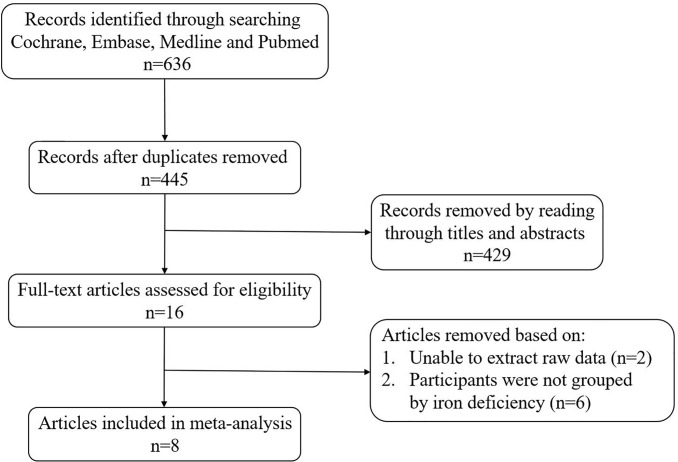
In this systematic review and meta-analysis, studies published on the Cochrane, Embase, Medline, and PubMed databases by October 2020 were searched. A total of 636 studies which discussed the correlation between ID and thyroid disorders were eligible in the initial search. Pooled mean differences (MD) and 95% confidence intervals (CI) were calculated for the assessment of thyrotropin (TSH) and free thyroxine (FT4) levels. Combined odd ratios (OR) and 95% CI were calculated for the assessment of the prevalence of overt and subclinical hypothyroidism, positive thyroid peroxidase antibody (TPOAb), and thyroglobulin antibody (TgAb).
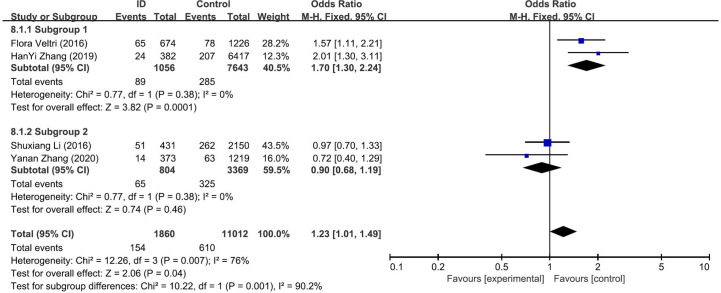
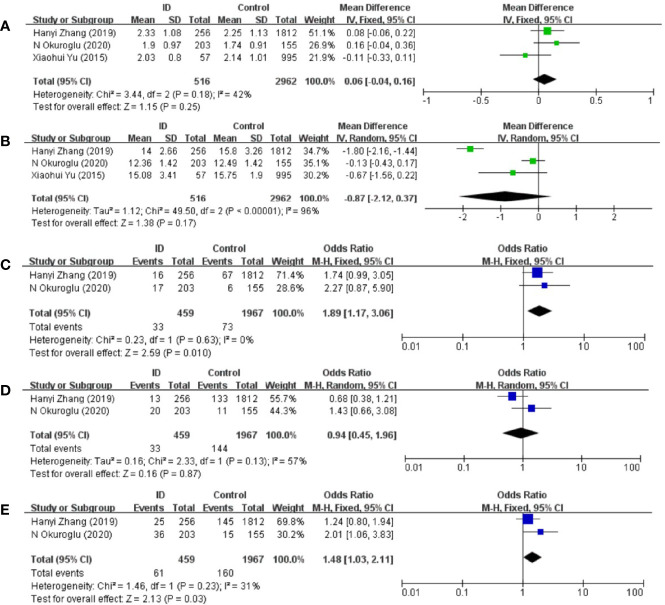
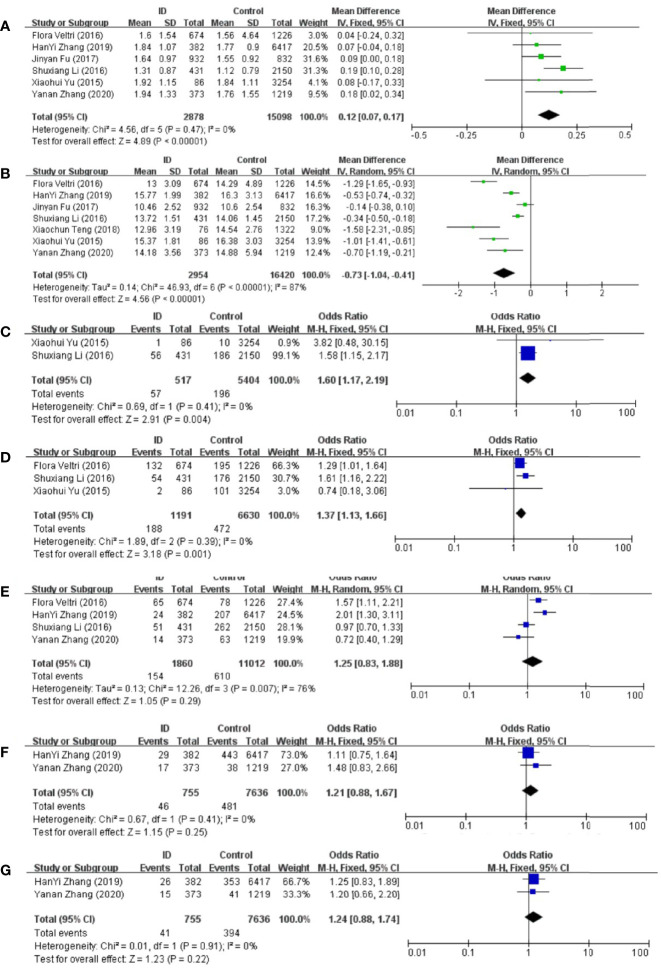
For women of reproductive age, ID could significantly increase the risk of positive TPOAb (OR: 1.89; 95% CI: 1.17, 3.06: = 0.01) and both positive TPOAb and TgAb (OR: 1.48; 95% CI: 1.03, 2.11: = 0.03). The meta-analysis of pregnant women showed that pregnant women with ID had increased serum TSH levels (MD: 0.12; 95% CI: 0.07, 0.17; P < 0.00001) and decreased FT4 levels (MD: -0.73; 95% CI: -1.04, -0.41; P < 0.00001). Meanwhile, the prevalence of overt (OR: 1.60; 95% CI: 1.17, 2.19; P = 0.004) and subclinical (OR: 1.37; 95% CI: 1.13, 1.66; P = 0.001) hypothyroidism in pregnant women with ID was significantly increased.
ID may adversely affect thyroid function and autoimmunity of pregnant and reproductive-age women and it is very necessary for monitoring iron nutritional status and early treatment of ID for them.
铁缺乏(ID)是全球最常见的营养缺乏症。铁缺乏对孕妇和育龄妇女甲状腺功能和自身免疫的影响存在争议。本研究旨在总结相关证据并评估 ID 与甲状腺疾病之间的关系。
本系统评价和荟萃分析检索了 Cochrane、Embase、Medline 和 PubMed 数据库截至 2020 年 10 月发表的研究。最初检索到 636 项讨论 ID 与甲状腺疾病相关性的研究符合纳入标准。评估促甲状腺激素(TSH)和游离甲状腺素(FT4)水平采用合并均数差(MD)和 95%置信区间(CI)。评估显性和亚临床甲状腺功能减退症、甲状腺过氧化物酶抗体(TPOAb)阳性和甲状腺球蛋白抗体(TgAb)阳性的患病率采用合并比值比(OR)和 95%CI。
对于育龄妇女,ID 可显著增加 TPOAb 阳性(OR:1.89;95%CI:1.17,3.06;=0.01)和 TPOAb 和 TgAb 均阳性(OR:1.48;95%CI:1.03,2.11;=0.03)的风险。对孕妇的荟萃分析显示,ID 孕妇血清 TSH 水平升高(MD:0.12;95%CI:0.07,0.17;P<0.00001),FT4 水平降低(MD:-0.73;95%CI:-1.04,-0.41;P<0.00001)。此外,ID 孕妇显性(OR:1.60;95%CI:1.17,2.19;P=0.004)和亚临床(OR:1.37;95%CI:1.13,1.66;P=0.001)甲状腺功能减退症的患病率显著升高。
ID 可能对孕妇和育龄妇女的甲状腺功能和自身免疫产生不利影响,非常有必要对其铁营养状况进行监测并对 ID 进行早期治疗。