Division of Rheumatology, Inflammation, and Immunity, Brigham and Women's Hospital and Harvard Medical School, Boston, MA, United States.
Rheumatology Section, VA Boston Healthcare System, Boston, MA, United States.
Front Immunol. 2021 Feb 25;12:623716. doi: 10.3389/fimmu.2021.623716. eCollection 2021.
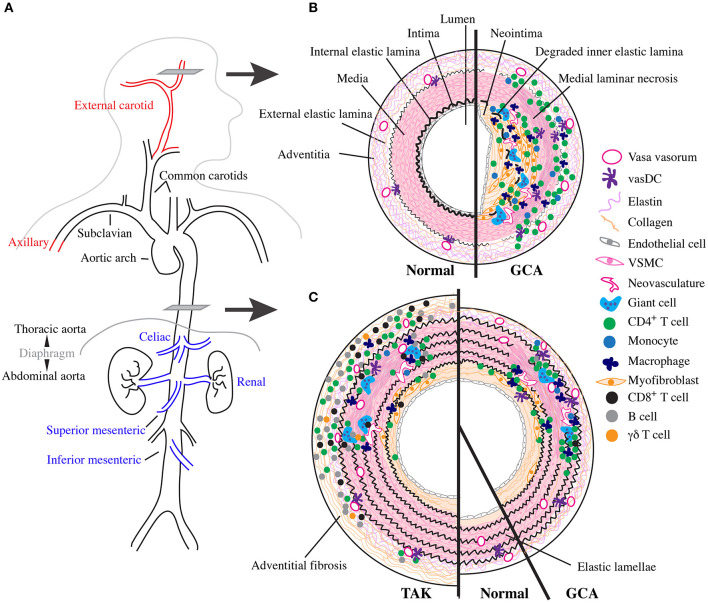
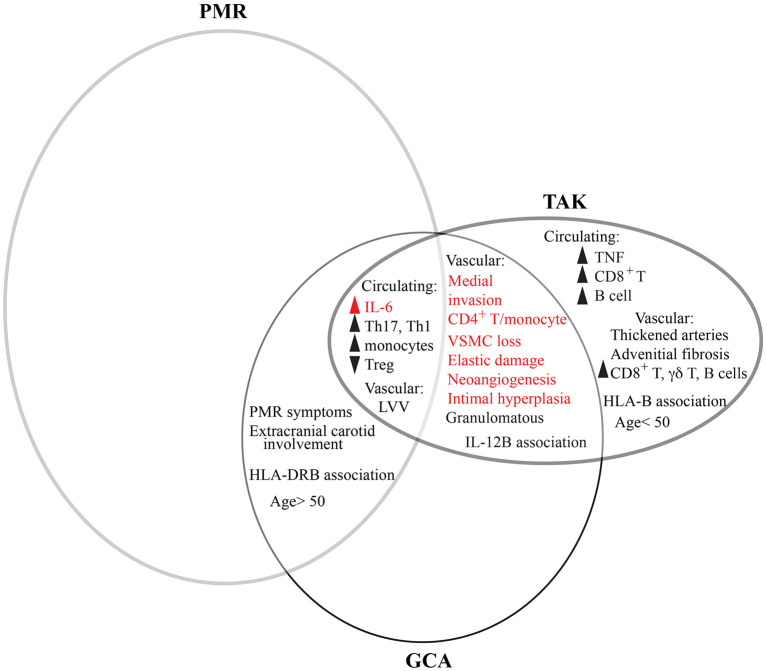
Giant cell arteritis (GCA) is a granulomatous systemic vasculitis of large- and medium-sized arteries that affects the elderly. In recent years, advances in diagnostic imaging have revealed a greater degree of large vessel involvement than previously recognized, distinguishing classical cranial- from large vessel (LV)- GCA. GCA often co-occurs with the poorly understood inflammatory arthritis/bursitis condition polymyalgia rheumatica (PMR) and has overlapping features with other non-infectious granulomatous vasculitides that affect the aorta, namely Takayasu Arteritis (TAK) and the more recently described clinically isolated aortitis (CIA). Here, we review the literature focused on the immunopathology of GCA on the background of the three settings in which comparisons are informative: LV and cranial variants of GCA; PMR and GCA; the three granulomatous vasculitides (GCA, TAK, and CIA). We discuss overlapping and unique features between these conditions across clinical presentation, epidemiology, imaging, and conventional histology. We propose a model of GCA where abnormally activated circulating cells, especially monocytes and CD4 T cells, enter arteries after an unknown stimulus and cooperate to destroy it and review the evidence for how this mechanistically occurs in active disease and improves with treatment.
巨细胞动脉炎(GCA)是一种累及大动脉和中等大小动脉的肉芽肿性系统性血管炎,好发于老年人。近年来,诊断影像学的进步揭示了比以前认识到的更大程度的大血管受累,将经典的颅动脉-GCA 与大血管(LV)-GCA 区分开来。GCA 常与尚未完全了解的炎症性关节炎/滑囊炎疾病巨细胞动脉炎(PMR)同时发生,并且与其他影响主动脉的非传染性肉芽肿性血管炎(如 Takayasu 动脉炎(TAK)和最近描述的临床孤立性主动脉炎(CIA))具有重叠特征。在这里,我们回顾了文献,重点关注 GCA 的免疫病理学,其背景是在三种具有信息意义的情况下进行比较:LV 和颅 GCA 变体;PMR 和 GCA;三种肉芽肿性血管炎(GCA、TAK 和 CIA)。我们讨论了这些疾病在临床表现、流行病学、影像学和常规组织学方面的重叠和独特特征。我们提出了一个 GCA 模型,其中异常激活的循环细胞,特别是单核细胞和 CD4 T 细胞,在未知刺激后进入动脉,并合作破坏它,并回顾了在疾病活动期和治疗中这种机制是如何发生的证据。