Xia Dandan, Liu Baoling, Xu Xiaowei, Ding Ya, Zheng Qiuling
Department of Pharmaceutical Analysis, School of Pharmacy, China Pharmaceutical University, Nanjing, 210009, China.
State Key Laboratory of Natural Medicines, China Pharmaceutical University, Nanjing, 210009, China.
J Pharm Anal. 2021 Feb;11(1):122-127. doi: 10.1016/j.jpha.2020.02.002. Epub 2020 Feb 5.
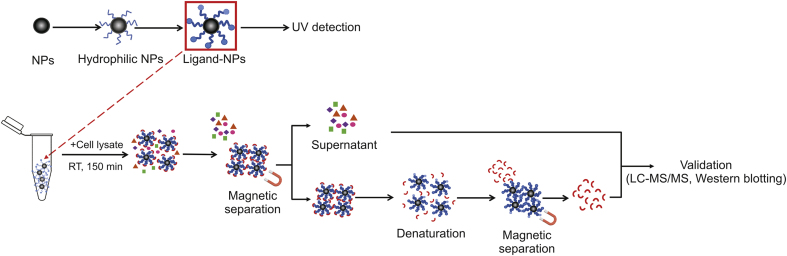
Drug target discovery is the basis of drug screening. It elucidates the cause of disease and the mechanism of drug action, which is the essential of drug innovation. Target discovery performed in biological systems is complicated as proteins are in low abundance and endogenous compounds may interfere with drug binding. Therefore, methods to track drug-target interactions in biological matrices are urgently required. In this work, a FeO nanoparticle-based approach was developed for drug-target screening in biofluids. A known ligand-protein complex was selected as a principle-to-proof example to validate the feasibility. After incubation in cell lysates, ligand-modified FeO nanoparticles bound to the target protein and formed complexes that were separated from the lysates by a magnet for further analysis. The large surface-to-volume ratio of the nanoparticles provides more active sites for the modification of chemical drugs. It enhances the opportunity for ligand-protein interactions, which is beneficial for capturing target proteins, especially for those with low abundance. Additionally, a one-step magnetic separation simplifies the pre-processing of ligand-protein complexes, so it effectively reduces the endogenous interference. Therefore, the present nanoparticle-based approach has the potential to be used for drug target screening in biological systems.
药物靶点发现是药物筛选的基础。它阐明了疾病的病因和药物作用机制,这是药物创新的关键。在生物系统中进行靶点发现很复杂,因为蛋白质丰度低且内源性化合物可能会干扰药物结合。因此,迫切需要在生物基质中追踪药物 - 靶点相互作用的方法。在这项工作中,开发了一种基于FeO纳米颗粒的方法用于生物流体中的药物靶点筛选。选择一种已知的配体 - 蛋白质复合物作为原理验证示例来验证其可行性。在细胞裂解物中孵育后,配体修饰的FeO纳米颗粒与靶蛋白结合并形成复合物,通过磁铁将其与裂解物分离以进行进一步分析。纳米颗粒的大表面积与体积比为化学药物的修饰提供了更多活性位点。它增加了配体 - 蛋白质相互作用的机会,这有利于捕获靶蛋白,特别是对于那些丰度低的靶蛋白。此外,一步磁分离简化了配体 - 蛋白质复合物的预处理,因此有效降低了内源性干扰。因此,目前基于纳米颗粒的方法有潜力用于生物系统中的药物靶点筛选。