Anderson Simon D, Gwenin Vanessa V, Gwenin Christopher D
School of Natural Sciences, College of Environmental Sciences and Engineering, Bangor University, Bangor, LL57 2UW, UK.
Nanoscale Res Lett. 2019 May 30;14(1):188. doi: 10.1186/s11671-019-3019-6.
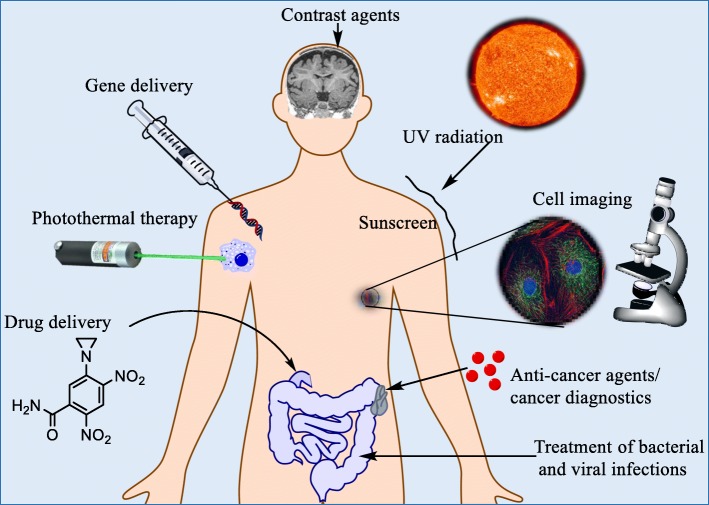
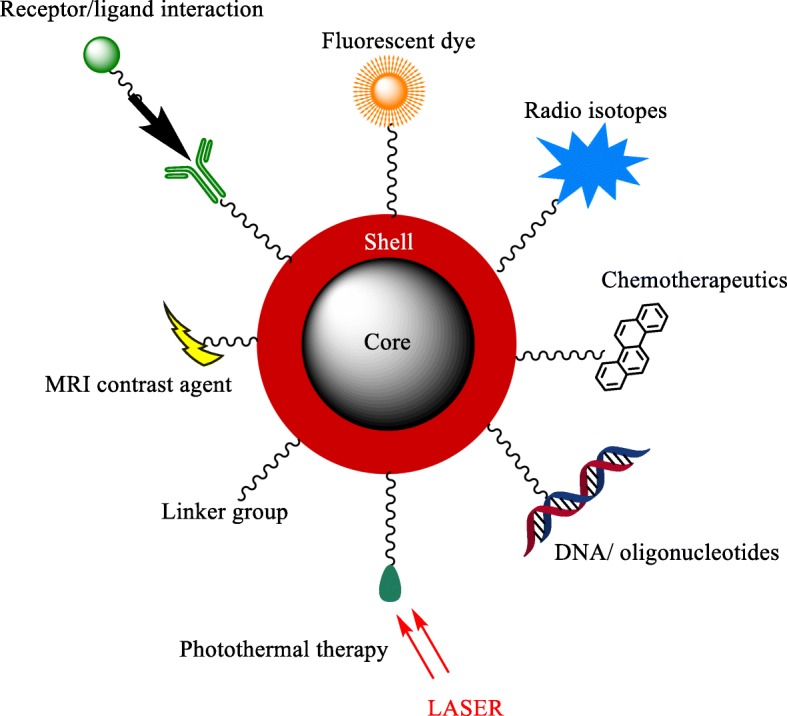
Medicine is constantly looking for new and improved treatments for diseases, which need to have a high efficacy and be cost-effective, creating a large demand on scientific research to discover such new treatments. One important aspect of any treatment is the ability to be able to target only the illness and not cause harm to another healthy part of the body. For this reason, metallic nanoparticles have been and are currently being extensively researched for their possible medical uses, including medical imaging, antibacterial and antiviral applications. Superparamagnetic metal nanoparticles possess properties that allow them to be directed around the body with a magnetic field or directed to a magnetic implant, which opens up the potential to conjugate various bio-cargos to the nanoparticles that could then be directed for treatment in the body. Here we report on some of the current bio-medical applications of various metal nanoparticles, including single metal nanoparticles, functionalized metal nanoparticles, and core-shell metal nanoparticles using a core of FeO as well as synthesis methods of these core-shell nanoparticles.
医学一直在寻找针对疾病的新的和改进的治疗方法,这些治疗方法需要具有高效性且具有成本效益,这对发现此类新治疗方法的科学研究产生了巨大需求。任何治疗的一个重要方面是能够仅针对疾病,而不对身体的其他健康部位造成伤害。出于这个原因,金属纳米颗粒过去和现在都在被广泛研究其可能的医学用途,包括医学成像、抗菌和抗病毒应用。超顺磁性金属纳米颗粒具有一些特性,使其能够通过磁场在体内定向移动或被引导至磁性植入物,这为将各种生物载体与纳米颗粒结合开辟了潜力,然后这些纳米颗粒可以被引导至体内进行治疗。在此,我们报告各种金属纳米颗粒当前的一些生物医学应用,包括单一金属纳米颗粒、功能化金属纳米颗粒以及以FeO为核的核壳金属纳米颗粒,以及这些核壳纳米颗粒的合成方法。