Ng Kai-Yu, Shea Queenie T, Wong Tin-Lok, Luk Steve T, Tong Man, Lo Chung-Mau, Man Kwan, Yun Jing-Ping, Guan Xin-Yuan, Lee Terence K, Zheng Yong-Ping, Ma Stephanie
School of Biomedical Sciences Li Ka Shing Faculty of Medicine The University of Hong Kong Pokfulam Hong Kong.
Department of Biomedical Engineering The Hong Kong Polytechnic University Hung Hom Kowloon Hong Kong.
Adv Sci (Weinh). 2021 Jan 4;8(5):2002483. doi: 10.1002/advs.202002483. eCollection 2021 Mar.
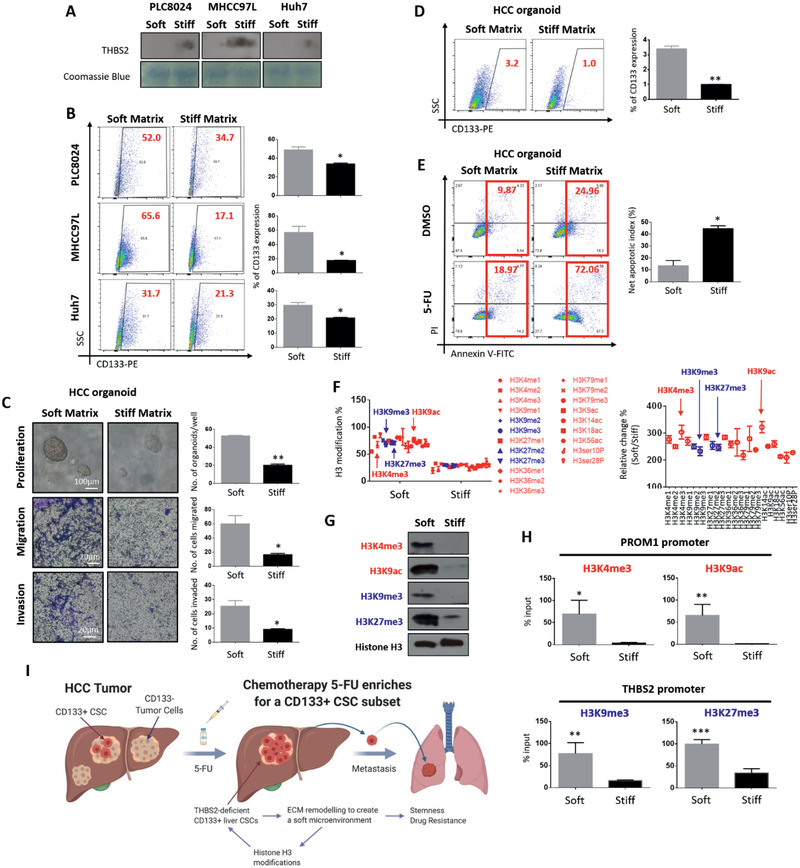
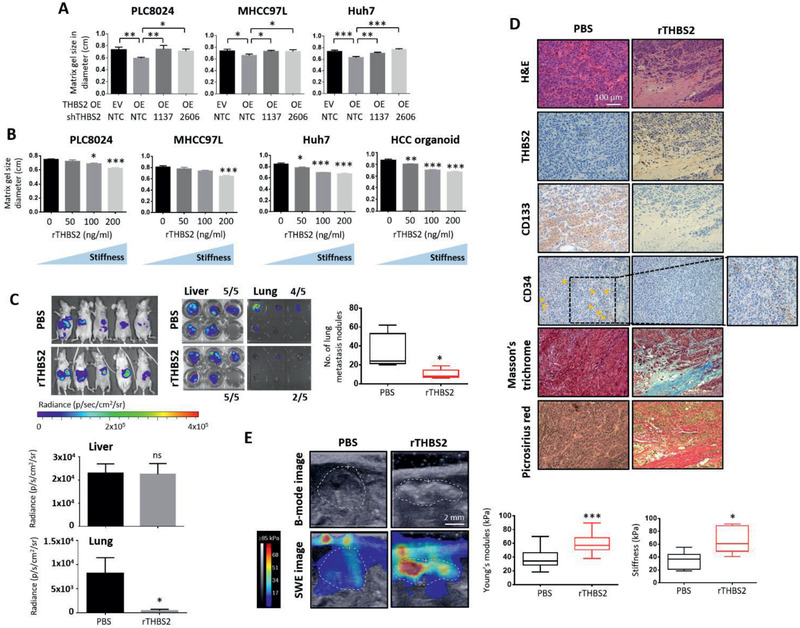
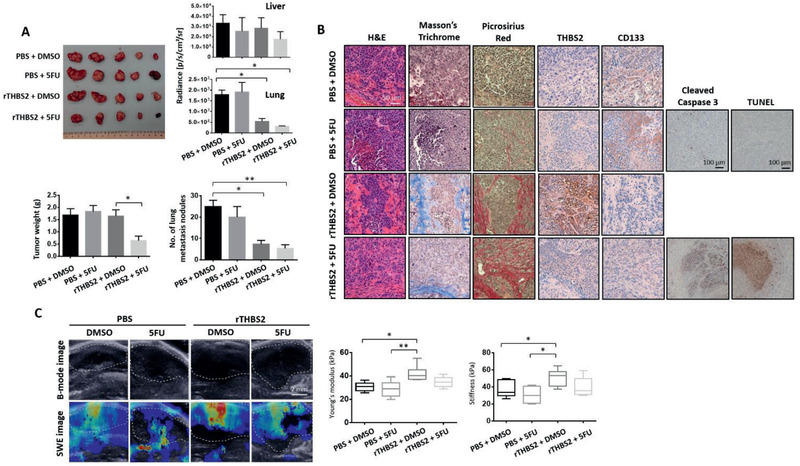
The physical microenvironment is a critical mediator of tumor behavior. However, detailed biological and mechanistic insight is lacking. The present study reveals the role of chemotherapy-enriched CD133+ liver cancer stem cells (CSCs) with THBS2 deficiency. This subpopulation of cells contributes to a more aggressive cancer and functional stemness phenotype in hepatocellular carcinoma (HCC) by remodeling the extracellular matrix (ECM) through the regulation of matrix metalloproteinase (MMP) activity, collagen degradation, and matrix stiffness. The local soft spots created by these liver CSCs can enhance stemness and drug resistance and provide a route of escape to facilitate HCC metastasis. Interestingly, a positive feed-forward loop is identified where a local soft spot microenvironment in the HCC tumor is enriched with CD133 expressing cells that secrete markedly less ECM-modifying THBS2 upon histone H3 modification at its promoter region, allowing the maintenance of a localized soft spot matrix. Clinically, THBS2 deficiency is also correlated with low HCC survival, where high levels of CSCs with low THBS2 expression in HCC are associated with decreased collagen fiber deposits and an invasive tumor front. The findings have implications for the treatment of cancer stemness and for the prevention of tumor outgrowth through disseminated tumor cells.
物理微环境是肿瘤行为的关键调节因子。然而,目前仍缺乏详细的生物学和机制方面的深入了解。本研究揭示了富含化疗药物的CD133 + 且缺乏THBS2的肝癌干细胞(CSCs)的作用。这一细胞亚群通过调节基质金属蛋白酶(MMP)活性、胶原蛋白降解和基质硬度来重塑细胞外基质(ECM),从而导致肝细胞癌(HCC)中出现更具侵袭性的癌症和功能性干细胞表型。这些肝脏CSCs产生的局部软斑可增强干细胞特性和耐药性,并为促进HCC转移提供一条逃逸途径。有趣的是,研究发现了一个正反馈回路,即HCC肿瘤中的局部软斑微环境富含表达CD133的细胞,这些细胞在其启动子区域的组蛋白H3修饰后分泌显著减少的ECM修饰因子THBS2,从而维持局部软斑基质。临床上,THBS2缺乏也与HCC患者低生存率相关,HCC中THBS2表达低的高水平CSCs与胶原纤维沉积减少和肿瘤侵袭前沿相关。这些发现对癌症干细胞的治疗以及通过播散肿瘤细胞预防肿瘤生长具有重要意义。